

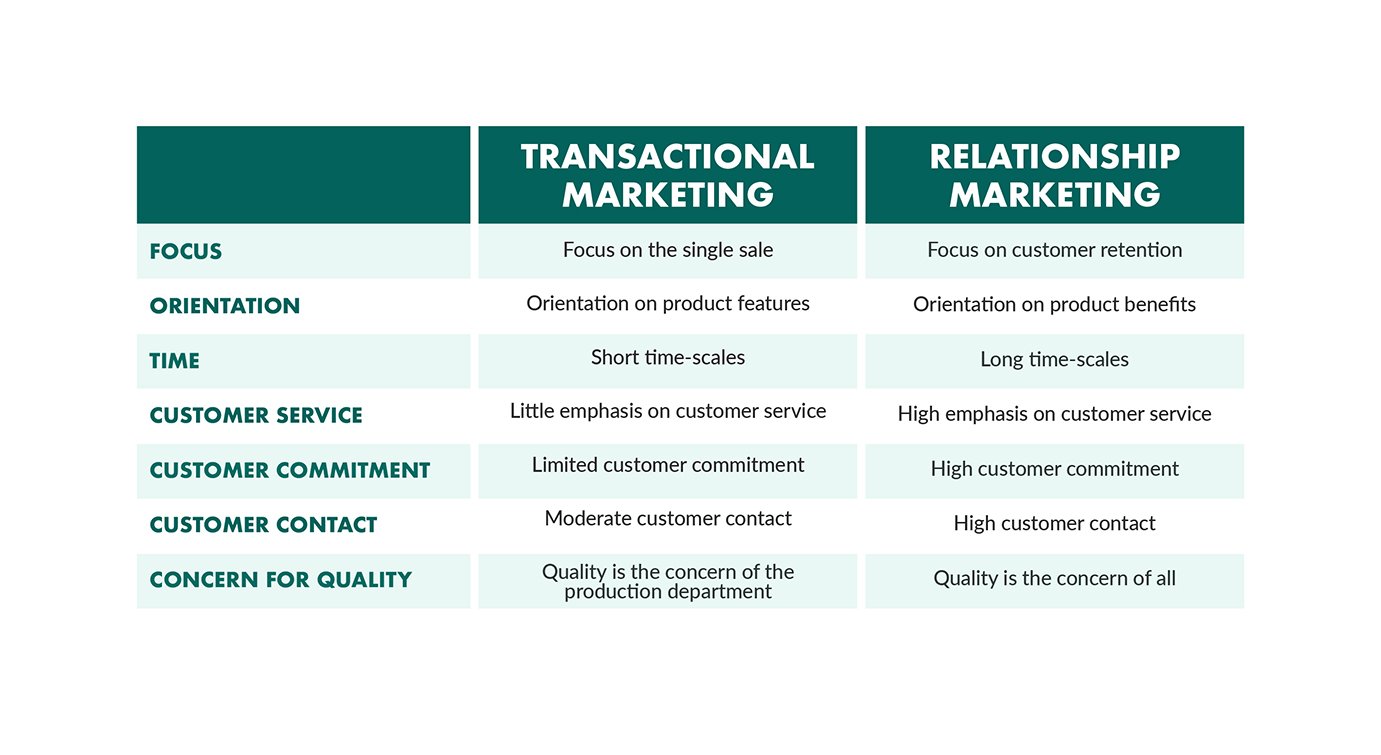
Relationship marketing is a marketing method that maximizes the lifetime value of customers by building relationships with them and having them become loyal customers. Through relationship marketing, you can expect to increase the repeat rate, increase the average spend per customer, and spread the word of mouth.
In this article, we will explain the overview and benefits of relationship marketing, as well as specific techniques.
What is relationship marketing?
Relationship marketing is a marketing method that maximizes the lifetime value of customers by building relationships with them and having them become loyal customers.
Rather than increasing the market share of products and services, we focus on deepening relationships with customers, aiming to encourage repeat purchases of products and services, increase the average spend per customer, and spread the word of mouth.
Relationship marketing was proposed by Leonard Berry in 1983.
The idea behind this idea is the Pareto Principle, which states that 80% of sales come from the top 20% of customers.
Developing new customers costs money and effort.
Relationship marketing is the idea of gaining sales by deepening relationships with existing customers and having them become loyal customers, rather than cultivating new customers.
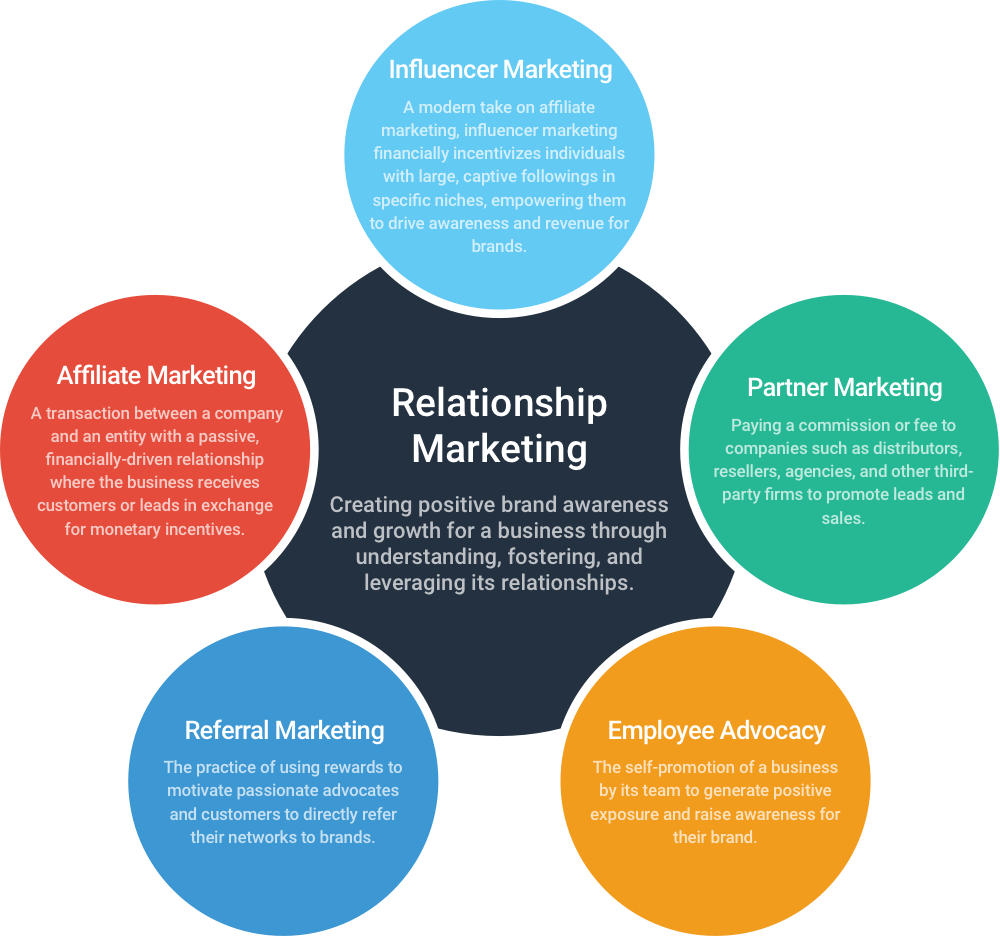
Benefits of relationship marketing
The benefits of relationship marketing are
1. Increase repeat rate and decrease churn rate
2. Increased unit price per customer
3. Spread by word of mouth
4. Increase customer lifetime value
It becomes.
1. Increasing the repeat rate and decreasing the churn rate
<br/> If you create good customers through relationship marketing, the customers will repeatedly purchase your products and services, increasing the repeat rate.
In addition, there is no need to switch to another company in order to feel fully satisfied with the products and services, and the churn rate decreases.
If you can increase the repeat rate and reduce the churn rate, there will be no need to spend money and effort to acquire new customers.
2. Increased spend per customer
<br/> When good customers are created through relationship marketing, the average annual purchase amount and purchase amount per purchase by the customer will increase, and the cost per customer will increase.
Additionally, as trust in your company increases, the likelihood of purchasing related products and services in addition to the products and services they were originally looking for increases.
If the average price per customer increases, you can increase sales even if you have a small number of customers.
3. Spread through word of mouth
<br/> Excellent customers created through relationship marketing are more likely to spread the word of mouth about your company’s products and services.
Reviews from good customers who actually like your products and services have credibility, so new customers who receive reviews are more likely to positively consider purchasing.
In this way, relationship marketing allows you to acquire new customers without incurring any cost or effort.
4. Increase customer lifetime value
As mentioned above, relationship marketing increases the repeat rate, lowers the churn rate, increases the average spend per customer, and spreads the word of mouth.
As a result, customer lifetime value will increase significantly.
.webp?width=650&height=650&name=relationship_marketing_definition_graphic (1).webp)
Specific methods of relationship marketing
Let’s take a look at specific methods of relationship marketing.
To deepen relationships with customers through relationship marketing,
1. Database marketing
2. Account-based marketing (ABM)
Marketing techniques such as:
1. Database marketing
Let’s take a look at the overview, benefits, and precautions of database marketing.

・What is database marketing?
Database marketing is the provision of products and services that match customer preferences by collecting, storing, and analyzing various information about customers as a database, such as personal information, attribute information, purchase history, and responses to questionnaires. It’s a marketing method.
The purpose of database marketing is not to acquire new customers, but to build long-term relationships with existing customers.
Suppose you find out from your purchase history that a customer tends to purchase a certain product at a certain time.
In that case, it will be possible to carry out promotional activities for the product at that time for that customer.
A classic example of database marketing is “Toyama Medicine Seller.”
It is said that medicine sellers in Toyama knew their customers’ chronic illnesses and proposed different medicines for each customer.
・Advantages of database marketing
The benefits of database marketing are:
1. Strengthen relationships with customers
By creating a database, information about customers can be shared throughout the company, rather than being kept only by the person in charge.
Therefore, even if the person in charge changes, the quality will not change and we will be able to provide detailed support to our customers.
2. Increased possibility of receiving orders
With database marketing, it is possible to capture the emergence of customer needs, as in the example above.
By approaching them when a need arises, you increase your chances of winning an order.
3. Promotional activities become more efficient
By centralizing customer information in a database, you can reduce the effort involved in data management and operation.
Additionally, as the amount of data increases, the accuracy of customer information increases, allowing for more efficient promotional activities.
[
Points to note when conducting database marketing]
The first thing to keep in mind when doing database marketing is that the promotions you carry out need to be reflected in the database from time to time.
If your data isn’t always up-to-date, you can’t make accurate predictions for your customers.
Furthermore, simply collecting data does not make it possible to utilize the data.
It is important to clarify the purpose and use of data and conduct appropriate data analysis.
2. Account-based marketing
Let’s take a look at the overview, benefits, and implementation steps of account-based marketing (ABM).
・What is account-based marketing?
Account-based marketing is a BtoB marketing method in which marketing activities are carried out individually for each customer company (account).
We narrow down the list of excellent companies and take a strategic approach tailored to each company.
In account-based marketing, the target company is clearly defined.
In order to conclude business negotiations that will lead to many orders, the quality of prospective customers is more important than the quantity.
Even if you look at the behavior history of potential customers on an individual basis, such as accessing the web or participating in seminars, it is difficult to convert them into actual business negotiations.
Account-based marketing can lead to business negotiations by taking an approach tailored to the target company, such as changing website content depending on job title.
・Advantages of account-based marketing
The benefits of account-based marketing are as follows:
1. Marketing activities become more efficient
Account-based marketing makes your marketing efforts more efficient.
This is because we narrow down our targets to only good companies and conduct marketing activities only to those companies.
2. Reduce resource waste
Account-based marketing narrows down your target companies, allowing you to effectively utilize your company’s resources.
It also reduces wasted resources because it does not involve extensive marketing activities.
3. Easier to track potential customers
By narrowing down the target companies, it becomes easier to track potential customers for advertisements, campaigns, etc.
In addition, by approaching target companies multiple times and measuring and examining the results, you can conduct more accurate marketing activities.
4. Easy to collaborate with sales department
Account-based marketing makes it easier to collaborate with the sales department.
This is because sales departments often carry out sales activities for each corporation.
・Steps to implement account-based marketing
The steps to implement account-based marketing are as follows.
1. Select target companies
When implementing account-based marketing, the first step is to select the target company.
From among the companies with which we have done business in the past, we select companies that we can expect to do business with repeatedly and that are likely to maximize sales.
2. Identify key people
Next, identify key people in your target company.
Information from the sales department will be useful.
3. Decide on the method and content of your approach
Once you have selected your target company and identified key people, consider the method and content of your approach.
Prepare content offerings that solve important issues that your target companies are currently facing.
4. Run a campaign
Once we have decided on the approach method and content, we will actually implement the campaign.
The key points are coordination with the sales department, appropriate timing, and consistent messaging.
5. Measure effectiveness and consider problems
After running a campaign, measure its effectiveness and consider any issues.
It is important to repeatedly implement campaigns and measure their effectiveness in order to take a more accurate approach.
summary
◆ Relationship marketing is a marketing method that aims to build relationships with customers and maximize customer lifetime value.
◆ Relationship marketing has benefits such as increased repeat rate, increased spend per customer, and word-of-mouth diffusion effect.
◆Specific methods of relationship marketing include database marketing and account-based marketing.