

Do you know the word “ROI”? This is a term often heard in the business and marketing world, but it is one of the indicators used to verify cost effectiveness. It is one of the important points of view in companies and businesses, and it can be said that thoroughly verifying the effectiveness of investment is an essential point to avoid making mistakes in management decisions later on. .
In this article, we will explain the overview of ROI, how to calculate it, the benefits and points to note when calculating it, and points to increase ROI. By deepening your understanding, you will be able to apply it to your own business, and it will help you make smoother management decisions in the future, so please deepen your understanding.
What is ROI?
Many people involved in business may have heard of it, but some may think, “I know the words, but it’s difficult to explain.” First, I will explain the meaning and overview.
It shows how much effect there is on the investment.

ROI is an indicator that shows the effectiveness of your investment. In Japanese, it is also called “return on investment”. It is extremely important to understand the extent to which a company’s businesses and measures are effective. At that time, we use ROI to confirm and verify effectiveness. The higher this index is, the higher the investment efficiency, and the more successful the investment.
Purpose of using ROI
It is extremely important for companies to understand and deepen their understanding of how effective their business and marketing measures are. It is good to implement measures and increase sales, number of transactions, and number of customers, but what a company should aim for is to increase profits, and if profits are not being generated effectively, then the measures should not be implemented. I can’t say it was very effective. Continuing to spend money even though you are not getting the results you expected for the money spent can lead to business losses.
When focusing on cost-effectiveness, such as “I want to implement more effective measures within the available budget,” it is important to check ROI and make business decisions. . You will be able to think about whether the current measures are okay and what is the most effective method, and will be able to make appropriate management decisions.

How to calculate ROI
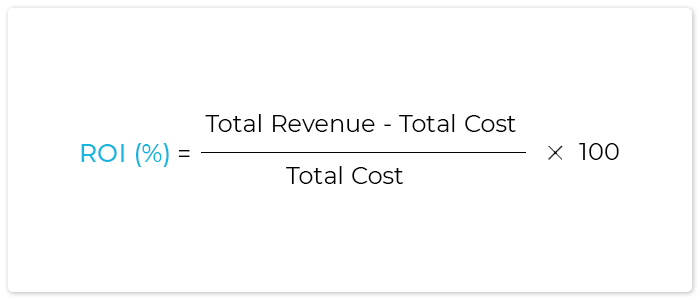
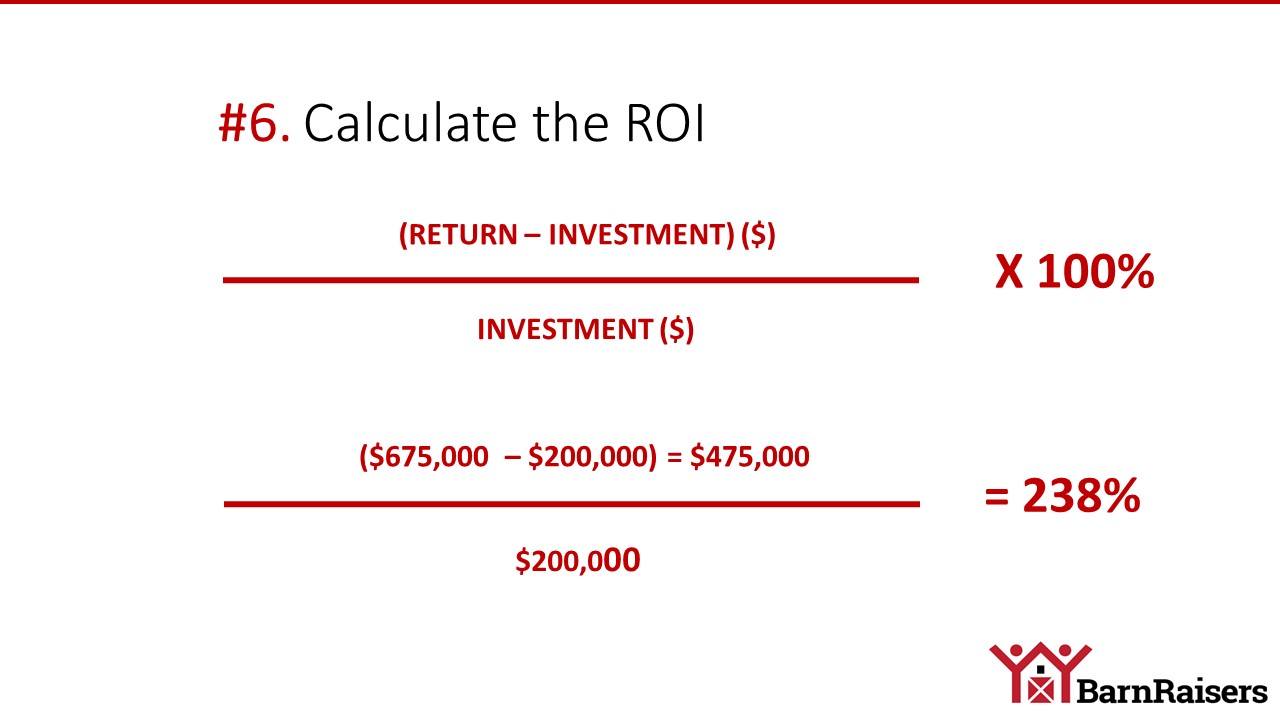
ROI is generally calculated using the following formula:
ROI (%) = (sales – cost of sales – investment amount) ÷ investment amount x 100
(Sales – Cost of sales – Investment amount) is what is called “profit”. It is calculated by dividing the profit by the investment amount, and you can check the effect on the funds spent by that number. If the profit is less than the investment amount, it will be less than 100%. In that case, it can be interpreted that there is a high possibility that the business will end up in the red.
Let’s calculate this using an actual example. Suppose that two companies implement measures to increase business sales, and the results are as follows.
Company A…Invested 5 million yen and made a profit of 10 million yen.
Company B…invested 200,000 yen and made a profit of 1 million yen.
In this case, the ROI for the two companies would be as follows:
Company A…10 million yen ÷ 5 million yen x 100 = 200%
Company B…1 million yen ÷ 200,000 yen x 100 = 500%
Looking at the numbers alone, Company B’s investment amount and profits are much lower than Company A, but it can be said that Company B has a higher return on the funds spent. It can be concluded that Company B is the one that is able to manage its business effectively.
Let’s know about ROI as well.
ROI indicates the effectiveness of the spent funds, but there are other terms that express marketing indicators. By knowing this information, you can apply it to your own business, so let’s deepen your understanding.
 (1).png)
ROAS
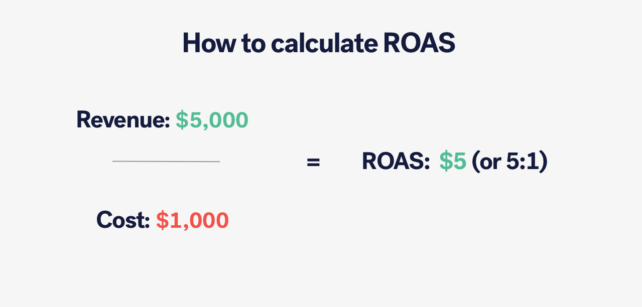
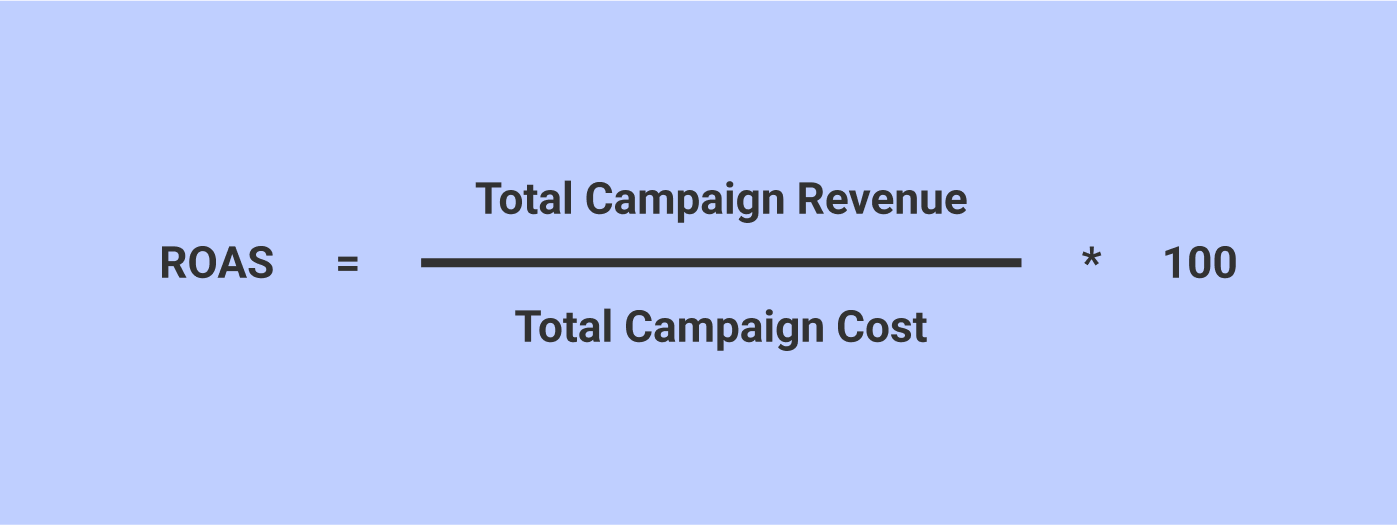
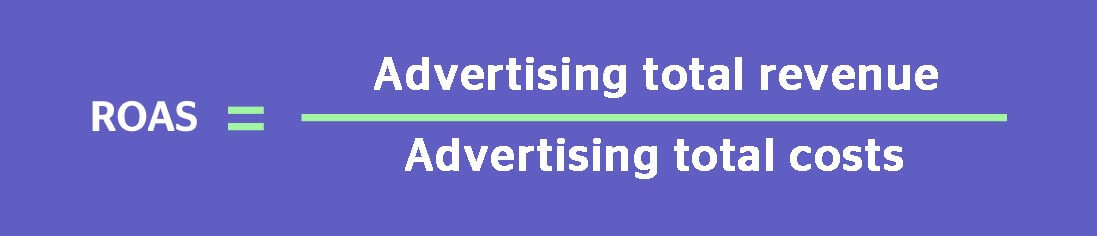
ROAS is an acronym for “Return On Advertising Spend,” and it is an indicator that shows how much sales are generated relative to the expenses spent on advertising. In Japanese, it means “cost effectiveness in advertising.” ROAS is calculated as follows
ROAS (%) = (Sales from advertising – Advertising cost) ÷ Advertising cost x 100
ROI covers all investments, while ROAS is limited to advertising costs. Another difference is that ROAS represents the effect of advertising investment on sales. The higher the ROAS value, the more effective your advertising measures are, and it is an important indicator when allocating advertising budget to improve sales.
ROE
ROE is an acronym for “Return on Equity” and is an indicator that shows how much profit a company has generated by operating its own capital. In Japanese, it means “return on equity.” ROE is calculated as follows.
ROE (%) = Net income ÷ (Net assets – Stock acquisition rights – Minority interests) x 100
ROE is an indicator mainly used by shareholders and investors when checking a company, and is a standard for determining whether a company can generate adequate profits and whether the company is suitable for investment. If a company increases its profits efficiently and is evaluated as a company worth investing in, it will have a positive impact on the company’s performance.
ROIC
ROIC is an acronym for “Return On Invested Capital” and is an indicator that shows how efficiently a company can generate profits for the funds raised. In Japanese, it means “return on invested capital.” ROIC is calculated as follows.
ROIC (%) = Operating profit ÷ Invested capital (interest-bearing debt + stockholders’ equity) x 100
Companies raise funds by borrowing from financial institutions (interest-bearing debt) or investing from shareholders (stockholders’ equity), and then invest the funds in their business. You can see how much profit you have generated from the funds raised. It can be said to be an indicator that allows you to understand the profitability of a company as a whole.
ROA
ROA is an acronym for “Return On Assets” and is an indicator that shows how much profit is generated relative to total assets. In Japanese, it means “return on total assets.” ROA is calculated as follows.
ROA (%) = Net income ÷ Total assets x 100
ROA allows you to check whether a company is able to efficiently use its assets to generate profits. For example, if management is highly skilled, employees are working with high productivity, materials are used without waste, and assets are used efficiently, which leads to profits, ROA will be high. . Like ROE, it is an indicator used by shareholders and investors when checking companies, and is used to judge companies with good management efficiency.
CPA
CPA is an acronym that stands for “Cost Per Action,” and it is a measure of the advertising cost required for one conversion. In Japanese, it means “cost per customer acquisition.” CPA is calculated as follows.
CPA(%) = Advertising cost ÷ Number of conversions x 100
By calculating CPA, you can evaluate the effectiveness of advertising. Therefore, it is possible to optimize the budget and allocate it appropriately to improve profits.
LTV
LTV is an acronym that stands for “Life Time Value,” and it represents how much profit a customer brings to your company from when they start doing business with you until they end it. It’s an indicator. In Japanese, it means “customer lifetime value.” LTV is calculated as follows.
LTV = Average customer unit price x Profit rate x Purchase frequency x Duration
LTV is a numerical value of the profits that customers will bring to your company, so increasing it is extremely important for improving profits and marketing activities. Also, if you roughly understand LTV in advance, it will be easier to understand how much it will cost to acquire customers.
The reason why LTV is being emphasized is that it is difficult to acquire new customers, so attention is focused on retaining existing customers. There is a common theory in marketing called the “1:5 rule,” which states that acquiring a new customer requires spending five times as much as retaining an existing customer. As it is becoming more difficult to acquire new customers, it is becoming more important to check LTV as an indicator for determining the retention and expansion of existing customers.
Four benefits of leveraging ROI
Utilizing ROI in business activities is extremely beneficial and brings various benefits. Here we will explain four advantages.
Able to measure the effectiveness of projects and measures
Utilizing ROI makes it possible to measure the effectiveness of businesses and measures because it allows you to understand “how effective a business is” based on data. This measurement is very important in business. It is good to implement measures to increase profits, but if the effects do not come out as planned, it cannot be said that the measures were highly effective. Continuing to spend money even though you are not seeing the expected results can lead to losses from a management perspective. By checking how much profit you have earned on your investment, you can smoothly judge the success or failure of your measures and make future management decisions.
Comparisons can be made regardless of the type of business or policy.
Because ROI is an indicator that numerically understands investment effects, it is possible to easily evaluate and compare the effects of investments, even for businesses of different scales and measures of different nature. When running a business, it is easy to focus on the high profits and scale of the business, but in reality, there are many cases where the business has a low return on investment. On the other hand, even if the scale of the business is small, there are cases in which the ROI can be calculated and the business can be found to have a very high return on investment. Since it is possible to identify highly profitable businesses and measures in this way, it can also be useful in making management decisions, such as increasing the amount of investment in superior businesses, selecting and prioritizing investments, etc. is possible. This is an essential indicator for managers.
Numerical data can be clearly checked
ROI can be clearly checked numerically and the pure investment effect linked to profit after deducting costs and sales and administrative expenses can be grasped, so it is possible to accurately see how effective the actual business and measures were. It is possible to check. In addition, by checking spent expenses and revenue over time, you can understand when the results were effective and what measures were most effective, allowing you to accurately determine the direction of future measures.
Become a trigger for business improvement
Quantifying cost effectiveness using ROI will lead to visualization of productivity for each company and business. You will be able to check how much profit you are making with limited resources and how efficiently you are making profits, and you will be able to make business improvements based on the results.
To increase profits, you need to work more efficiently. By visualizing productivity, it becomes easier to objectively judge whether current business processes are efficiently generating profits or are putting pressure on profits. Based on the results, you will be able to consider management matters, such as working on business improvements and considering the allocation of personnel.

Points to note when using ROI
There are great benefits to using it, but there are some things to keep in mind when making calculations. Be sure to understand the precautions before using it.
It is not possible to evaluate something that cannot be quantified.
ROI is a clear numerical evaluation of how much effect there is against the cost spent, so it is not possible to evaluate things that cannot be quantified. For example, things that cannot be measured numerically, such as increased awareness of products and services through advertising, efforts to address environmental issues, improved brand power, and convenience, will not be reflected.
Therefore, it is best to avoid making all decisions based on ROI alone. This is because there is a risk of overlooking results that cannot be measured numerically but contribute to profits. For example, if the measures currently in place are not producing sufficient profits, we would normally conclude that the measures are not cost-effective. However, if the company’s image is gradually improving as a result of the measures, continuing the measures may lead to an increase in profits in the future. In this way, it is important to understand what cannot be expressed numerically, and to be careful not to make short-sighted decisions when verifying cost-effectiveness.
Difficult to assess long-term benefits
ROI is an indicator that is checked based on profit at the time of measurement, so it is not suitable for evaluating profit growth from a long-term perspective, such as “how the business will grow in the future.” No.
In fact, depending on the business or policy, there are many cases where the speed at which results are achieved is slow and it does not lead to short-term profits. For example, when trying to carry out content marketing to implement SEO measures, it may take several months to a year to see results. Therefore, at the beginning, only costs are incurred, and the ROI number is a step down. However, if you just look at that number, you will easily end up cutting off measures that are meaningful from a long-term perspective, and you may end up underestimating the profits you can expect in the future. Be careful not to make decisions based solely on current numbers, such as taking a time-based perspective such as “in what period should you make a decision?” or taking a perspective that looks ahead to the future.
6 points to increase ROI
ROI is one indicator that can measure whether a company is generating profits commensurate with its investment, and increasing it effectively is what companies and business managers are required to do. Here we will explain six points to increase ROI.
increase profitability
Basically, increasing sales increases profits, so it is important to increase sales volume and unit price to increase profitability. We recommend that you take measures to acquire new customers, increase repeat customers, and increase the average spend per customer. Additionally, “upselling” and “cross-selling” are effective ways to increase the average price per customer.
“Upsell” refers to the act of proposing products that are higher in quality than what the customer has already purchased or intends to purchase. Encourage them to make a satisfied purchase by showing them that a higher-end option or another version might better meet their needs.
“Cross-selling” refers to proposing other products related to what the customer has purchased or is planning to purchase, and having them purchase them together. Let’s tell the customer about products that can complement the parts that are not satisfied with the current product or the necessary parts to use the current product more comfortably. In many cases, cross-sold items have a complementary effect on each other, so customers have the potential to purchase both.
cost reduction
While it is important to increase sales, it is equally important to reduce costs that are not related to profits. Even if the sales amount is the same, if you can reduce purchasing costs, manufacturing costs, selling costs, etc., you can secure more profits. However, when reducing costs, it is important to consider the products and services provided to customers.For example, if you want to reduce purchasing costs, you may end up purchasing products of poor quality, If the quality of the service or service deteriorates, it would be putting the cart before the horse. Even if costs can be reduced, there may be cases where the number of sales decreases and ultimately profits decline. Although it is important to reduce costs, it is important to maintain the quality of products and services that will satisfy customers.
Selection of cost-effective measures
In order to develop your business, it is also important to select cost-effective measures. There are many cases where businesses focus only on high profits, and the measures taken in high-profit businesses turn out to be measures with low return on investment. Identifying cost-effective measures and allocating resources there will lead to efficient increases in profits.
For example, by implementing listing advertisements effectively, it is possible to approach targeted users. Since data is automatically collected even after the ad is activated, you can improve the ad at any time based on that data, making it possible to take the necessary actions to achieve your goals. .
In addition, by using SNS effectively, you can reach many users around the world. It is possible to create an account on most SNS for free, and there are fewer people who do not use SNS these days, and the number of people who obtain information on SNS is also increasing significantly. You can conduct marketing at a relatively low cost by posting posts and advertising that are likely to be of interest to your target users. Also, depending on the industry, by using influencer marketing etc., it is possible to spread the word explosively and implement measures cost-effectively.
Review/reset targeting
When implementing measures, you can further increase effectiveness by reviewing and resetting targeting. For example, even if you implement a strategy such as web advertising, if the content does not resonate with the target audience, the ad will not be effective. You need to appeal to people who have searched for your product in the past, people who have just learned about your product, people who are interested in your product, people who have a strong desire to purchase, etc., and that appeals to the target phase. It is important to review and optimize targeting and implement measures that suit each.
In addition, reviewing and optimizing targeting can have positive effects such as preventing unnecessary advertising and improving click-through rates and conversion rates, which may also lead to the reduction of unnecessary costs. there is.
Utilization of MA
By utilizing MA, you can expect to improve your profits and ROI. MA is an acronym for “Marketing Automation” and is a method of automating marketing activities for the purpose of increasing profits and streamlining operations. There are many different types of marketing measures, but they all require market research, understanding customer needs, and formulating measures, so they are extremely wide-ranging and complex. However, by making full use of MA, it is possible to automate routine tasks that used to be done manually and tasks that took a large amount of time, thereby improving efficiency.
For example, the following activities can be performed automatically:
Perform regular and continuous analysis
It is very important to calculate and analyze ROI regularly and continuously, rather than calculating it once and ending it. By quantifying cost-effectiveness and visualizing the productivity of each company and business, it is important to formulate new plans to further increase productivity and come up with subsequent improvement plans. Your skills as a manager will be tested based on the current situation of your company and what kind of management decisions you will make accordingly. Let’s clarify our company’s direction based on the ROI indicators.

summary
In this article, we explained the overview of ROI, how to calculate it, the benefits and points to note when calculating it, and points to increase ROI. ROI is an indicator that shows how much of an effect an investment has had, and it is extremely important for companies and managers to understand and improve this indicator. Identifying highly profitable businesses and measures can serve as a key point in subsequent management decisions. If you have not quantified your ROI before, please put the numbers into a formula, check it out, and use it as an opportunity to improve your measures and promote operational efficiency.