


“Title” and “Description” are important for SEO measures.
In fact, I’ve recently come to realize that getting clicked in search results is more important than improving search rankings.
In the past, it was said that in order to be successful with SEO, you had to be at the top of the search results, but in reality, even if you are number 1 in the search results, your CTR (click-through rate) is only about 20%. I’ve come to understand.
Here, let’s check the “Title” and “Description” settings to get more clicks.
How to give a title
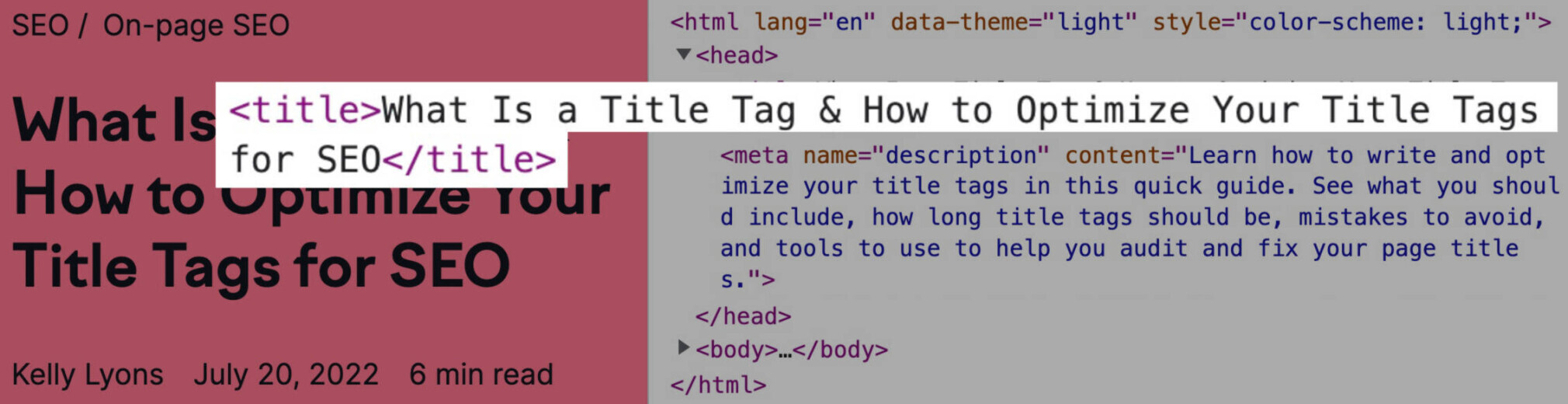
The title tag is an important element for SEO, and it is common sense to set appropriate keywords here.
However, since it is such a major SEO measure, we often see many sites that list too many keywords in their titles.
Will a title like this be successful in terms of SEO?
In fact, there is a shocking fact in SEO-related data that even if you rank first in the search results for a specific keyword, the click-through rate is shockingly around 20%.
From now on, the title should include a certain amount of keywords and be something that arouses the user’s interest.

As an easy-to-understand analogy, I think the title will be easier to understand if you imagine the spine of a book on a bookshelf.
When we look at a short sentence written on the spine of a book on a bookshelf, we instantly decide, “I want to read this” or “I don’t need to read this.”
Both the title on the search results and the title on the spine of the book must contain keywords that describe the content of the book and be interesting enough to make people want to click on it.
Also, the title display on Google is around 30 characters, but on smartphones, it’s a good idea to aim for around 20 to 25 characters per line to account for text wrapping.
Also, if you are unsure about the keywords to include in the title, try setting the title sentence to include frequently searched keywords, while referring to the combinations of keywords often used in searches that are displayed at the bottom of the search results. .

How to write a description
As mentioned in the previous title, in order for a search result to be clicked, the information displayed in the search result must be attractive to the user.
Earlier I compared the page title to the spine of a book, but I think it’s easier to understand if you think of the description as the “sash” of the book.
The spine of a book summarizes its content in a limited number of characters, so it must provide additional information that will make the reader want to read more.
In books, the obi plays this role, but in search results, the description part plays this role.
So how should I set the description?
Descriptions are called “snippets” in Google search results, and what is displayed is
- Generated from the discrition attribute of the meta element in the head element
- If the meta element’s discriotion attribute is not set, approximately 160 characters are required from the main text of the page.
Google automatically picks up and generates phrases.

There will be two.
Now, since I think many people use WordPress to build websites, let’s take a look at the settings in WordPress.

☆By default, WordPress does not have an input field to set a description.
If you are building a site or blog with WordPress, unfortunately there is no input field to set the meta element’s discriotion attribute by default.
As mentioned above, search engines such as Google automatically generate descriptions “from the body of the page.”
So, is there no way to set a description in WordPress?
Actually, by installing an SEO plugin, you will be able to set the description.
A well-known SEO plugin that is often used is
“All in One SEO Pack.”
【summary】
The title and description are not just a place to embed keywords, they are the spine and band of the book.
Just as users instantly select the book they want to read from summarized information at a bookstore, the same thing happens with search results.
Titles and descriptions were simply places to embed keywords to improve search engine rankings.

However, as search engine algorithms return search results that are more closely aligned with human interests and tastes, it is likely that pages with titles that are just a list of keywords will be excluded from search results. It won’t be in the distant future.
Now that content SEO is becoming more important, titles and descriptions must be made more understandable and attractive to users.