

If you are in the web industry, you probably remember that major sports manufacturers such as Nike and Workman left major
e-commerce
platforms such as Rakuten and Amazon. Shopify is attracting attention because it allows you to easily develop your own e-commerce site. However, there are many people who do not understand the overview and basic functions of Shopify.
Therefore, in this article, we will introduce an overview of Shopify, its basic functions, and the advantages and disadvantages of using it. We will also explain Shopify’s pricing plans, fees, and success stories, so please use this as a reference if you are considering implementing Shopify.
What is Shopify?
First, let’s start with an overview of
Shopify
. Shopify is an e-commerce
platform
that is comprehensively equipped with functions for managing e-commerce sites and opening stores. Shopify is a Canadian company and one of the world’s largest platforms, installed in over 1 million shops worldwide.
Before the advent of e-commerce platforms such as Shopify, if you wanted to open an e-commerce site, you had to contract for your own
server
and obtain
a domain
. As a result, it took a lot of man-hours to actually create an e-commerce site, and when customization was added, it was not uncommon for it to take several months or more to open a store.
However, with Shopify, you can leave the management of your servers and network in your hands. Operators can easily open an e-commerce site by simply operating Shopify’s simple management screen. This ease of use is the reason why Shopify is highly regarded. In addition, themes are available on the Shopify side, and if you install them, you can achieve a design that is equivalent to creating your own.

Shopify’s main features
So far, we have provided an overview of Shopify. From here, we will introduce Shopify’s main features.
Let’s look at each in turn.

Basic functions
First, the basic functions. The basic functions include most of the functions needed to open an e-commerce site, and typical examples include the following.
As mentioned above, it is characterized by being equipped with all the functions from registering a product, actually publishing an EC site, to making payments. In addition, we support multiple payment methods, including credit cards and bank transfers, so that everyone from business people to general consumers can make payments.
Depending on how particular you are about the design, you can publish it as early as 3 days after registering with Shopify. You can say that the appeal of Shopify is that it allows you to achieve this sense of speed.

design template
Shopify also provides design templates. There are more than dozens of design templates available, and there are designs that are suitable for selling apparel brands and others for selling cosmetics.
Customization function
Shopify comes with over 5,000 customization features. Typical customization functions include the ability to support subscription payments and the ability to add translation functions.
Particularly if you are publishing an e-commerce site in the BtoC area, supporting subscription payments is essential. Video-on-demand and subscription services have become popular in recent years, so many users have no hesitation in paying by subscription.
If you pay a monthly fee through a subscription, you can expect sales for several months ahead, allowing you to consider expanding your e-commerce site and making upfront investments in your business.
Shopify has a full range of customization features. Since the initial functionality is kept to a minimum, you can add additional functionality to suit your company’s needs. It is also possible to post coupons depending on the season and situation.
It’s a good idea to first register with Shopify, check what customization features are available, and then consider which features to implement.

What is Shopify payments?
Shopify payment is an online payment service officially provided by Shopify. Shopify payments lets your customers pay online. Since this service is officially provided by Shopify, you can eliminate the hassle of having customers enter personal information such as address and phone number each time.
All major payment methods are automatically set up for you to use immediately after you create your store. We accept all commonly used credit cards such as “Visa”, “Mastercard”, “JCB”, and “American Express”.

Other useful Shopify optional services
Other useful Shopify optional services include:
Shopify email
Shopify Email is an email sending system that you can use for free if you build an online store with Shopify. By using Shopify’s unique email marketing tool, you don’t need to install a separate email distribution system.
It is very easy to use, just select your favorite email template from the email templates that have already been created, enter text and send, and the email will be sent to registered customers. If you find it tedious to send emails manually, you can automate the process by using the automation feature.
All emails sent with Shopify Email accumulate data such as open rates and sales status, so you can analyze your store. These analysis results can also be used to improve campaign performance.
Shopify POS Pro
Shopify POS Pro is a POS system that allows you to perform advanced inventory management. “POS” stands for “Point of Sale,” meaning “point of sale information management.” It has been implemented in most retail stores and allows you to manage information at the time a product is sold.
With Shopify POS Pro, you don’t have to install a separate POS system. In addition to managing inventory counts, receipt/shipment records, order forms, etc., it also has inventory analysis functions and functions that suggest sale items.
You can also manage your sales staff at the same time by creating an unlimited number of store staff accounts. With this function, you can collect information such as staff performance individually, and you can also categorize it by performance.
Advantages of using Shopify
The benefits of using Shopify include:
You can build an e-commerce site while keeping costs down
The biggest advantage of using Shopify is that you can easily build an e-commerce site. When creating your own e-commerce site, you will need a development budget of about 500,000 yen to 1 million yen, depending on how many functions you want to include. In addition, monthly maintenance costs range from 20,000 yen to 50,000 yen, and it takes several months to publish.
However, with Shopify, you can build and publish an e-commerce site in as little as three days. Even if your company does not have enough resources, it does not require a large amount of man-hours, so it has the advantage of making it easy to implement e-commerce.
Strong in terms of delivery
Shopify has the advantage of being an e-commerce platform that is strong in terms of delivery. You can see inventory status, sales status, sales status, etc. at a glance from the management screen, making inventory management easier. In addition, it can also be linked with store inventory status, making it possible to centralize and manage inventory for the entire business.
Can be linked with external services and SNS
Shopify has features that allow you to link with external services and SNS. By utilizing this function, you can build an omnichannel system that includes various external e-commerce sites, SNS, and physical stores. Specifically, you can link with the following external services and SNS. (Partial excerpt)
| EC site | SNS |
| Amazon | |
| rakuten market | |
| Google Shopping | TikTok |
| eBay |
etc.
Highly customizable apps from Shopify partners
The Shopify App Store offers over 7,000 apps. This allows you to freely customize your e-commerce site built with Shopify.
By using these apps, you can add necessary functions to your site at any time without having any knowledge of website development or programming skills, and you can significantly improve usability.
You may also be able to discover the world’s most cutting-edge web marketing methods through the app. Being able to learn about the latest marketing techniques from these apps is one of the benefits of using Shopify.
Can support cross-border EC
Shopify partners with international shipping services such as FedEx and UPS, so you can ship internationally. In other words, by building an e-commerce site with Shopify, you can support cross-border e-commerce.
Currently, Shopify is the leading e-commerce shop construction service in Japan that allows you to deploy global e-commerce solutions across borders. If we can build cross-border e-commerce, we can expect an increase in orders from overseas.
According to research by the Ministry of Economy, Trade and Industry, the size of the cross-border e-commerce market between Japan, the United States, and China in FY2020 was enormous at 395.4 billion yen.
Source:
Ministry of Economy, Trade and Industry, FY2020 market survey on electronic commerce
Being able to enter such a huge market just by building an e-commerce site with Shopify is a dream come true, and the benefits are huge. However, building an e-commerce site does not mean that the number of orders will increase immediately; it is necessary to carry out steady marketing activities after carefully conducting on-site surveys.
There is a blog function
Shopify has a blog feature. By adding a blog to your online store, you can post the latest product information, discount information, campaign information, etc. This will increase the rate at which your customers visit your website.
Additionally, by providing additional product explanations and introducing the product from a different perspective, you can further arouse customer interest. By introducing a blog like this, you can add volume to your e-commerce site and it will also be effective as an SEO measure.
You can analyze your store
Shopify has features that allow you to analyze your store. Stores accumulate sales and order information and customer data from time to time, and this information is displayed on the store analytics page. These features allow you to see all sales channels and understand your store’s performance at a glance.
In addition, by performing store analysis based on this information, you can “compare sales between the previous period and the second period,” “understand the performance of each sales channel,” and “determine the average order amount for each period and confirm changes.” , you can visualize various achievements.
Disadvantages of using Shopify
The disadvantages of using Shopify include:
Not suitable for large sites
Shopify is not suitable for large sites. In particular, it is not a good idea to use Shopify if you want to manage customer information and move into
the CRM
field for upsells and cross-sells. Also, if you become a large-scale site with more than a few million page views per month, page speed will inevitably drop and your CVR will also drop. Shopify is recommended for e-commerce sites with monthly sales of several million yen.
Some knowledge of HTML may be required
When customizing Shopify, some knowledge of HTML may be required depending on the function. If you don’t have engineers in-house, your only option is to outsource the work.
In most cases, the cost will be in the tens of thousands of yen. If you outsource all the production of your e-commerce site, it will cost more than several hundred thousand yen, so there is no doubt that it is cheap compared to that.
Some functions are not supported in Japanese.
Shopify is a multinational company based in Ottawa, Canada, and its primary information is in English. Because of this, there are some parts of the management screen, templates, third-party apps, etc. that are not yet available in Japanese.
In particular, many apps are developed by overseas developers, so many of the descriptions are only written in English. A big disadvantage is not being able to take advantage of useful features that would greatly improve the usability of your store.
Support doesn’t have phone support
Shopify offers telephone support in English, but not in Japanese.
Inquiries can only be made via email; other means of self-help include “asking questions in the community forum,” “finding answers in the help center,” and “using the guide.” Not having a staff member who can help you over the phone when you have a problem is a huge disadvantage.

Shopify pricing plans
What you should be concerned about when actually implementing Shopify is the necessary cost. Here, we will introduce Shopify’s pricing plans.
Initial cost
Shopify has multiple pricing plans, but no matter what plan you choose, the initial cost is free. There are also e-commerce platforms that require initial costs, so this can be said to be a great advantage.
Monthly cost
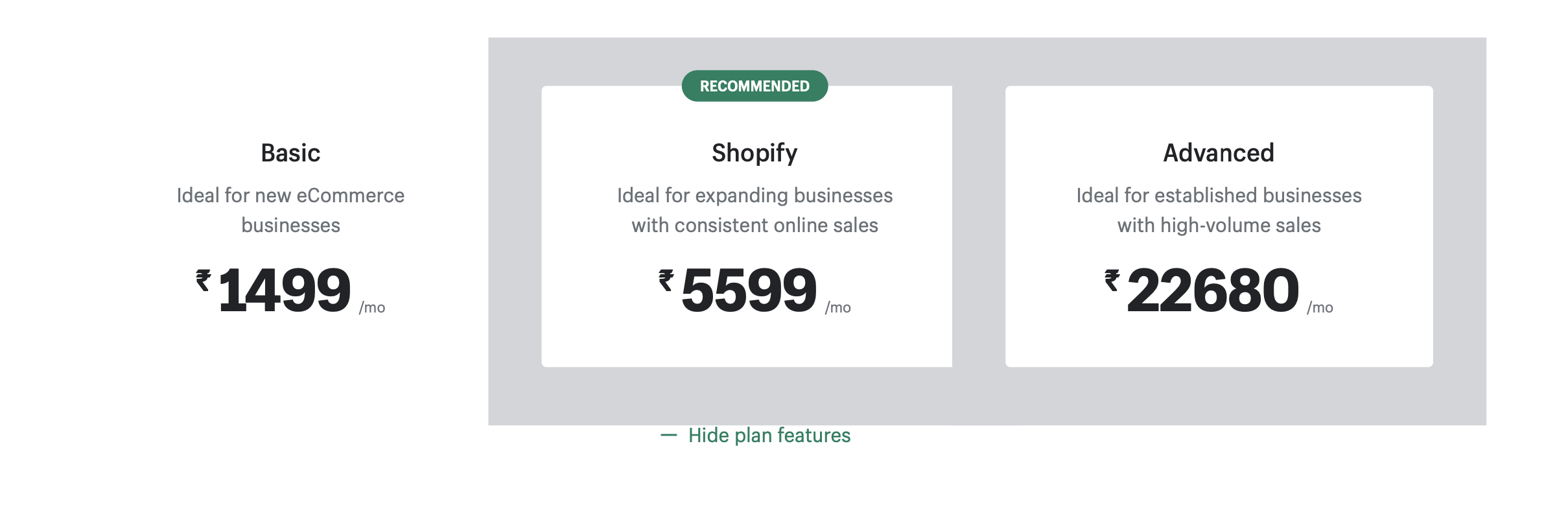
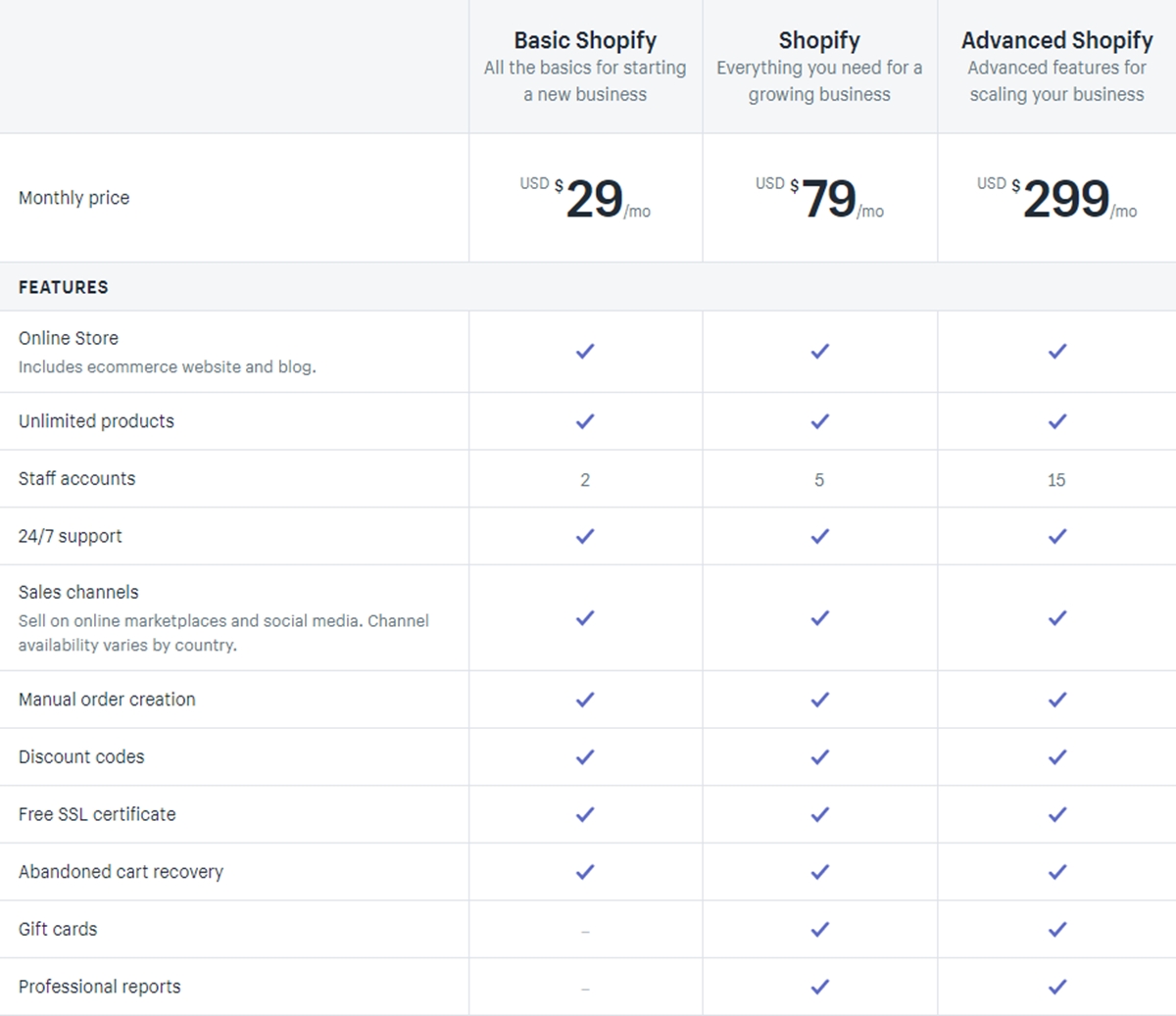
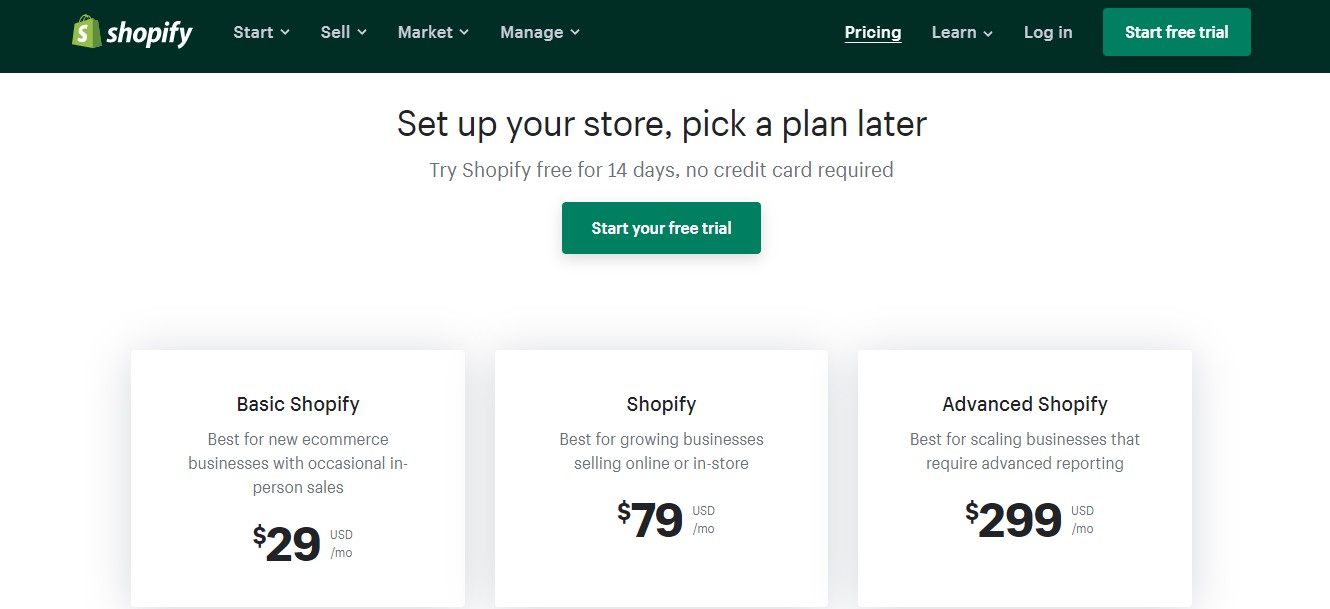
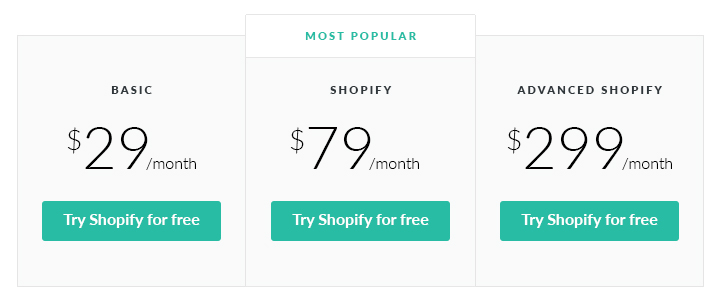
Shopify has three pricing plans: Basic, Standard, and Premium. The monthly costs for these three services are as follows:
All plans come with a 3-day free trial.
commission
Shopify credit card fees vary depending on your pricing plan.
The above fees vary depending on the user’s payment method. Domestic-issued credit cards have the lowest fees, while overseas-issued credit cards have slightly higher fees.
In order to keep operating costs low, we recommend starting with a basic or standard plan.
What is Shopify Plus?
Shopify Plus is a service that is positioned as a higher level plan than the regular Shopify plan. Shopify has regular plans called “Basic,” “Standard,” and “Premium,” but Shopify Plus is a plan that goes beyond these plans. It is mainly aimed at large companies and clients with large transaction volumes.
Therefore, specialized knowledge is often required when it comes to building an online store, and if it is difficult to do so yourself, you may need to consult with a “Shopify Plus Partner certified company.” Since most of the manual work can be automated, this plan is expected to significantly improve work efficiency.
Case studies of successful implementation of Shopify
Finally, I would like to introduce two successful cases of implementing Shopify.
I will explain each in turn.
go go curry
Go Go Curry is a curry brand that created the Kanazawa curry boom. We are equipped with multiple payment systems so that people of all ages can make payments. Another feature is that each product page has a SNS share button, which automatically attracts customers by spreading the word. If you are selling food-related products, please consider Go Go Curry.
Kakimori
Kakimori, a stationery store famous for its order notes, is an e-commerce site that collects potential customers by posting many customer-attracting columns on Shopify. You can see that they have put a lot of thought into the site, as it has been linked with Instagram, and the design has been optimized to suit the user group. If you would like to publish a column at the same time, why not consider Kakimori?

summary
In this article, we have explained about Shopify. Shopify is a platform that allows you to easily publish your e-commerce site. It is equipped with all the functions you need, including basic functions, design templates, and customization functions. Monthly running costs are also low, making it easy to operate over the medium to long term.
Why not start by actually registering with Shopify and checking out what features are included?