

Churn rate is one of the important management indicators in SaaS business. Churn rate refers to the customer cancellation rate, which is directly linked to business revenue in SaaS and subscription services, and is also an indicator for improving services.
Churn rate is also closely related to LTV, which in turn affects the marketing costs spent on new acquisitions. This time, we will introduce the types and importance of churn rates that marketers should keep in mind.
What is Churn rate?
Churn means “cancellation”, and Churn rate is the “cancellation rate”. It shows the percentage of users who canceled or downgraded to a free plan over a certain period of time, and is sometimes called the unsubscribe rate or customer churn rate. .
Churn rates vary depending not only on the number of companies, but also on the number of users, usage fees, and whether upsells and cross-sells are included. There are two main types of churn rate: customer churn rate, which is calculated by multiplying the number of users, and revenue churn rate, which is calculated by revenue. .
①Customer churn rate
Customer churn rate is collectively referred to as customer-based churn rate. It is further divided into two categories, user-based and company (account)-based.
The churn rate for each user is called the “customer churn rate,” and the churn rate for each company (account) is called the “account churn rate.”

②Revenue churn rate
Revenue churn rate is a churn rate that can be viewed in units of revenue (revenue), and is further divided into two depending on whether it includes not only downsells but also upsells and cross-sells.
The churn rate that takes into account the decrease in revenue due to cancellations and downgrades is called the “gross revenue churn rate,” and the rate that takes into account the decrease in revenue due to cancellations and downgrades and the increase in revenue due to upsells and cross-sells is called the “net revenue churn rate.”
The importance of churn rate
Churn rate is an important management indicator for SaaS and subscription services. There are two reasons for this: it is directly linked to profits, and it is an indicator of service improvement.
① Directly linked to profits
SaaS business is not a one-time sale business, but a business model that assumes continuous use. Therefore, depending on when a user cancels, your revenue may be less than the cost of acquiring that user.
If this happens and the number of cancellations exceeds the number of new users, the business will be in the red and will not be profitable. Therefore, the churn rate is an important indicator for determining the health of a business.
Also, by being able to make improvements, you can have a big impact on the growth of your SaaS business. Just reducing the churn rate from 2% to 1% has the impact of doubling LTV.

② Service improvement indicators
Churn rate is important not only to measure the health of your business, but also as an indicator for service improvement. In order to reduce the churn rate itself, it is necessary to set goals and improve it. It is necessary to continue working on specific measures.
By investigating the causes of churn, you can eliminate the dissatisfaction that users feel for some reason and increase user satisfaction. Therefore, the churn rate measures whether users are satisfied with the service and is an extremely important indicator for improving the service.
Churn rate calculation method and average value
We will introduce how to actually calculate the churn rate and the average value.
① How to calculate customer churn rate
Customer churn rate is calculated on a company-by-company and user-by-user basis, and is used when there is only one pricing plan. Furthermore, for BtoB services, we use the number of companies (account churn rate), and for BtoC services, we use the number of users (customer churn rate).
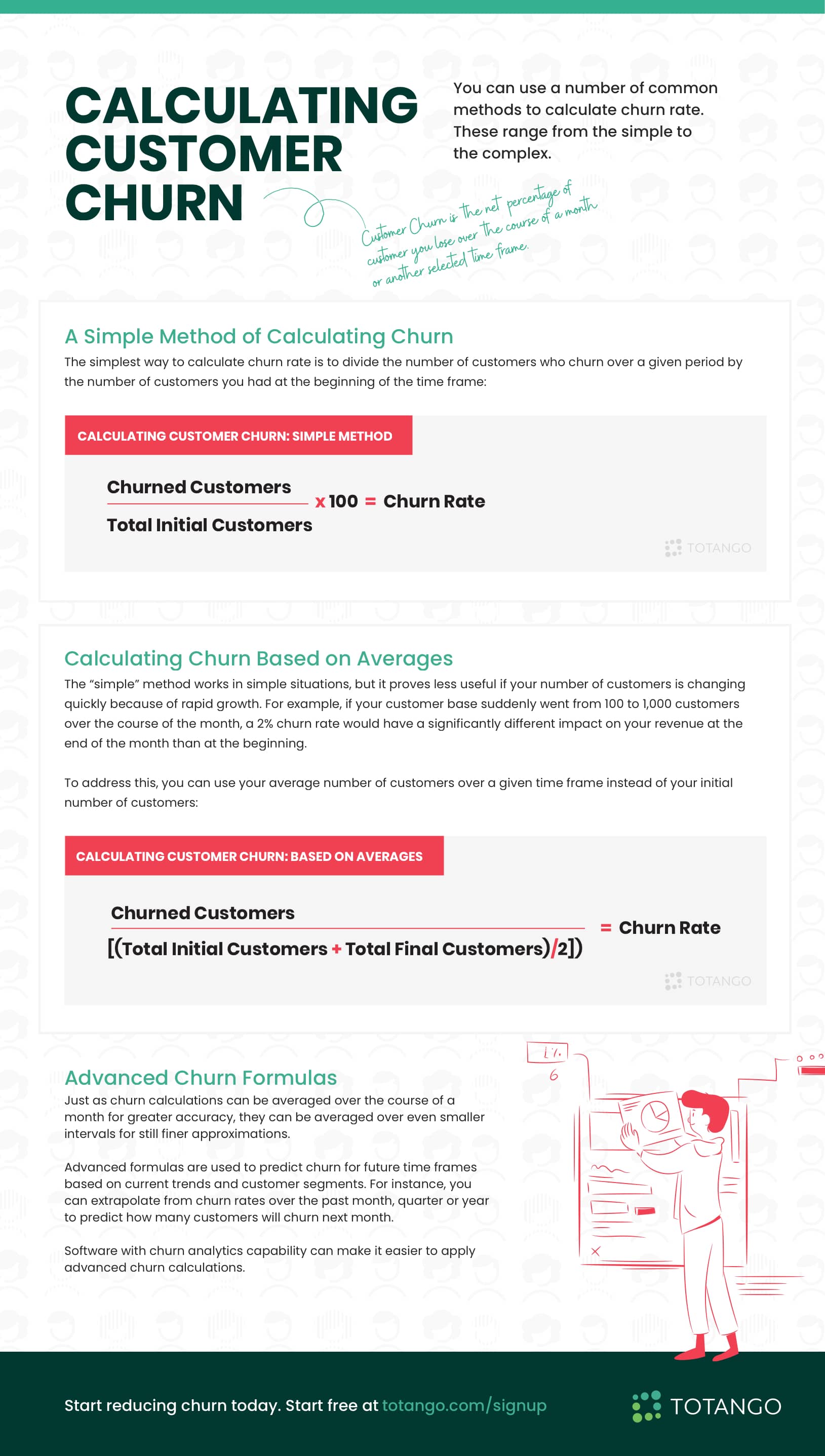
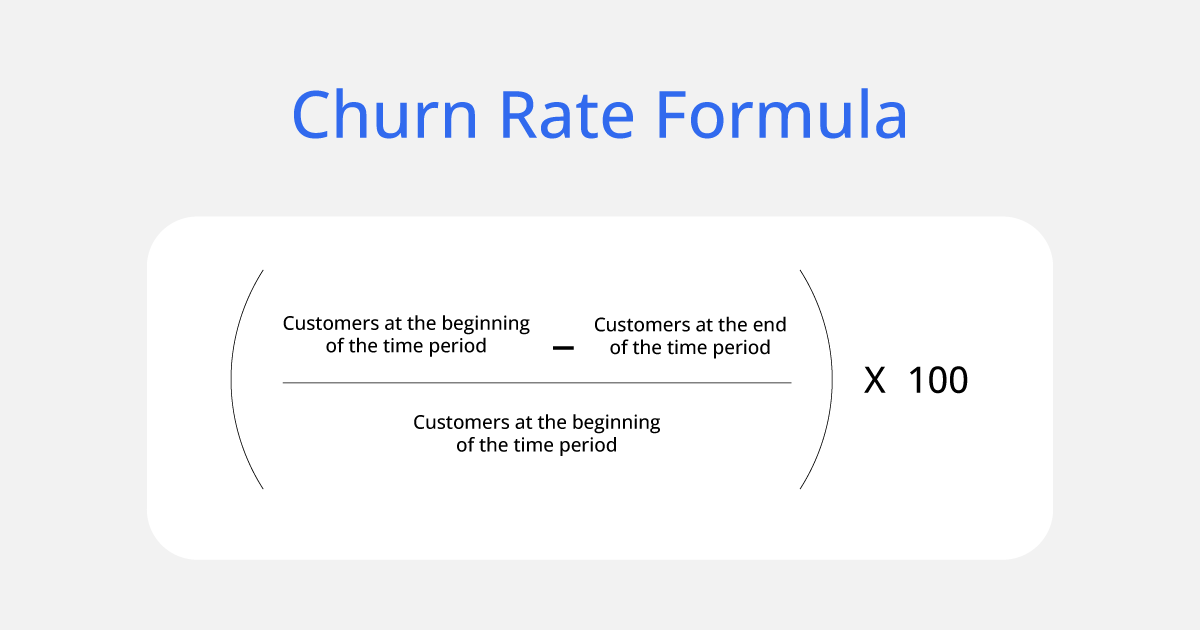
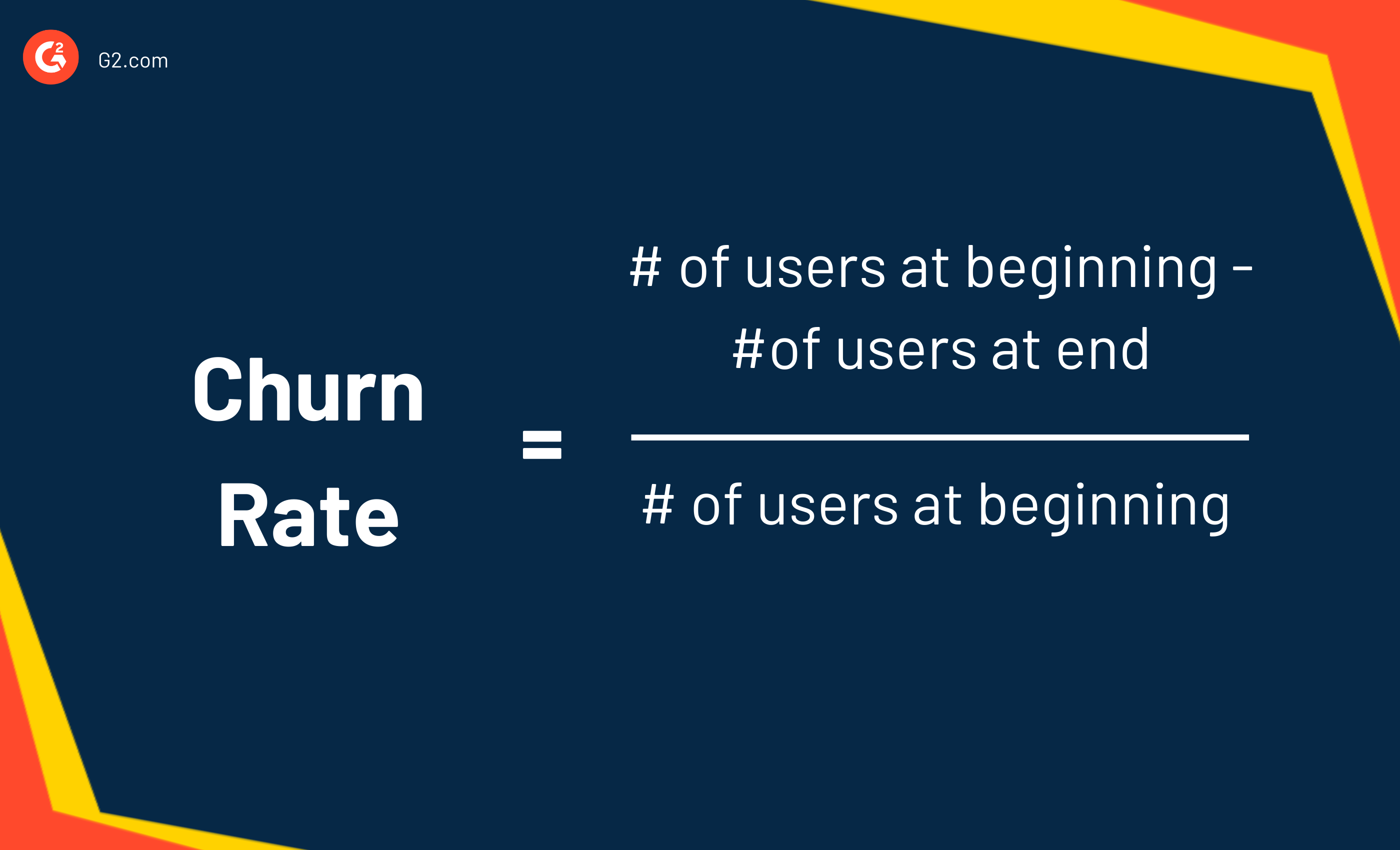
Formula = Number of companies (or number of users) that canceled within a certain period ÷ Number of companies (or number of users) before the period

②How to calculate revenue churn rate
Revenue churn rate is calculated on a revenue unit basis. Used when there are multiple rate plans.
Calculation formula = average usage unit price × number of companies (or number of users) that canceled within a certain period of time ÷ revenue over a certain period of time
In addition, the gross revenue churn rate, which is calculated by taking into account the decrease in revenue due to cancellations and downgrades, is used to understand the impact of cancellations on revenue. The net revenue churn rate, which is calculated by taking into account increases in revenue from upsells and cross-sells, is used to understand total revenue and predict sales.

③Average value of churn rate
It is said that the average churn rate that should be used as a guideline varies depending on the industry and company size. For the sites below, the BtoB average is 5% and the BtoC average is 7%, so BtoC tends to be higher. When using churn rate as a KPI or setting it as a goal, find out in advance what a rough guideline is appropriate.
Subscription churn rate industry benchmarks – Recurly research

Churn rate is necessary to calculate optimal marketing costs
LTV (lifetime value) is determined by the user’s continued use of the service, that is, the user’s “unit purchase price,” “purchase frequency,” and “continuation period.” Therefore, improving churn rate has a big impact on improving LTV.
Additionally, in SaaS businesses, you can use churn rate to calculate LTV.
LTV = Service unit price × Gross profit rate ÷ Churn rate
An appropriate CPC (cost per customer acquisition) can be calculated using the LTV calculated from the churn rate, and it is generally said that LTV three times the CAC is a healthy value for a SaaS business. From there, you can clarify the optimal marketing costs for acquiring new customers.
As you can see from the formula for calculating LTV, the lower the churn rate, the higher the LTV and the higher the appropriate CAC, which increases the cost of acquiring new users. Therefore, improving your churn rate will enable you to acquire more new users, which will also have a positive impact on your marketing.

summary
- Churn rate is the percentage of users who cancel or downgrade to a free plan out of all users, and there are two main types: customer churn rate by user and revenue churn rate by revenue.
- Churn rate is an important management indicator for SaaS and subscription services because it is directly linked to revenue and serves as an indicator of service improvement.
- It is said that the average churn value that should be used as a guideline varies depending on the industry and company size, but the BtoB average is 5% and the BtoC average is 7%, and BtoC tends to be higher.
- LTV can be calculated from the churn rate, and an appropriate CPC (cost per customer acquisition) can be calculated from LTV. From there, the optimal marketing cost for acquiring new customers will be clarified.