

“Big data” refers to data that is an order of magnitude larger. Large-scale analysis of a variety of unstructured data, including text, audio, and video, is expected to bring great utility value to corporate management and research and development.
This time, let’s take a look at the definition and classification of big data, examples of its use in companies, and how to use it for BtoB marketing.
■What is the definition of big data?
The general definition of big data is “a collection of data that is larger in volume and more diverse than companies have ever handled,” and its characteristics can be expressed in three Vs.
- Large capacity (Volume)
- Time series (Velocity) updated daily
- Variety

●Large capacity
Big data is characterized by a huge amount of data. Due to faster networks and the development of IoT devices such as sensors, various events are being converted into data and distributed.
In order to handle this data, the data capacity is said to be from several terabytes to several petabytes, a size that cannot be managed with existing general technology.

●Time series that is updated and accumulated daily
Big data means that large amounts of data continue to be generated 24 hours a day from social media, IoT devices, etc.
Data has a chronological nature that is updated and accumulated daily. Handling big data requires high processing speed that can process large amounts of data in real time.

●Variety of types
A major feature of big data is the diversity of data types. Until now, corporate core systems have basically handled structured data.
However, the data handled by big data is not limited to structured data.
Unstructured data such as text, audio, video, log files, searches, location information, and data emitted from various IoT devices will be handled.
Big data, which processes larger and more diverse data at higher speeds than previously used data, has come to have greater utility than ever before as a resource for corporate management and research and development.
It is expected that demand will be created sustainably by creating new products and services in terms of process, product, organizational, and marketing innovations.
■Classification of big data
The Ministry of Internal Affairs and Communications’ “2017 Information and Communications White Paper” calls 2017 the “first year of big data utilization,” and states that big data is classified into the following four types: government, corporate, and individual data.
1. Government: Open data provided by national and local governments
Based on the “Basic Act on the Promotion of Public-Private Data Utilization,” the opening of public information held by the national and local governments as data will be strongly promoted.
2. Companies: Data that digitizes tacit knowledge (know-how) (digitization of knowledge)
Various know-how and accumulations held by industries and companies will be digitized.
3. Enterprise: Streaming data output from M2M (Machine to Machine)
Data collected from IoT devices installed at production sites such as factories, data such as distortion and vibration collected from IoT devices installed on bridges, and the type and weight of passing vehicles.

4. Individual: Personal data related to individual attributes
Data such as personal attribute information, movement/behavior/purchase history, and personal information collected from wearable devices.
■Examples of how big data is used in companies
Big data is already starting to be used by companies. Let’s take a look at some examples of how it can be used in companies.
●Panasonic “Word-of-mouth analysis on social media, etc.”
Panasonic’s BtoB in-vehicle equipment business analyzed “in-car user problems” from over 2 million Twitter tweets related to “in-car”.
Because the majority of problems were related to odors, the company proposed its air purifier to the client company, which led to its adoption.
●NTT Docomo “Mobile Space Design”
The location information of individuals who own NTT Docomo mobile phones is de-identified so that individuals cannot be identified, and the data is provided to business operators, local governments, etc. as demographic data.
●Toyota Motor Corporation “Telematics Service”
Data collected and stored through Toyota Motor Corporation’s telematics service, such as vehicle position, speed, and driving conditions, can now be processed into traffic information and other statistical data, which can be used to improve traffic volume, provide map information, disaster prevention measures, etc. Providing information.
●OMRON Healthcare “Wellness LINK”
We provide lifestyle improvement services by collecting data such as travel distance, sleeping hours, height, weight, etc. from individuals wearing wearable devices and providing it to medical institutions.
■How to use big data for BtoB marketing
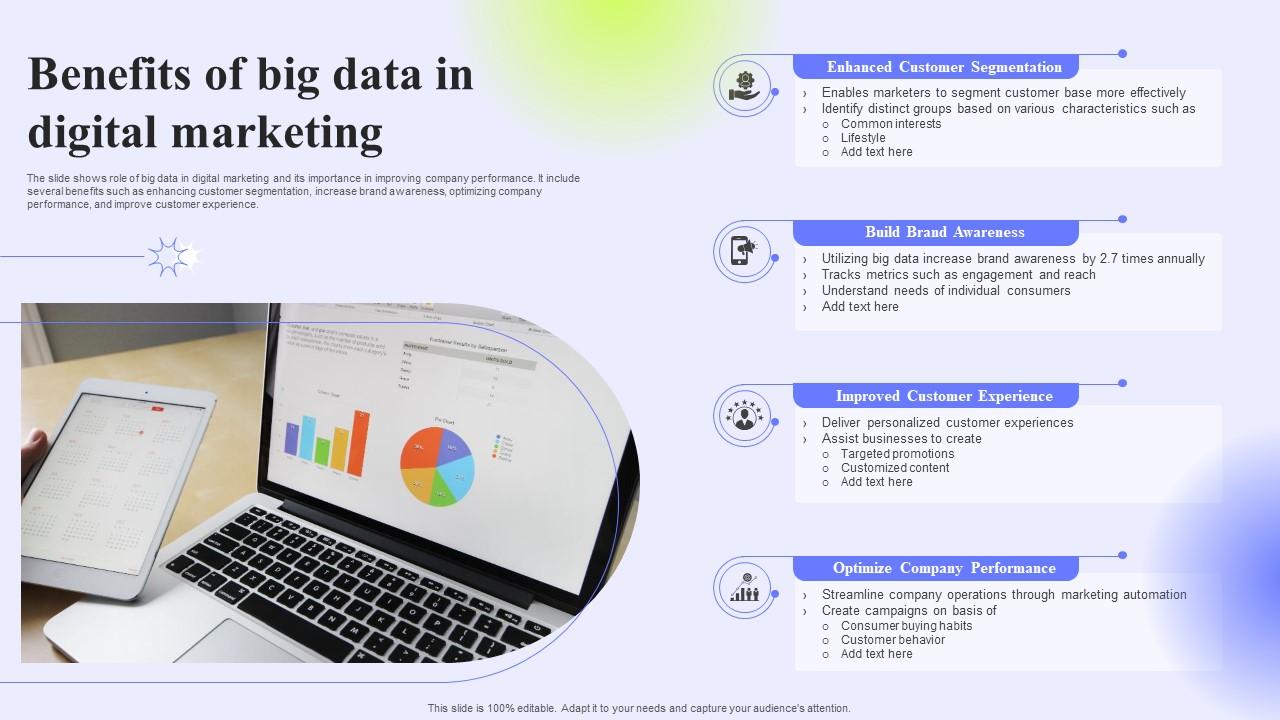
Big data is also effectively used in BtoB marketing.
●Retargeting
Encourage repeat visits and improve conversion rates based on information about which pages visitors view on your site and for how long.
●Persona settings
Use the age, gender, family status, etc. of visitors to your company’s website, which is analyzed based on big data, as a reference for setting personas.
●Analyze the buyer’s personality
Based on the buyer’s communication method preferences, which are analyzed using big data, we analyze the personality of buyers, including whether they have purchasing decision-making power, how much influence they have, and what kind of information they are easily influenced by.
●Analyze what stage the purchase is in
Analyze what stage buyers are in, from the initial research stage to the final decision stage. Based on the results, take measures such as adjusting the method and frequency of communication with buyers or strengthening the pipeline between your sales and marketing departments.
●Analyze the partner company’s hesitations
When a company purchases a product or service, we analyze where the confusion that arises is caused by having to go through the steps of going through many departments.
This information will be used as a basis for deciding on content to remove that confusion.

◆ Summary
◆ Big data refers to data that is larger and more diverse than companies have previously handled.
◆ Big data can be classified into four categories: national open data, corporate knowledge digitization, M2M streaming data, and individuals’ personal data.
◆ Big data can also be effectively used for BtoB marketing