

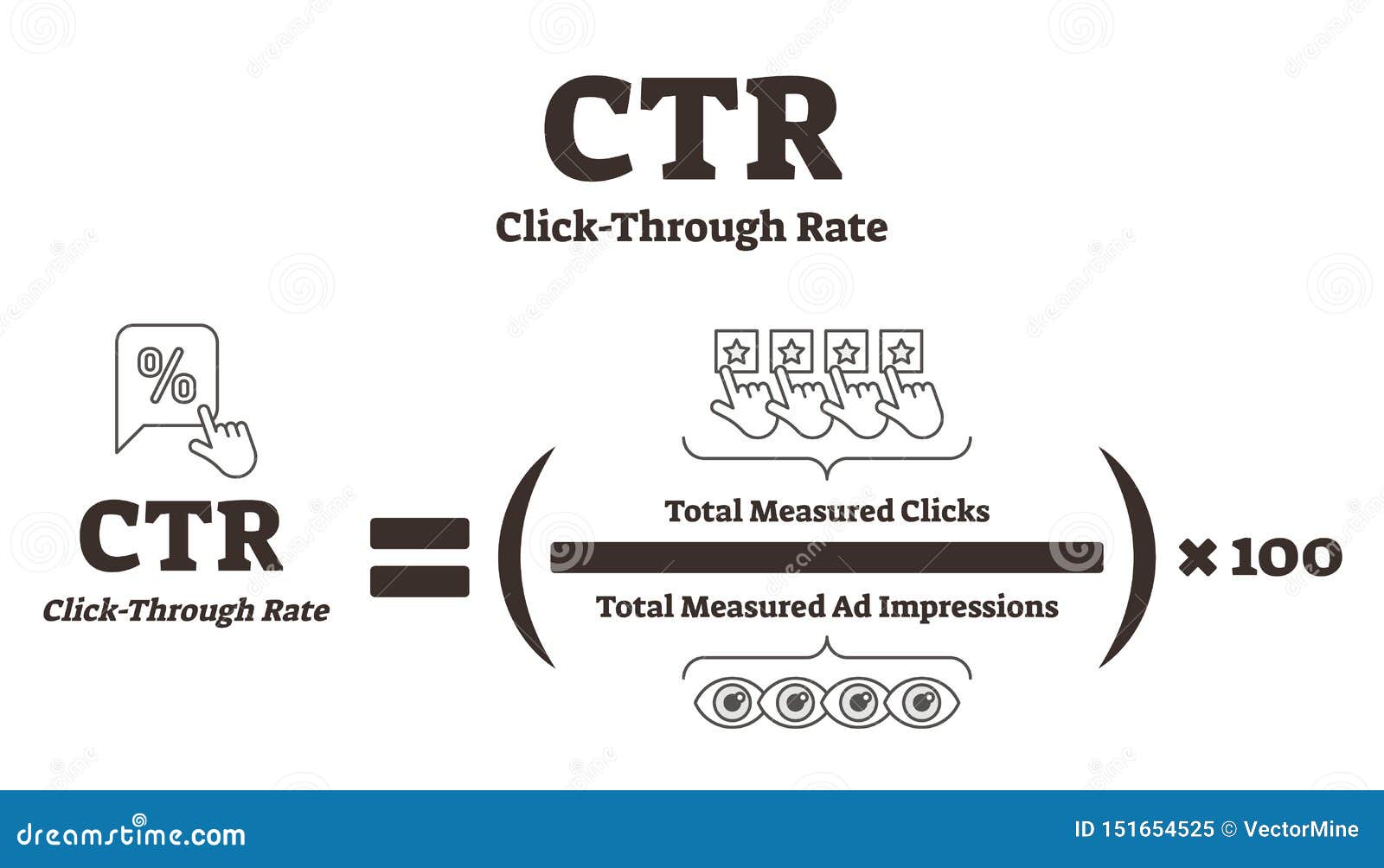
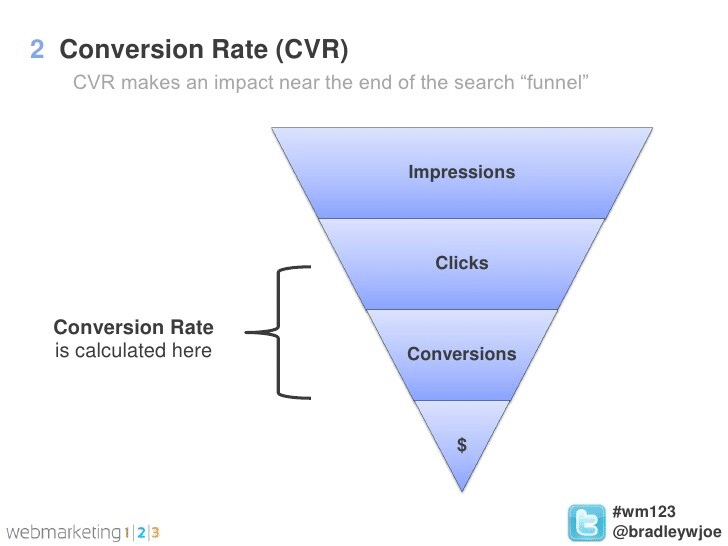
CTR (click-through rate) is the number of times an ad or link to a homepage is clicked divided by the number of times the ad or link to a homepage is displayed. The formula is “CTR (click-through rate) = number of clicks ÷ number of impressions.”
This time, we will introduce CTR (click-through rate) as useful information for marketers and how it can be used in Internet advertising and SEO.
What is CTR (click rate)? To put it simply…
CTR (click through rate) is an acronym for “Click Through Rate,” and it is the number of times content is displayed in Internet advertisements, search engine natural search results, Internet advertisements, etc. This is an indicator that shows what percentage of clicks are made by users.
Many people focus on increasing the CTR (click-through rate) of advertisements and links to homepages.
The number of times your content is viewed is sometimes referred to as “impressions.”
The formula is “CTR (click-through rate) = number of clicks ÷ number of impressions.” This number is usually multiplied by 100 to express it as a “%”.
How to calculate CTR (click rate)
Let’s actually calculate the CTR (click-through rate) by applying the formula: “CTR (click-through rate) = number of clicks ÷ number of impressions.”
For example, let’s say your page is displayed 100 times and clicked on 15 times in a search engine’s natural searches.
The number of clicks divided by the number of impressions.
15÷100=0.15
Multiply by 100 to convert to %
1.15×100=15
As a result, “15%” is the CTR (click rate).
What does CTR (click-through rate) mean?
Even if you know how to calculate CTR (click-through rate), it is of no use if you do not know how to utilize it. However, when I am working, I am given instructions such as “Please increase your CTR (click-through rate)” or “Improve your CTR (click-through rate)”, and there are cases where it is necessary to increase your CTR (click-through rate). Will visit often.
First, let’s understand what CTR (click-through rate) is.
This article covers two main ways to use CTR (click-through rate): improving CTR (click-through rate) for natural searches for SEO purposes, and improving CTR (click-through rate) for internet advertising. , I will explain each one.
1. What is CTR (click-through rate) in natural search/SEO?
When implementing SEO (search engine optimization) for your company’s homepage, etc., you may use CTR (click-through rate) as an indicator. For example, let’s say your company’s homepage is listed on the first page of a search engine’s natural search results. If it’s on the first page, it’s more likely to be noticed by searchers and clicked on, so the click-through rate will be higher than if it’s on the second page or later. However, even on the first page, the CTR (click-through rate) changes depending on the number of pages from the top of the search ranking. Naturally, the first position is the most likely to be clicked, so the higher the search ranking, the higher the click rate.
Natural search/SEO CTR (click-through rate) is a useful number that allows you to know how well search results match the needs of search users. You can measure how well the title and description of your company’s homepage match and interest users who searched for that search keyword. This information will be an important indicator when implementing SEO.
2. What is CTR (click-through rate) of Internet advertising?
There are various types of Internet advertisements in the world. Among them, display advertisements and listing advertisements are the most commonly used advertisements. For these ads, the CTR (click-through rate), which measures how many clicks each time an ad is displayed, is very useful information.
This will give you a clue as to whether the user was interested in the ad.
The click-through rate of Internet advertisements varies depending on various factors such as the medium, placement location, title, ad text, target audience, and advertising time. By improving all of these factors one by one, you can increase your CTR (click-through rate).
CTR (click-through rate) can serve as a valuable metric for achieving SEO and advertising objectives.
Average/estimate of CTR (click rate)
Let’s know what the actual CTR (click-through rate) is for natural search/SEO and internet advertising.
1. CTR (click-through rate) guideline for natural search/SEO
The CTR (click-through rate) of natural search changes depending on the position of your website when it appears on the search results page.
As a rough guide, 1st place is around 20-30%, 2nd place is around 15%, 3rd place is around 10%, and as the ranking goes down, the CTR (click rate) decreases and remains flat, and 1.5% for 10th place. It will be about. Even if you appear on the first page of search results, there is a 6-20 times difference between being displayed in 1st to 3rd place and 10th place.
The purpose of SEO is to increase the number of accesses as much as possible, so we aim to increase the number of accesses by increasing the CTR (click-through rate).
2. CTR (click-through rate) guideline for internet advertising
The CTR (click-through rate) of Internet advertising is one of the important indicators for measuring advertising performance. Although it is important for advertisements to reach as many people as possible, this alone will not directly lead to customer attraction or sales. Once an ad is displayed, how it gets clicked is important.
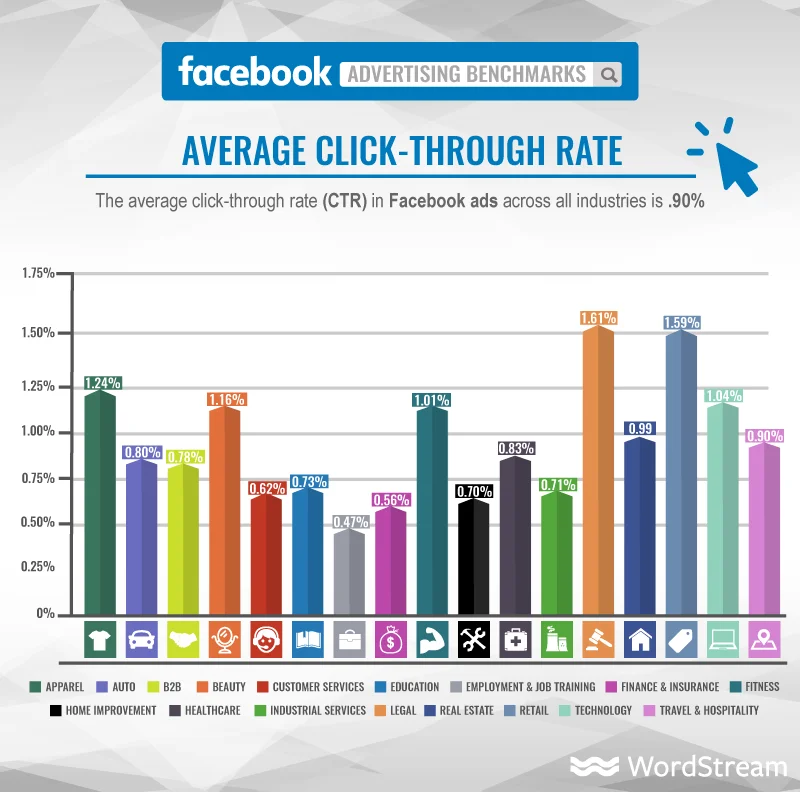
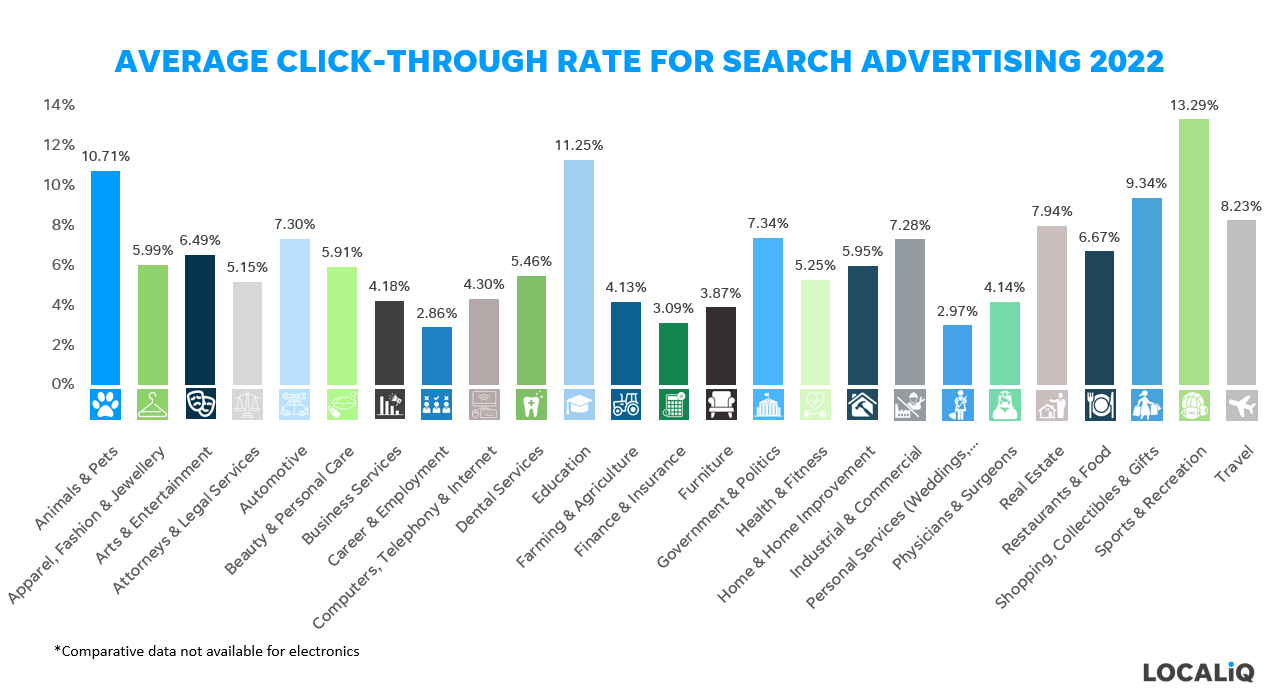
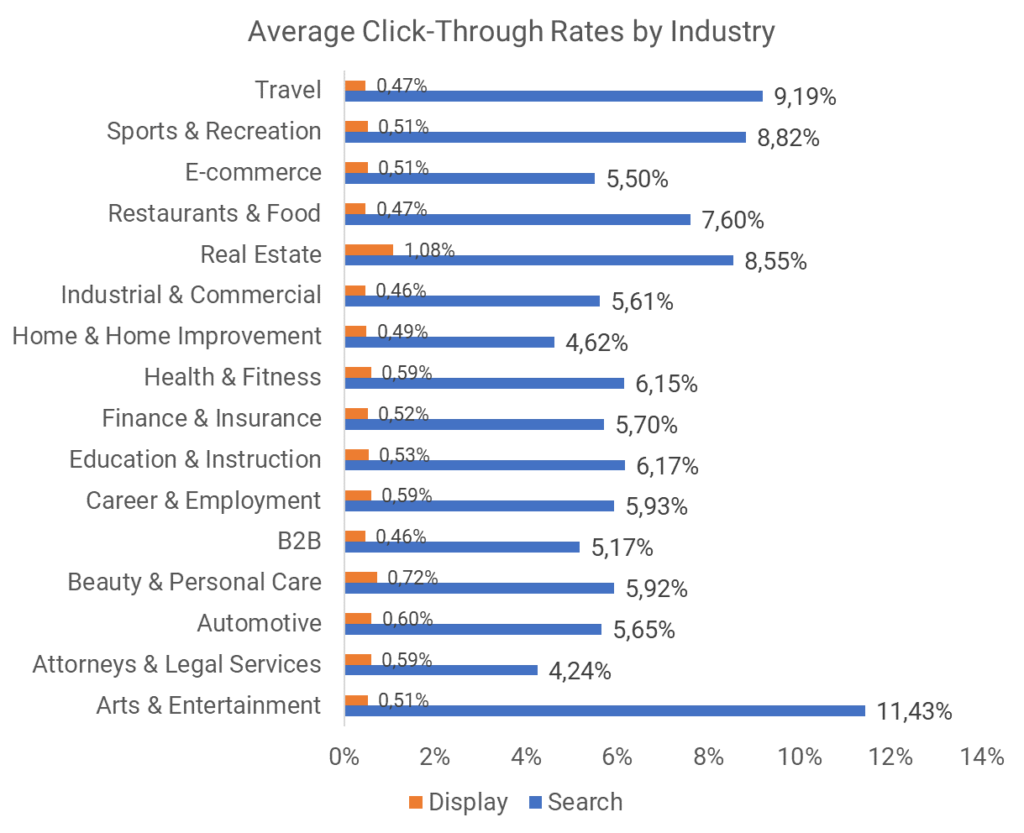
What is the CTR (click-through rate) of internet advertising? The average value of listing ads displayed in search engine search results is around 2-6%. The average value of display ads displayed in various parts of a website is around 0.3-1%.
The reason why listing ads have a higher click-through rate than display ads is said to be related to user needs. Listing ads are displayed to users who have taken a search action with some purpose in mind, so they are considered to be more likely to be clicked as they match the user’s needs. On the other hand, display advertising targets users who are viewing the website for various purposes, so they may not necessarily have a need for the products that are advertised in-house. Therefore, the CTR (click-through rate) will be correspondingly high.
Even for the same listing ad, the CTR (click-through rate) will vary depending on the industry and genre. Looking at various aggregated data, we find that CTR (click-through rate) tends to be high in the fields of customer service, travel/tourism, automobiles, and arts/entertainment.
What is the reason for low CTR (click-through rate)?
Whether it’s SEO or advertising, you can expect to attract more customers and increase sales by increasing CTR (click-through rate). However, unless you know the reason why CTR (click-through rate) is not increasing or is low, you cannot take countermeasures. Let’s take a look at the reasons for organic search and internet advertising.
1. Reasons why the CTR (click-through rate) of natural search/SEO is low
If your natural search/SEO CTR (click-through rate) is low, your search ranking may be low. The lower your search ranking, the lower your CTR (click-through rate), so you need to increase it.
In particular, you will hardly get any clicks below 5th place, so if you want to increase not only your search ranking but also your click-through rate, it is a good idea to aim for at least 5th place or higher.
Additionally, it is said that click-through rates tend to increase for services related to areas such as travel, real estate, medical care, and education, so click-through rates vary depending on the industry.
2. Reasons why the CTR (click-through rate) of internet advertising is low
The CTR (click-through rate) of Internet advertising depends on the content of the advertisement.
For listing ads, the first step is to be displayed, but unless it beats out other displayed ads, you won’t get people to click on it. Of course, it will be difficult if the ad copy is not appealing to the user.
Display advertising content can be created using not only text but also images, but the text, images, and all visuals must be able to attract the user’s attention.
When it comes to advertising, first impressions are important. I can almost believe that I haven’t seen it for even a second. The condition for a click is that it instantly resonates with the user and grabs their attention. As mentioned earlier, the CTR (click-through rate) for display ads should be 1% on average. However, if there are no clicks at all, you will not get any visible results, so you should focus on the problem with the ad content and take measures.
Of course, publication time, publication location, and media are also factors that reduce CTR (click-through rate). Let’s take various factors into account.
I will explain the countermeasures later.
What are the benefits of increasing CTR (click-through rate)?
By the way, what are the specific benefits of increasing CTR (click-through rate)? Let’s take a look at the actual benefits of improving CTR for natural search and internet advertising.
1. Benefits of increasing CTR (click-through rate) for natural search/SEO
As mentioned earlier, in order to increase CTR (click-through rate) in natural search, you need to improve your search ranking. Therefore, when you implement SEO measures to improve your search rankings, you can also expect your CTR (click-through rate) to increase. Therefore, along with SEO, CTR (click-through rate) will increase, which will naturally lead to attracting more customers. If you sell products or services, this will naturally lead to increased sales.
2.CTR (click rate) of internet advertising
By increasing the CTR (click-through rate) of Internet advertising, you can expect various effects as shown below.
Improve your ad quality score
In particular, Google Ads has a quality score, and the higher the CTR (click-through rate), the higher the quality score. The higher the CTR (click-through rate), the more users are interested and clicking, which proves that the ad is good and effective. The quality score of Google Ads evaluates not only the ad itself but also the quality of the linked landing page, so it cannot be said that a good quality score = high CTR (click-through rate). Increasing your click-through rate will definitely increase your quality score.
A high quality score means lower bids (CPC), higher rankings, and more distribution.
Increase in number of CVs (conversions)
If an ad is clicked, more users will visit the landing page, which will increase the number of conversions on the landing page.

Measures to improve CTR (click-through rate)
Improving and increasing CTR (click-through rate) will lead to increased sales and CV (conversion). How can you specifically increase your CTR (click-through rate)? Let’s take a look at natural search and internet advertising.
1. Measures to improve natural search/SEO CTR (click-through rate)
Make the title catchy
Users first look at the title of a search result to decide whether to click on it. You can instantly decide whether the information you want to know is on the next page. When doing so, it is important not only to match the title and the content of the page, but also to choose wording that is appealing.
The minimum requirement is that the title contains the keyword that the user just searched for.
Get your keywords right
Does the content of the page really match what the searcher is searching for? I think you are doing SEO by targeting keywords, but are the keywords you are targeting appropriate for users? By reviewing this, your CTR (click-through rate) will increase and the users who visit your page will be more satisfied.
It is necessary to conduct a thorough target analysis, such as setting personas, to find out what the user wants to know using the search keyword.
Add numbers/make it easier to understand
It is also important to include numbers in the title and description to clarify the basis and express it in an easy-to-understand manner. If your target age group is clear, it is also effective to use expressions that are familiar and easy to understand for that target.
2.Measures to improve CTR (click-through rate) of Internet advertising
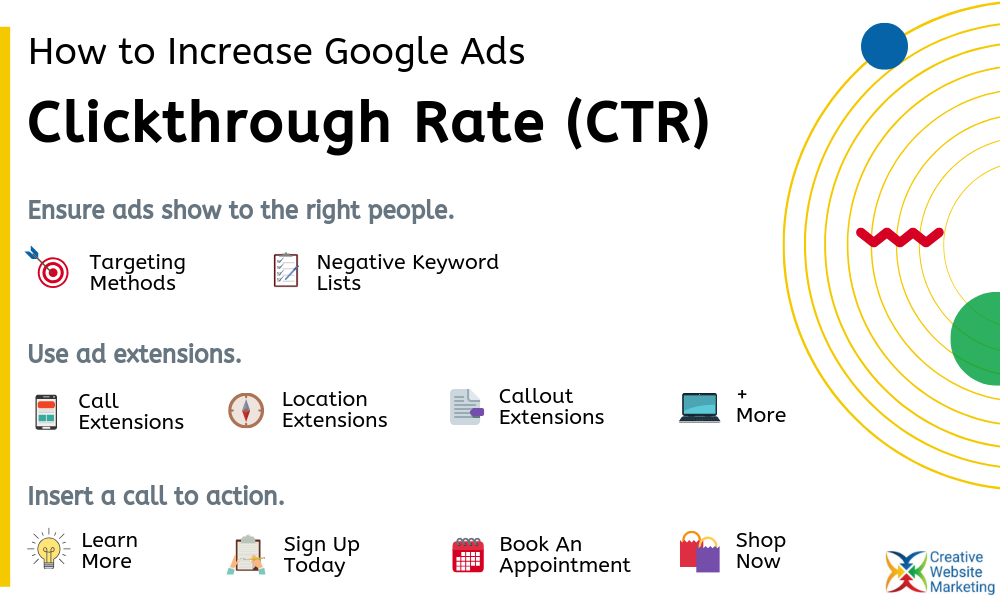
Attract users with ad title and text
Titles and text are also important in advertising. The key is how much of an impact you can leave on users who only see it for a moment. In listing ads, the text needs to be optimal for search users. Of course, including keywords is essential. In display advertising, it is necessary to appeal in conjunction with creative.
Get your keywords right
When it comes to keywords in listing ads, it is necessary to consider matching them with search keywords in the same way as SEO. In the case of advertisements, keywords are also set on the ad management screen, so be sure to put effort into choosing keywords for setting as well as keywords to include in the ad text.
If the keywords are not appropriate, your quality score will drop, which will put you at a disadvantage as an ad.
Target properly
Advertisements are distributed by narrowing down the targets, but there are cases where the selection of targets is poor and advertisements are distributed to users who have no needs at all, resulting in wasted advertising costs. In order to avoid such situations and increase CTR (click-through rate), it is important to clearly define your targets. Identify region, age, gender, etc.
Check if the appeal points match
Even if the keywords and targets are appropriate, if the appeal points are off, the clicks will not be made. Even if the advertisement is for the same product, if the appeal point changes, the advertisement will be completely different. If what the user is looking for does not match the appeal point of the ad, the user will not click to view the landing page.
In order to optimize your appeal points, you need to identify the concerns that your target users have and prepare advertising creative and text that respond to those concerns. There are not only worries, but also frustrations. By directly appealing to users that you can solve their worries and anxieties, you can get users interested and click on your site.
Include specific numbers and data
We also need concrete numbers and data. For example, if there is an advertisement for a hair growth agent, the ad will show some form of numerical data such as the hair growth effect, satisfaction level, and number of products sold. It becomes more likely that users will be able to solve their problem, so they will be more likely to click on it.
Covers all the information users want to know
Comprehensiveness is also said to be important when it comes to ad titles and text. Comprehensiveness means whether the information that users want to know is covered. If there is information in another company’s advertisement that is not in your own advertisement, you will feel that the other company’s advertisement is somehow higher quality. In addition to numbers and data, think carefully about comprehensiveness and include them.
To achieve this, it is essential to analyze and dig deeply into user needs. Also, research your competitors’ ad text.
Clarify purchasing decision factors
If the advertisement is to sell products or services or encourage customers to visit the store, whether the information that will be the determining factor when purchasing or selecting the product or service is clear is an important factor that influences clicks. It becomes.
For example, let’s say a user is looking for a dental clinic. In that case, the purchasing (visit) decision factors include the address, access method, map, consultation hours, closed days, phone number, fees, reservation method, symptoms that can be treated, the director’s profile and track record, and the flow of treatment. It’s difficult to include all of these in your ad text, but by including some of these, you can satisfy several purchasing decision factors. It will be more likely to be clicked and the visit rate will increase.
Another key point is to select the purchase decision factors that resonate most with users and that they most want to know about, based on their search keywords, and include them in the ad text.
Make the right connection to your landing page
Do the keywords and ad text match the content of the landing page? Also, does it have the content that the user wants? If the content is inconsistent, even if someone clicks on it, they will simply leave. It also reduces trust. There is a risk that you might think, “This page doesn’t suit me. I was fooled by the ad text. Next time I see an ad for this company, I won’t click on it.”
The key to improving CTR (click-through rate) is to accurately understand user needs
Above, we have provided an overview of CTR (click-through rate) and explained the knowledge and points necessary to improve CTR (click-through rate). All that said, at the end of the day, it’s the user who clicks. If you create something that your target users want to click on, you can increase your CTR (click-through rate).
Specific ways to accurately understand user needs include hearing about needs from departments that directly interact with customers, such as your sales department or customer service department, or conducting a survey directly to users. there is.
Determine your web page title and ad text by accurately understanding your users’ needs.
Another important point is not to focus too much on increasing CTR (click-through rate). This is because if you take measures only to increase CTR (click-through rate), the title and the content of the landing page often become misaligned. Naturally, if this happens, it will not lead to CV (conversion), so there is a risk that results will not be produced. Treat it as one of the most important indicators and improve it while looking at the balance with all other indicators.
summary
- CTR (Click Through Rate) is an acronym for “Click Through Rate” and is the percentage of the number of times content is displayed in Internet advertisements, search engine natural search results, listing advertisements, etc. This is an indicator that shows whether the user clicked on the page.
- The standard CTR (click-through rate) for natural search/SEO is around 20-30% for first place, around 15% for second place, and around 10% for third place, and decreases as the ranking goes down. The CTR (click-through rate) of Internet advertising is approximately 2-6% for listing ads displayed in search engine search results, and 0.3-1 for display ads displayed in various parts of a website. %degree.
- If your natural search/SEO CTR (click-through rate) is low, your search ranking may be low. Regarding the CTR (click-through rate) of Internet advertisements, there are often problems with the content of the advertisements.
- Measures to improve the CTR (click-through rate) of natural search and SEO include “make the title catchy,” “use appropriate keywords,” and “use numbers and make it easy to understand.” Measures to improve the CTR (click-through rate) of Internet advertisements include: attracting users with the ad title and text, using appropriate keywords, setting targets appropriately, and checking whether the appeal points match. ”, “Include specific numbers and data”, “Cover all the information users want to know”, “Clarify purchase decision factors”, “Appropriately link to the landing page”, etc.