

Why-why analysis is a way of thinking that thoroughly identifies the root cause of an incident in order to prevent it from happening again.
By effectively conducting why-why analysis, you can solve problems that occur and prevent them from happening again. In addition, why-why analysis is not only useful for investigating causes and solving problems in a wide range of industries, but it is also a method that can be used in private life.
This article provides an overview of why-why analysis, how to perform it, and tips on how to do it effectively.
What is why-why analysis?
Why-why analysis is a method of finding the cause of a problem in order to solve it or make improvements, and it is a method developed by Toyota Motor Corporation.
In English, it is called 5whys (five whys) because it repeats “why” five or more times. It is also called “Root Cause Analysis (RCA)” because of the idea of investigating the cause and preventing recurrence.
I will explain in detail what a 5-why analysis is.
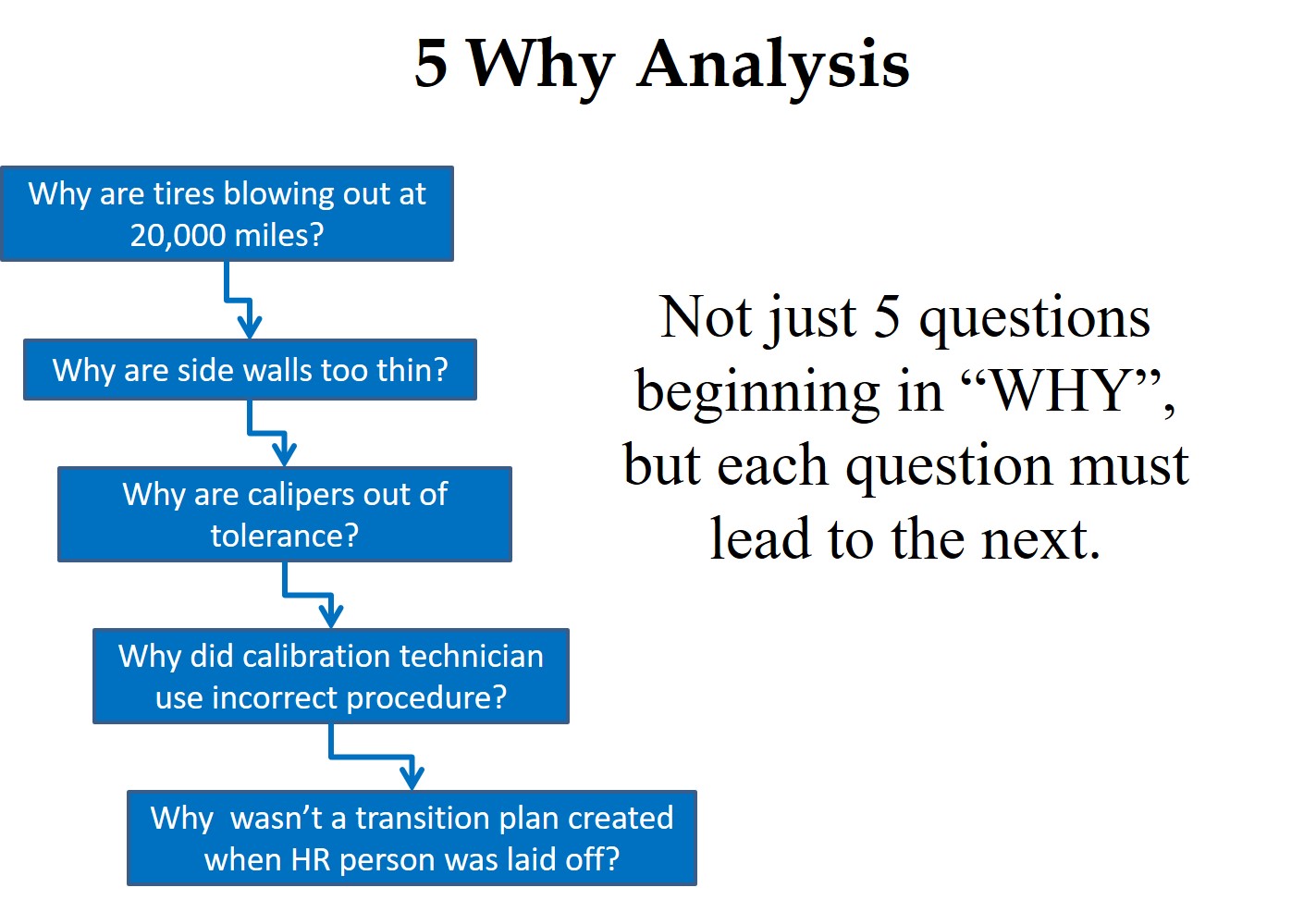
Analysis method that repeatedly asks “why” to find the root cause
“Why-why analysis” is a method of finding the cause of a problem in order to solve it or make improvements. Specifically, in order to investigate the cause of a problem, we dig deeper into why the problem occurred, and by repeatedly asking the cause, “Why?” This is a method to find the cause.

For example, if there is a problem that a certain product has a high defective rate, we will ask the question, “Why is the defective rate high?” as the cause. If the answer is “It’s because of an inspection error,” we repeatedly ask the question “Why do inspection errors occur?” to find the root cause.
If you repeat “why” 5 times, you will arrive at the root cause.
In why-why analysis, you can typically find the root cause by repeating “why” five times. By repeatedly asking “Why did the problem occur?” and “Why?”, we can discover the root cause and lead to the formulation of effective solutions and measures to prevent recurrence.
However, in some cases you may need more than six “whys”. Therefore, you need to adjust the number of “why” questions to suit the situation and problem.
The importance of doing a why-why analysis
Toyota Motor Corporation, which invented the why-why analysis, created the why-why analysis for the purpose of “problem solving” and “recurrence prevention” in the company’s business operations. Not only can you find the cause of problems that occur at work, but you can also come up with preventative measures.
If you deal with the problem on an ad hoc basis when it occurs, the problem will reoccur and the same problem will result in a loss for the company. When running a company, it is a very big problem to have the same problem over and over again reduce the company’s sales.
In order to satisfactorily resolve a problem that has already occurred, prevent it from happening again, and protect the company’s management, “problem solving” and “recurrence prevention” through why-why analysis are important.

How to conduct a why-why analysis
If you just think, “I just need to repeat the why five times,” it may not be enough to conduct a full why analysis. Please be aware of the following 5 steps and follow them correctly.
Set up the problem (define it specifically)
Before you can do a 5-why analysis, you need to be clear about the problem you want to solve. If the problem is abstract, it is important to define it concretely. By defining it specifically, you can accurately understand the problem to be solved.
For example, if you want to specifically define the problem that “the number of orders is decreasing,” you can cite specific numbers such as “The number of orders has decreased by 20% compared to last month.”
Repeat and dig deeper by asking “Why?”
Once you have defined the problem specifically, you can dig deeper by repeatedly asking “Why?” At this time, when answering “why?”, it is important to keep in mind the answer is based on objective data and facts. Answers based on emotions and subjective opinions may overlook the root cause.
For example, if we take the problem of “the number of orders decreasing”, we first ask, “Why is the number of orders decreasing?” Suppose that the answer is, “It’s because customers are no longer interested in the product.” In response to this answer, dig deeper by asking, “Why are customers no longer interested in your product?”
<Example of why-why analysis>
“Why is the defective rate so high?” “It’s because there are inspection errors.”
↓
“Why do testing errors occur?” “It’s because the burden on employees conducting testing has increased.”
↓
“Why has the burden on employees increased?” “It’s because of a lack of manpower.”
↓
“Why is there a labor shortage?” “It’s because we can’t attract people even if we recruit.”
↓
“Why don’t we get people even though we’re recruiting?” “That’s…”
We will dig deeper into this.
Clarifying the root cause
When you get to the fifth “why?” question, the root cause becomes clear. It is necessary to repeat the question “why?” once again to clarify the background and circumstances leading up to the cause.
By understanding this background and situation, you can develop countermeasures and preventive measures to prevent similar problems from occurring again.
By clarifying the cause, you can develop effective solutions to resolve the problem. For example, let’s say there is a problem with low sales of a certain product, and in the fifth question, “Why?”, the root cause becomes clear: “Customers don’t want to buy the product.”
By clarifying the causes, you can develop strategies to improve your product’s acceptance by customers. Specifically, measures could include improving product quality, reviewing prices, and strengthening advertising.
Set up a solution
Once the cause has been determined, the next step is to develop a solution. Solutions should be tailored to the cause of the problem. In addition, resources such as budget, schedule, and personnel must be considered in implementing the solution.
When considering solutions, the following approaches may be helpful:
Implementation and validation of the solution
The final step is to implement the chosen solution. Implementing a solution requires creating an implementation plan, assigning ownership, and securing the necessary resources. In addition, it is important to measure and improve the results of the implementation plan at the same time as implementing it.
When implementing a solution, you must confirm that the problem is resolved. It is important to set metrics to measure whether the chosen solution is solving the problem. This allows you to determine if the solution is effective.

An example of a why-why analysis of a manufacturer
I would like to introduce an example of a why-why analysis of a manufacturer. Here, let’s try to analyze why a manufacturer’s monthly sales have decreased due to the suspension of production for a certain period of time.

In this way, we repeatedly ask “why?” in response to problems that arise, and get to the root of the problem. Ultimately, you will be able to come up with workable solutions and take action to resolve the problem and prevent it from happening again.
Therefore, why-why analysis is a problem-solving method that is mainly used in companies for quality control and occupational safety management.

Tips for effective why-why analysis
There are several points to focus on in order to conduct an effective 5-5 analysis. Let’s implement the following.
Be clear and specific about the problem you want to solve
In order to perform an effective why-why analysis, it is important to be clear and specific about the problem you want to solve. Having clarity about the problem makes it easier to set up and implement solutions.
For example, suppose a company has a problem where its production line frequently stops. In this case, rather than just looking at the problem at the level of “production line stoppages occurring frequently,” we should also consider the frequency of stoppages, the causes of stoppages, what kind of losses are occurring, and the factors behind them. Need to be clear.
By defining the problem, you can determine what methods will be effective when developing a solution. For example, if a production line is frequently stopped, you can clarify what areas need improvement and set solutions.
Understand the history and background of the problem
In order to solve a problem, it is important to understand the history and background of the problem. By clarifying the situation before a problem occurs, the cause of the problem, and the situation before implementing a solution, you can come up with a more effective solution.
For example, when we investigated the background of the problem mentioned above where the production line frequently stopped, we found that the cause was the introduction of a new product, changes in product specifications, and insufficient maintenance. . By setting solutions based on this information, effective improvements can be made.
Analysis is done objectively.
When conducting a 5-why analysis, you should avoid basing the analysis on subjective judgments or expectations. It is important to conduct analysis objectively and based on evidence-based data.
For example, if you believe that a worker’s error is the cause of defective products, you should avoid immediately accepting that hypothesis as a definitive cause. While it is possible that an operator error was the cause, there may be other causes as well, so it is important to collect objective data and determine the cause of the problem.
Analyzes are linked together
In why-why analysis, it is necessary to be conscious of the chain and connect the events so as not to skip any links.
For example, an analysis performed on the event that “a worker fell down while walking” is much faster than an analysis performed on “the floor was slippery.” In this example, the cause of the slippery floor would be things like “the floor was wet” or “the workers’ shoes were worn out.”
It is important to break down phenomena and connect them in a chain so that solutions do not come to a sudden conclusion.
Make your solution workable
Once the problem is clear and the root cause has been identified, the next step is to think about solutions. However, there is no point in simply proposing solutions. The solutions you propose should be realistic and doable.
If a solution is not realistic, just proposing it can stop work and result in wasted time and costs to solve the problem. Proposing a solution that does not take into account its feasibility may end up shutting down the business rather than solving the problem.
It is important to consider the following points when proposing a solution:
By proposing solutions that take these points into consideration and implementing them, you can lead to problem solving.
You can say “why” more than 5 times.
It is important to repeat the question “why” and identify the root cause, which is the most important point of “5-why analysis.” Generally, it is recommended to repeat “why” about 5 times, but in some cases more than 5 times may be necessary.
In order to solve a problem, it is essential to identify the root cause, and to do so, it is necessary to repeatedly ask “why”. Finding the root cause can prevent similar problems from happening again. Additionally, by identifying the root cause, you can go beyond simply resolving the problem and potentially lead to business improvements.
However, sometimes no matter how many times you ask “why”, you still can’t find a solution. In that case, you need to consider a different approach. Understand that repeating “why” over and over again will not always lead to a solution.
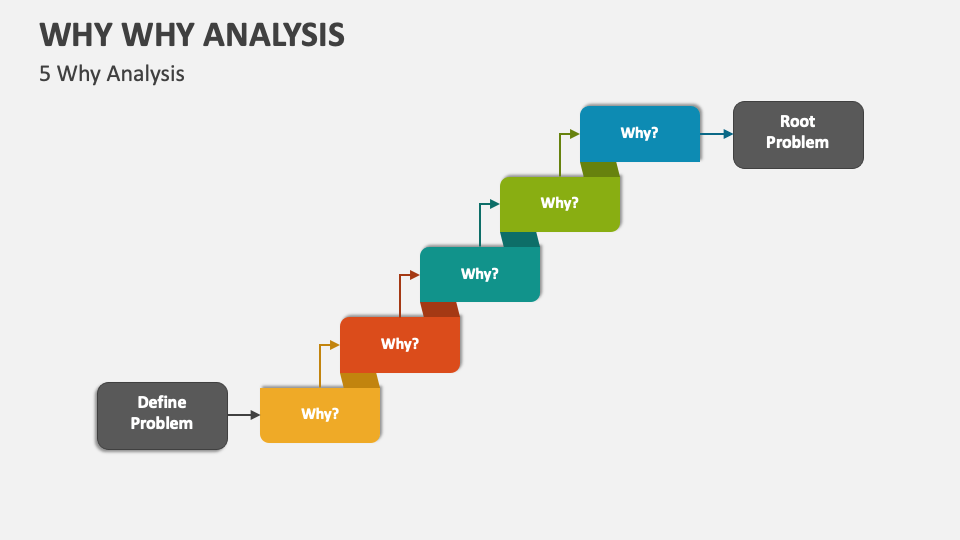
Points to note when why-why analysis does not go well
Why analysis is a very effective method for fundamentally solving problems, but sometimes it doesn’t work. If your 5-5 analysis is not working, please keep the following points in mind.
Is the problem you want to solve unclear?
First, one of the reasons why why-why analysis does not work is that the problem you want to solve remains vague. 5 Why analysis is performed to identify the root cause of a problem, but if the problem you want to solve is ambiguous, you will not be able to identify the cause and it will not work.
For example, let’s say you have a problem with your employees’ lack of motivation. However, this alone does not identify the problem. It is necessary to identify the specific problem by investigating the cause of the decline in motivation.
Are personal feelings or beliefs included in the analysis?
5 Why analysis requires finding problems from an objective perspective and deriving solutions. However, care must be taken as the person performing the analysis may base their analysis on personal feelings and beliefs.
For example, a boss may become very angry about an employee’s mistake and treat the employee like a problem child. In this case, you may end up identifying the problem based on your boss’s anger. But why-why analysis requires identifying factual rather than emotional issues.
The answer remains ambiguous, so why is the analysis not progressing?
A 5-why analysis is performed to clarify the answer, and if the analysis continues without the answer being vague, it will not fulfill its original purpose. As you proceed with your analysis, you will not be able to get to the essence of the problem, and in the end, time will pass without you being able to find a solution.
Possible reasons for proceeding with a why-why analysis with an ambiguous answer include insufficient information collection or problems with the way the analysis is proceeding. If information is insufficiently collected, information related to the essence of the problem may not be collected. Additionally, if there is a problem with the way the analysis is proceeding, it may not be possible to proceed with the analysis in an appropriate manner, and the answer may become ambiguous.
In such cases, it is effective to use other analytical methods in conjunction with other analysis methods to gather information related to the essence of the problem and clarify the answer. For example, tools such as the Four What Map (4W1H) and Fishbone Diagram can be used to analyze the essence of the problem in more detail.
Is your analysis based on mere speculation?
It is important that your 5-why analysis is fact-based, rather than based on speculation or imagination. If you perform analysis based on mere speculation, you will end up focusing on problems that are different from the actual problem, and you will not be able to find the correct solution.
In order to conduct a fact-based analysis, it is necessary to collect data and use it for analysis. The data includes the situation in which the problem occurred, the extent of its impact, and the events that caused it. Additionally, statistical analysis can help identify the cause of the problem.
Are you making it a personal problem?
When your analysis doesn’t go well, be careful not to make it a personal problem. This is because when analyzing a problem, you may lose an objective perspective because you are involved in the problem yourself.
For example, if a team is faced with a problem that progress on a project is falling behind, the team leader may make it a personal issue, saying, “We’re behind because I forgot to give instructions.” . This makes it impossible to objectively determine the cause of delays and does not lead to problem resolution.
If it’s a personal issue, collaborate with other team members to analyze the problem objectively. To achieve this, it is necessary to determine the essence of the problem and seek solutions.
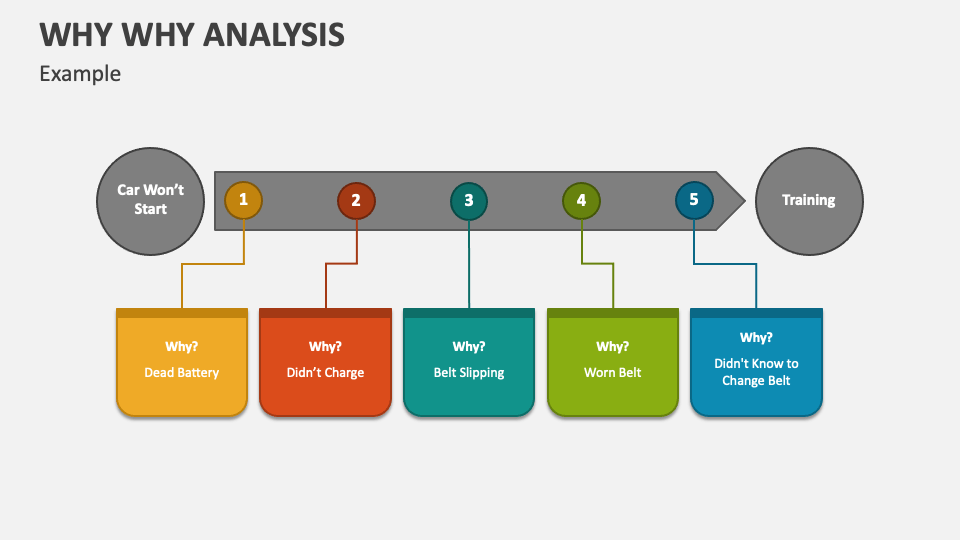
Tips for performing why-why analysis on corporate problems
Problem solving is an essential task for companies. At that time, effective use of why-why analysis can help you solve problems smoothly. Here, we will introduce the points to consider when conducting a why-why analysis of a company’s problems.
Analyzes are carried out by multiple people involved in the business.
When conducting a 5-5 analysis of a company’s problems, it is important that multiple people involved in the business conduct the analysis. By working with multiple people, you may be able to see the problem from more diverse perspectives and find solutions, rather than working alone.
For example, if a problem arises in which the defective rate of products is increasing at a manufacturing factory, all parties involved, including production line personnel, quality control personnel, and product designers, should gather together and analyze the problem. , you can find deeper causes and solutions.
However, when multiple people perform an analysis, disagreements and communication issues can occur. Therefore, it is important to share in advance how to proceed with the analysis and how to summarize opinions. It is also necessary to create an atmosphere where each member can speak freely and create an environment where everyone can easily participate.
Compare it with the actual situation.
When conducting a why-why analysis of a company’s problems, it is important to compare it with the actual situation. By understanding the actual problems occurring on-site and analyzing them, we can come up with more specific solutions.
When comparing the results with the actual situation, it is important to understand specific data and examples and perform analysis based on that. It is also necessary to accurately understand the actual situation and issues at the site while communicating with on-site staff and related parties.
Eliminate personal elements
When conducting a 5-5 analysis, it is important to exclude personal opinions and subjective judgments. Analyze the issue objectively, avoiding placing blame on anyone or reflecting personal preferences.
For example, when sales of a certain product drop, a company employee may claim that the cause is “bad product design.” However, if the employee is in charge of the design themselves or has specialized knowledge about product design, their claims will lack objectivity.
In such cases, it is necessary to have discussions among people from multiple viewpoints in order to objectively view the issue. Additionally, by utilizing data and statistical information, it is possible to eliminate subjective judgments and perform analysis based on objective facts.
Furthermore, by eliminating personal factors, it is possible to clarify changes and improvements needed to solve problems. Analysis results that reflect personal opinions and subjective judgments do not clarify the issues and importance of issues needed to solve problems, making it impossible to develop accurate countermeasures.
Do not combine multiple elements
When performing a why-why analysis, it is necessary to break down the problem being investigated into small pieces and explore the causes one by one. Therefore, if you combine multiple factors into one, you may not be able to find the true cause and the solution may be inadequate.
For example, let’s say a company has a problem with declining sales. Let’s say that when you perform a why-why analysis and find the cause, you get the following results.
If we conclude that cost cutting is the cause, we will not be able to identify the cause and the solution will be inadequate. Therefore, it is necessary to identify the true cause and formulate a solution by breaking down each element one by one.
Is the solution a solution that all employees can work on?
Finally, an important point when performing a 5-5 analysis is to ensure that the solution is one that all employees can work towards. This is because solutions found through analysis are meaningless unless they are actually implemented. Also, even if a solution is implemented, it will not solve the company’s problems if its impact is limited.
So you need to make sure that it’s a solution that the whole company can work on. For example, if a solution is limited to a specific department or job, or if the budget and resources required to implement it are limited, it may not be a solution that all employees can work on.
In order to find solutions that the entire company can work on, it is important to gather opinions from a wide range of people, including people from multiple departments and job types who participate in the analysis. In addition, to confirm whether the solution is feasible, you need to consider budget, resources, company rules, etc., and then create a plan that is actually executable.

Free Format Template for Why-Why Analysis
Here are some companies that offer free formatting templates for why-why analysis.
Why Why Analysis Template – Miro
Miro is a software company co-headquartered in Amsterdam and San Francisco. Furthermore, we are rapidly becoming a global company with branch offices around the world, including Tokyo, Sydney, London, and Paris.
The why-why analysis templates provided by Miro are color-coded and are very easy to read.
Why Why Analysis Template – Miro
Why Why Analysis Template – ATLASSIAN
ATLASSIAN is a software company headquartered in Sydney, Australia. We mainly develop and sell software related to project management and issue management for corporations.
As a company that specializes in project management and issue management, the why-why analysis templates are also created in detail.
Why Why Analysis Template – ATLASSIAN
Why Why Analysis Template – Dolly Blog
Dolly Blog is a personal blog that mainly posts business-related and self-development-related content. It also has a lot of content on business frameworks and offers many free templates in addition to the 5-why analysis template.
This why analysis template is very simple and easy to understand, so if you find other templates complicated and difficult, we recommend this template first.
Dolly Blog

Logical thinking skills you need to acquire before doing why-why analysis
Logical thinking is one of the techniques you should acquire in order to proceed with why-why analysis logically and effectively. Below, we will explain logical thinking in detail.
What is logical thinking?
Logical thinking is called “logical thinking method” in Japanese, and is a way of thinking that objectively grasps the relationships between phenomena and uses this to understand things and solve problems.
Logical thinking is a logical, consistent way of thinking that makes it possible to develop thoughts that are not influenced by feelings or subjectivity.
Benefits of logical thinking
Logical thinking has the following advantages:
I can express my thoughts simply
The ability to convey your ideas simply and clearly is essential in situations such as presentations. If you can’t do this, you may end up wondering, “What do you want to say?”
Even if your thoughts seem disorganized at first, if you use logical thinking to organize them in an orderly manner, you will be able to convey the main points to your listeners in an easy-to-understand manner.
Improve problem-solving skills
When you can effectively use logical thinking, you improve your ability to accurately understand the cause-and-effect relationships between events, which in turn improves your problem-solving skills.
In addition, improving your problem-solving skills will increase your work productivity, which in turn will improve your overall ability.
Disadvantages of logical thinking
Logical thinking is effective in logically deriving solutions, but it is not a way of thinking that can determine whether the preconditions for something are correct or incorrect in the first place. In other words, if the assumptions are wrong in the first place, you may not reach the appropriate conclusion.
To avoid such situations, when proceeding with analysis using logical thinking, it is important to first determine whether or not the premise is correct.
Characteristics of logical thinking
Characteristics of logical thinking include:
I am nervous about my way of thinking and its claims
One of the characteristics of logical thinking is that the way of thinking and its claims make good points. A framework called “Pyramid Structure” is convenient to proceed with the way of thinking.
In the pyramid structure, the conclusions are placed at the top of the triangle, and the basis of the basis is arranged at the bottom. The conclusions and grounds are diagramized in pyramids, making things visually captured, making it easier to develop logic.
No subjectivity intervenes
Logical thinking is a method of thinking that is performed by logic, so you must not enter your own subjectivity or emotion. Cognitive bias and halo effects are eliminated, and vague results based on intuition and empirical rules are eliminated.
Rational
It is also a major feature that it is reasonable in logical thinking. It is important to determine the priorities accurately and process them in order from the right tasks, rather than starting to solve the problem.
Think while disassembling the elements
In logical thinking, various information and logic are disassembled in the process.
What you need to be aware of when you disassemble is “overlapping and leaks”. These must be eliminated, as there is a contradiction in the results if there is an information and logic overlap or leakage in the same task.
The useful framework is “MECE”. MECE is written in English as “Mutualy EXCLUSIVE AND COLLECTIVELY EXHAUSTIVE” and means “there is no leakage as a whole without overlapping each other.”
By utilizing this MECE framework, information and logic can be disassembled without overlapping.
Correct understanding of the cause and results
It is also important to understand the relationship between the cause and the result correctly in logical thinking. It is possible to solve fundamental problems only after being able to grasp the true factors that have caused the events without being caught by biased ideas or subjectivity.
Accurate use of words and numbers
In logical thinking, the definition and numerical value of the words must be taken correctly and treated properly.
For example, when ranking in a group or group, the result depends on whether “absolute evaluation” or “relative evaluation” is used, but if the definition of the two is incorrectly recognized. You cannot guide you with the right conclusion.
In this way, the appropriate perception of words definitions and numbers also have an important meaning in logical thinking.
Logical thinking is a very effective way to analyze logic because of the above features. Why don’t you use it to make the analysis more meaningful.

What is why-why analysis? Summary of meaning, method, tips, and procedures
This time, I have explained “Why and why analysis”. “Why and why analysis” is a very effective way to solve the problem. With this method, you can find out not only on a superficial problem but also for the fundamental cause.
By using this method, you can eliminate emotional aspects in decision -making. Therefore, you can solve problems more objectively.
In order to perform “why and why analysis” effectively, it is important to clearly specify the problem and perform an objective analysis. In addition, it is necessary to connect and think about analysis, and you should avoid leaving the answer ambiguously.
When analyzing for corporate issues, it is important to analyze with multiple people involved in the business and to compare them with the site. It is also necessary to eliminate personal elements and find solutions that all employees can work on.
There are various methods for solving problems, but “why analysis” is very useful because it can solve the problem objectively. Please refer to this content and work on solving problems.