

Analyze search intent and use SEO-effective keywords in your content
Google is currently the leading search engine used around the world.

One of Google’s policies is to “put user convenience first.”
In other words, content that can satisfy the “search intent” of why users search will be evaluated by Google.
This time, let’s take another look at SEO measures that focus on user search intent and keywords, which are extremely important when launching owned media.
The importance of analyzing search intent in SEO measures
Google uses over 200 factors, algorithms, etc. to evaluate content.
The algorithm is not fixed and will be updated to the optimal version.
Due to algorithm updates, the display ranking of content will change significantly.
A large-scale algorithm update was carried out in 2019, and a lot of content has experienced ups and downs, and analyzes are being conducted to determine why the rankings have increased and why the rankings have decreased.

Improving content through analysis is necessary for
SEO
measures.
It would be difficult to reveal all of Google’s 200+ factors and algorithms, and we don’t know when updates will be made.
Amongst the uncertainties, one thing that is clear is one of Google’s policies: “We put user convenience first.”
Analyzing user search intent and rewriting content to improve its quality is important for SEO.

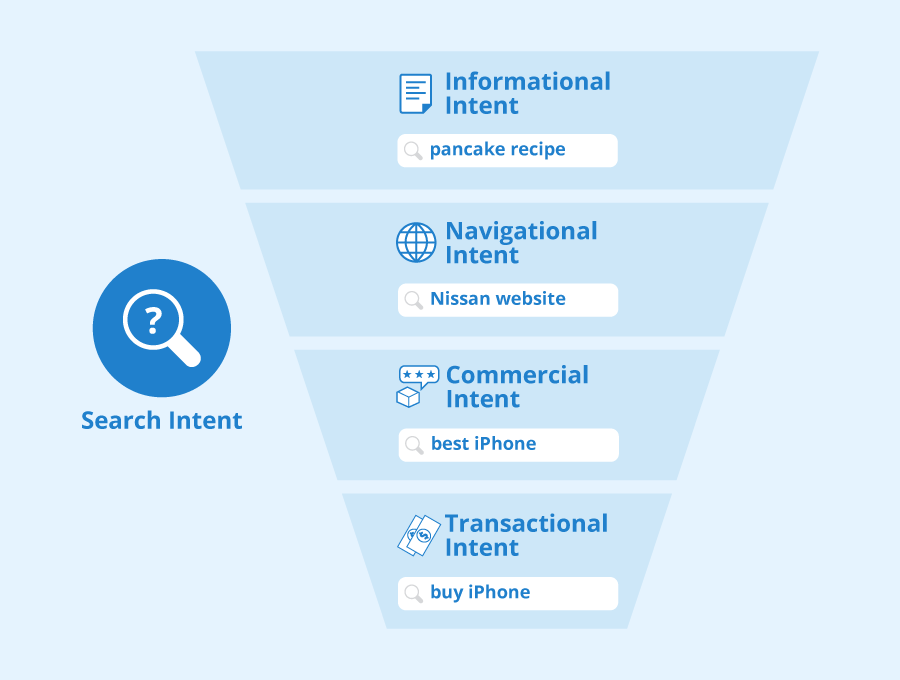
Google considers the four search intentions of users
Let’s take a look at how Google considers user search intent when considering SEO measures.
I want to know
The moment a user wants to know something, they search.
For example, users use their smartphones to search for something they saw on TV.
i wanna go
Users search when they want to go to a destination.
Every day, people use their smartphones to search for places they want to go, such as “where the user is currently located, ○○ nearby”.
Search engines are also used when searching for restaurants and other shops.
I want to do it
Users search for ideas the moment they want to do something, whether it’s business or personal, or when they’re already doing it.
A lot of YouTube’s “how-to” content is viewed through search engines.
I want to buy it
Users search the moment they want to buy something.
More and more people are purchasing products and services through searches.

How to aim for SEO effect with keywords?
If there are keywords in your content that are low in search rankings, check the search intent of the keywords and rewrite the content to be more valuable to users.
First, perform a keyword search and find out the search intent from the content of the top articles.
Keywords with search intent of “I want to know”

If the search intent of the keyword is “I want to know”, the advertised article that is normally displayed will not be displayed at the top of the search results page.
Since the content of an article whose search intent is “I want to know” must be an answer, there are many cases where keywords are not necessarily included in the titles of the top articles.

Keywords of desired search intent
If the keyword search intent is “I want to go,” a map will be displayed at the top of the search results page.
This is evidence that Google has determined that the search intent is “want to go”.
When rewriting articles for the keywords you want to visit, it’s a good idea to consider the relationship between the keywords and the location, as well as reviews.
Keywords of desired search intent
If the keyword search intent is “I want to do something,” the top articles on the search result page will include “easy/easy,” “do it yourself,” “try it,” “get started,” “method/how to do it,” “procedure,” “materials,” and “tips.” It is characterized by a list of sub-keywords related to how-tos, such as “Notes” and “Videos/Images.”
Keywords with search intent to buy
If the search intent of the keyword is “I want to buy”, a series of advertising articles will appear at the top of the search results page.
Users with search intent to buy will likely select advertising articles that lead to purchase.
The search ranking for the keywords you want to buy seems to be based on “selling order” or “order of good reputation” with the user’s convenience in mind first.

Related search keywords

Several “related search keywords” are listed at the bottom of the keyword search results page.
You can see that some of the related search keywords match the content of the top articles.
Please use this as a reference when rewriting the article.
Suggested word
Enter a keyword in the Google search keyword input field and left-click to see suggested words.
This will also serve as a reference for rewriting the article.

Points to note when using keywords in content
It is important for SEO to analyze the content of the top articles displayed as a result of a keyword search, confirm the user’s search intent, and create content.
However, if the content is similar to the higher-ranked articles, there is a high possibility that it will be considered duplicate content, so you cannot aim for higher rankings.
Your content must be unique and unique.

summary
◆ One of Google’s policies is to “put user convenience first”
◆ Content that can satisfy the “search intent” of why users search will be evaluated by Google.
◆ Analyzing user search intent and rewriting to improve the quality of content is important for SEO.
◆ Google considers the four search intentions of users as “I want to know,” “I want to go,” “I want to do,” and “I want to buy.”
◆ It is important for SEO to analyze the content of the top articles displayed as a result of a keyword search, confirm the user’s search intent, and create content.
◆ Content must have uniqueness that other content does not have.