

What is “
marketing
”? When asked this question, many people may find it difficult to immediately give a clear answer.
There are various reasons for this, but one of the major reasons is that the concept of the word “marketing” and the phenomena it encompasses are extremely broad, and the concept itself has various layers (levels). can be mentioned.
As a result, words such as “○○ marketing (or marketing ○○)” are overflowing on the streets, and some words have been conceptually organized by academics, while others have been coined by people whose business is marketing consulting and
solutions
. words are mixed.
There are too many examples to list, but there are ”
digital marketing
,” “SNS marketing,” “WEB marketing,” “video marketing,” ”
influencer marketing
,” “buzz marketing,” “data-driven marketing,” “neuromarketing,” etc. …Even if you arrange them in any way you can think of, it seems like more will come out.
There are various terms such as “○○ marketing”,
each of which deals with a different level of phenomenon or concept, which can confuse people with no marketing experience or beginners.
To make matters even more complicated,
not all words have clearly differentiated meanings; some have things in common, while others may look the same but have slightly different nuances.
This time, for those who are wondering, “What is marketing after all?”,
we will confirm the basic definition of marketing, and explain the hierarchy (levels) of the marketing concept that you should understand. , I will explain the perspective of marketing as management.
What is marketing? An overview of the history of the modern marketing concept.
Establishment and development of marketing in Europe and America
Before we get into the discussion of the definition of marketing itself, let’s first check the background of marketing by looking at how marketing was established and the historical changes that led to the establishment of modern marketing. Let’s. If you are not very interested in the history and evolution of marketing, please skip this section and read on to
the next section
.
There are various theories about when marketing was established and its trajectory, and the way we define “establishment” changes depending on the level of granularity and context in which
we
view marketing. In this article, I would like to mainly focus on modern industrialization since the early 20th century.
Generally speaking, marketing as a phenomenon or activity was born in the era when industrialization of mass production and mass consumption accelerated with the birth of the Model T Ford in the United States in 1908 and the establishment of the automobile industry. It is said that there is.
On the other hand, marketing as an academic discipline was developed in the first half of the 20th century by A.W. Shaw (1912; 1915; 1916), an entrepreneur and business theorist, and R.S., who worked at companies such as P&G and General Foods. The theory is said to have been established by practitioners such as Butler (1914; 1917; 1925) based on their own experiences.
Additionally, it is generally believed that the academic field of business administration was fully established after the publication of Frederick W. Taylor’s “Scientific Management” (Taylor, 1911), and coincidentally, it occurred between the 1910s and 1920s. It can be said that this era was a time when management and marketing greatly developed both in practice and theory.
However, business administration and marketing, which both began to develop around the same time, have different points of emphasis, although they both focus on actual corporate activities. For example,
Taylor’s scientific management method focuses on production management, which is a management method that improves efficiency and productivity by objectively and scientifically analyzing the work processes of factories and factory workers. I did.
After Taylor’s scientific management method, the Hawthorne Study (1927-1932) led by management scholars such as G. E. Mayo and F. J. Roethlisberger, and the 1938 study by Chester, I. Barnard, a pioneer in organizational theory. With research results such as “The Role of Managers” and “Organizations” by March & Simon (1958), business administration expanded its field from production management to issues of organizations and people, and after 1960, H, Modern management strategy theory
was
established by world-leading management scholars such as I. Ansoff, A.D. Chandler, and Michael Porter.
On the other hand,
Shaw focuses on the structure of product distribution and sales, or corporate sales management, and focuses on issues such as rationalizing a company’s sales activities, while Butler focuses on methods for managing product development and sales management. , focuses on more practical marketing activities such as campaign design.
In the time of Shaw and Butler, modern media (television, radio, magazines, etc.) had not yet become widespread,
and
they basically dealt with issues related to manufacturing and distribution.
The logic of practitioners such as Shaw and Butler became widespread as a marketing method, and marketing research as an academic or scientific field later became active. In 1959, management scholar Neil H. Borden termed the combination of various means, from product development to sales and advertising, the `
`marketing mix
” to carry out marketing activities. It shows that it is an activity.
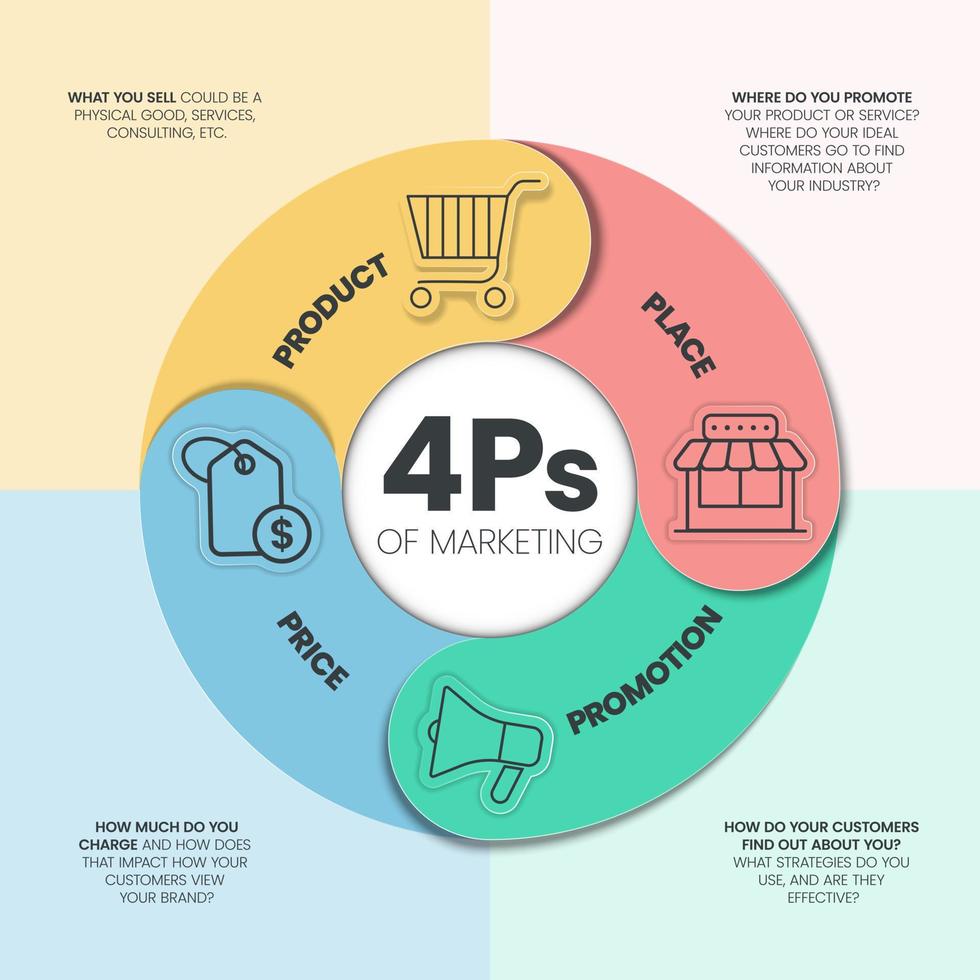
Around the same time, in 1960, marketing researcher E. J. McCarthy proposed the famous 4Ps framework. Since the arrangement by McCarthy, the marketing mix has generally been considered to be the integrated management of marketing consisting of the 4Ps (Product, Price, Place, Promotion)
iv
. 4Ps was widely accepted around the world because it was a framework that concisely classified items managed in marketing operations in the manufacturing industry at the time. Therefore, even today, the 4Ps is one of the first frameworks that many marketing beginners are taught.
By the way, there are many marketing professionals who mistakenly believe that the concepts of the marketing mix and 4Ps were proposed by
Phillip Kotler
, who is known as the “father of modern marketing.” , Kotler is not the creator of these concepts. Kotler’s greatest achievement was the publication of Marketing Management
V
in 1967, in which he systematically summarized the practice and theory of marketing, which had been expanding and subdividing into various fields, and incorporated it into both academic and practical fields. It has spread widely throughout the world. In other words, Kotler can be said to be a person who comprehensively and systematically compiled the knowledge of the time that spanned the academic and practical aspects of marketing.
So far, we have reviewed a brief history of how Kotler’s “Marketing Management” came to be, which is widely read by businesspeople, academics, and students even today.
As mentioned above,
Kotler has systematized the 4Ps and STP, which are considered the basis of marketing, and various marketing-related concepts to some extent.
Furthermore, the content of “Marketing Management” is revised regularly, and Kotler has frequently published books such as “
Marketing We continue to expand and deepen our efforts.
Therefore, it may be difficult in reality to comprehensively understand all the knowledge in the field of marketing. However, if a beginner in marketing wants to understand marketing practice and theory in a somewhat systematic manner, the first step is to read through Kotler’s latest “Marketing Management”, although I think the amount of text is too much. We recommend that you re-read the parts you don’t fully understand.
I would like to discuss the recent developments in marketing research and their research results on another occasion.
Development of marketing in Japan
As a side note, I have described the general changes in marketing in the United States, so let’s briefly touch on what happened in Japan. In this section, we will not focus on the development or content of domestic marketing theory itself, but rather will provide a general understanding of the background of the development of marketing in Japan by reviewing historical events in the country and the founding dates of Japan’s leading companies. The purpose is
vi
.
Following Perry’s arrival in 1853, Japan officially opened its doors to the world by signing the 1868 Treaty of Japan, Spain, but from then on until the end of World War II. It is no exaggeration to say that Japan was basically at war with the rest of the world.
As mentioned earlier, with the birth of the Model T Ford in 1908, a large-scale manufacturing industry that engaged in mass production and mass consumption was established in the United States. On the other hand, Japan at the time was engaged in wars every 10 years, such as the Sino-Japanese War in 1894, the Russo-Japanese War in 1904, and World War I in 1914. In Japan during this period, the Meiji government advocated the idea of “rich country and strong soldiers,” and there was a strong movement towards centralization, so there was not a foundation in place for private companies to develop and grow on their own like in Western countries. You could say that.
However, even though Japan was in the mood for such a battle, several companies that represent Japan were born even today. For example, in 1872, Mr. Arinobu Fukuhara founded Shiseido, the first Western-style pharmacy in the private sector
.
In addition, Mr. Shinjiro Torii
founded
Torii Shoten (currently Suntory Holdings Ltd.) in 1899, and Kao Corporation, where I work, was founded by Tomio Nagase, the predecessor of Kao. Tomio Shoten was founded in 1887, and in 1890 Kao soap, Kao’s signature product, was introduced to the world. In this way,
from the end of the 19th century to the beginning of the 20th century, the consumer goods manufacturing industry, such as cosmetics and alcoholic beverages, which continues to this day, began to emerge in Japan
.
While Japan’s manufacturing industry was budding, Japan’s distribution and media industries were still underdeveloped at this time.
The full-fledged development of distribution in Japan began with the rapid spread of department stores in the 1920s and 1930s, which laid the foundations for Japan’s modern retail industry. However, at this time, it was far from a modern retail format like a chain store, and the breadth of its sales network was still limited. Huge modern sales networks spanning the country are said to have been established in the 1960s and 1970s with the rise of new retail formats such as supermarkets and convenience stores (Hirano, 2005).

On the other hand, regarding the domestic media environment, radio broadcasting began in the 1920s, a nationwide newspaper network was established in the 1940s through the consolidation of newspaper companies, and in the 1950s, NHK and Nippon Television began television broadcasting, and weekly magazines It developed in stages, with the spread of magazine culture as the publication format became established (Yoshimi and Mizukoshi, 2004; Mizukoshi, 2014; Tsuchiya, 2017; Sato, 2018).

From the postwar period until the 1970s, the spread of huge sales networks and media encouraged mass consumption, and the manufacturing industry, primarily consumer goods, achieved dramatic growth by leveraging the power of distribution and mass media. Ta.
Kao also strengthened
its
sales network by establishing its first wholesaler specializing in Kao products in 1966, and from the 1970s to the 1980s began marketing its “Benefits,” which are still used by many people today. , “Magicline,” “Laurier,’
‘
“Biore,” “Sofina,” and “Attack,” among other brands, and has achieved dramatic growth by implementing marketing management that spans multiple categories.xi Former Kao Chairman Kozaburo Sagawa, who supported Kao’s growth, spoke about the reality of marketing in this era in his 1992 book “New Marketing Practices.”
“The concept of marketing was developed in the early days of the “industrial age” in the 1920s, and it first became production-oriented and then moved to a sales-oriented approach, but in any case, it focused on producers and mass production. It is thought that it has been understood as a management technique that supports mass sales and the distribution of large quantities of products and services to consumers. At that time, the reality of marketing at that time was advertising and sales promotion techniques using mass media, which were rapidly developing, and related research techniques. ” (Sagawa, 1992, pp.50-51)
From the above,
modern mass marketing in Japan imported marketing concepts from the United States after World War II, and was gradually established from the 1950s to the 1970s along with the development of the distribution and media environment described above. I can say that it was.
Furthermore, Sagawa (1992) points out that since the 1970s, marketing has come to be understood as a system technology at the social level.
Up to this point, I have described the general flow before Kotler (1967), when modern marketing was established, and the events that formed the background to the establishment of marketing in Japan. In the next section, I would like to review the modern definition of marketing based on the AMA (American Marketing Association) definition, while also keeping in mind the points made by Sagawa (1992).
marketing definition
As mentioned in Section 1, there are various backgrounds to the creation of marketing. In particular, until the systemization of marketing theory in Europe and the United States around 1960 to 1970, and the establishment of modern distribution networks in Japan, the basic principles were production (manufacturing) management and sales management (salesmanship theory and sales management). management theory) was a central issue in marketing.
As technology and society develop, the phenomena that marketing deals with are expanding, and the points of discussion in marketing theory are also expanding. Along with this, the definition of marketing itself has changed with the times.
There are various organizations related to marketing in Japan and overseas,
but one of the most authorized organizations among them is the AMA (American Marketing Association)
xii
. The AMA has revised the definition of marketing several times, and the following is a list of them [Table 1].
|
Publication year |
Original text |
Japanese sentence |
| 1948 / 1960 | Marketing is the performance of business activities that direct the flow of goods and services from producer to consumer or user. | Marketing is the performance of business activities that directs the flow of products and services from producers to consumers or users. |
| 1985 | Marketing is the process of planning and executing the conception, pricing, promotion, and distribution of ideas, goods, and services to create exchanges that satisfy and organizational objectives. | Marketing is the process of planning and implementing the conceptualization, pricing, promotion, and distribution of ideas, products, and services to create exchanges that meet the objectives of individuals and organizations. |
| 2004 | Marketing is an organizational function and asset of processes for creating, communicating, and delivering value to customers and for customer relations in ways that benefit the organization and its stakeholders. | Marketing is an organizational function and set of processes that create, communicate, and deliver value to customers and manage customer relationships in a manner that benefits the organization and its stakeholders. |
|
2007 / 2013 Approved in 2017 |
Marketing is the activity, set of institutions, and processes for creating, communicating, delivering, and exchanging offerings that have value for customers, clients, partners, and society at large. | Marketing is the activity, system, and process of creating, communicating, and exchanging offerings of value to customers, customers, partners, and society in general. |
[Table 1] Definition of marketing by AMA, quoted from Takahiro and Fujikawa (2016) Hitotsubashi Business Review, with some additions
As you can see from Table 1, the original definition of marketing announced in 1948 emphasized the “flow of products and services,” and as already explained, there is a strong tendency to view marketing as sales. I think so. Since then, according to the 1985 definition, there has been a growing awareness of the marketing mix with an awareness of the so-called 4Ps and the management of integrated marketing operations as an organization. In the definition announced in 2004, the focus was revised to include the creation and provision of value and the series of processes that manage it, and compared to the previous definition, the scope covered was further expanded. Masu.
The definition announced in 2007 and approved in 2017 will be the latest definition as of January 2024, but in this definition, marketing can be seen as something more social. You can.
In addition, Takahiro and Fujikawa (2016) point out that a noteworthy point in the definition of marketing is that the definition until 2004 considered sellers such as companies and organizations as the subject, but in the latest definition, the subject I am pointing out the points that are missing. What this means is that,
in the latest definition of marketing, marketing is no longer limited to a relationship in which the company is the main subject and the customer is the object, and the customer side who is the buyer is also considered to be responsible for marketing activities. Takahiro and Fujikawa point out that they have come to understand this.
Incidentally, Sagawa (1992) also said, “Although the idea of consumer-oriented marketing had already existed since around 1930, it was ultimately a concept seen from the manufacturer’s perspective, based on the AMA’s definition of marketing in 1960. It’s clear to see,” he says, referring to the 1990s when marketing was viewed as biased from the producer’s perspective.
In this way, the definition of marketing itself has changed over time. As mentioned above, the latest definition goes beyond the concept of simply manufacturing and selling products, and considers marketing to include the interactions between various actors in society, and the sum total of these activities. .
If the phenomena and concepts that marketing deals with are expanding, then it may not be possible to say that all of the “○○ marketing” (or marketing ○○) that is all over the place is wrong.
However,
most of the “○○ marketing” that is being talked about in the street is mostly referring to the operational level of marketing management.
In the next section, we will explain the three hierarchies of marketing: those that view marketing as management or strategy, those that view marketing as business or departmental management, and those that view marketing as daily practice.
Marketing = Management? ~Differences in the level of marketing concepts and characteristics of managerial marketing~
What is marketing? When asked this question, I think many experienced marketing practitioners and managers would answer, “It’s management itself.” For example, as of January 2024, Mr. Hikaru Adachi, who is the CMO (Chief Marketing Officer) of FamilyMart Co., Ltd., has mentioned in interviews and in his own book that “marketing is business.”
This way of thinking about marketing as management itself is called “managerial marketing.” In marketing studies, it is often translated as “managerial marketing” (Morishita and Arakawa, 1966; Hashimoto, 1968; 1973; 1975). On the other hand, “marketing management” literally translates to “marketing management.”
Many people have probably heard of the term marketing management, but the term managerial marketing may not be as familiar to the general public. What is the difference between the two?
In conclusion,
managerial marketing considers the company’s strategy itself as marketing, and involves decision-making by managers
.
On the other hand, marketing management refers to marketing activities and management operations carried out by the marketing department and other functional departments. Furthermore, the day-to-day marketing operations carried out by departments, teams, and personnel under the department are called marketing operationsxiii
.
For example, Kotler et al. (2021) discuss these level differences: “Marketing planning and management typically occurs at three different levels: the company, the business unit, and the specific market offering. The company is responsible for designing the corporate strategic plan that guides the entire company, deciding how much resources to allocate to each business unit and which businesses to start or eliminate. Develop a plan to guide the market toward a profitable future.Finally, each market offering includes a marketing plan to achieve its objectives.
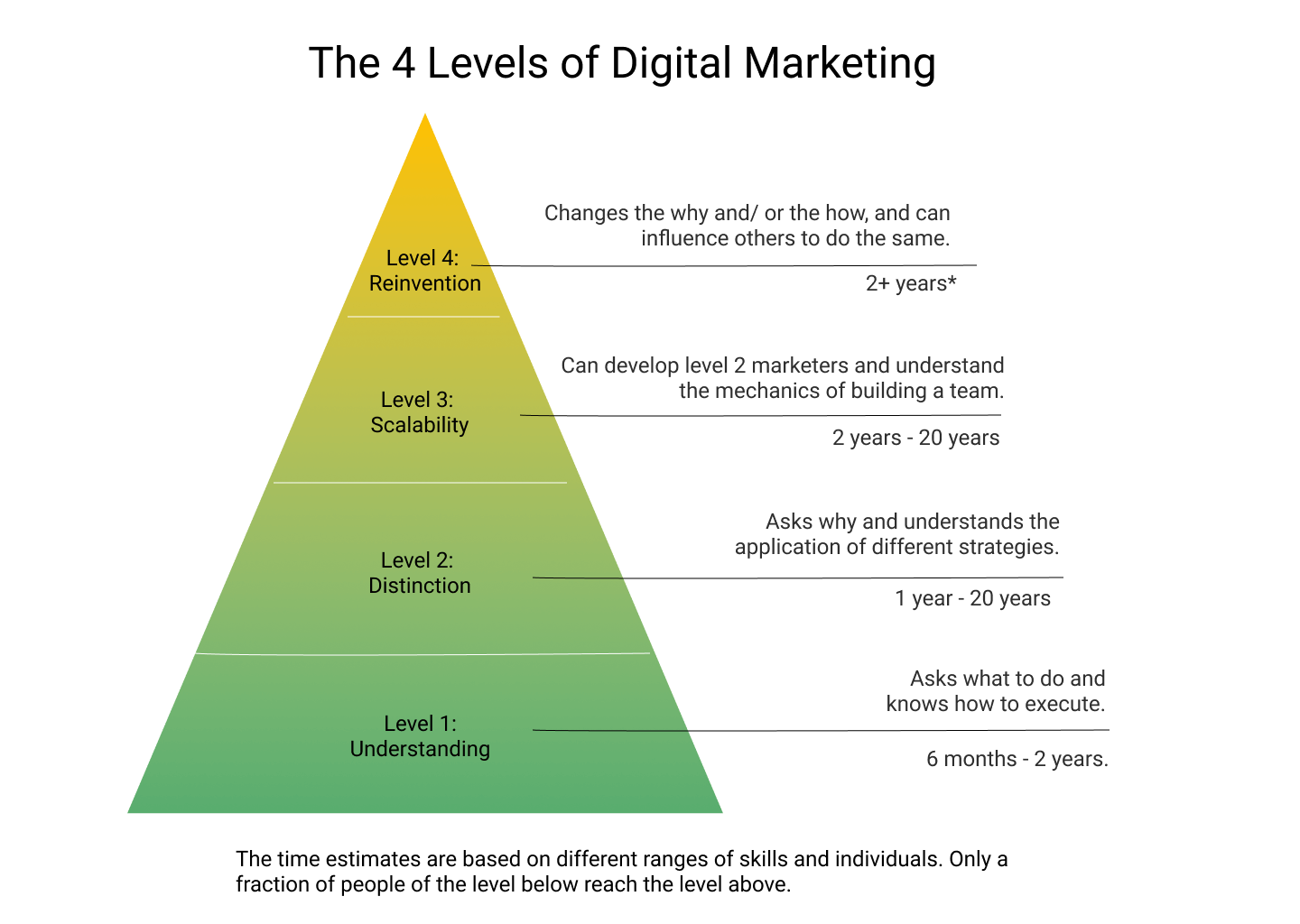
It may be a rough idea, but if you think of it more closely to the image of practitioners, the corporate strategy level referred to by Kotler et al. above is managerial marketing, the business planning level is marketing management, and the marketing planning level regarding market offerings is I think you can think of it as marketing operations.
In any case,
the important thing is to first recognize that the concept of marketing exists at three levels: the management strategy level, the business planning level, and the operational level.
What we must be careful about is talking about business-level solutions and problem solving as “strategy.” As I have mentioned many times, most of the “○○ marketing” that is out there is often a business-level solution, not a strategy.
If you are reading this article, when you use the word marketing in your daily life, what level are you talking about? Just making this distinction will change the way you think about marketing. I think it is.
However, among these three levels, marketing management and marketing operations may be easier to get a concrete image of if you have experience in marketing, but management such as managerial marketing It may be difficult to grasp the concept of level marketing orientation.
Below, I would like to confirm the characteristics of the concept based on existing marketing research for those who would like to go a little deeper into understanding the concept of managerial marketing.
Regarding the characteristics of managerial marketing, Morishita and Arakawa (1966) and Hashimoto (1973), who are authorities in domestic marketing history and academic research, state the following:
(1) Conventional marketing theory, that is, socio-economic marketing theory, focused on social distribution processes or systems and institutions, but
managerial marketing theory focuses on corporate behavior. As a result, it began to cover the “logic of corporate management behavior.”
(2) Significant changes and characteristics were also exhibited within corporate marketing theory. In other words,
it has evolved from the traditional “doing” or “operative” problem to an administrative problem.
(3) Among management issues, the scope of management has expanded and evolved from departmental management to overall management and integrated management. In other words, sales management further became marketing management, and
company-wide management coordination issues emerged.
Therefore, marketing has now
become integrated marketing, and has become total marketing,
rather than the traditional discrete techniques.
(4)
In line with the expansion of the management area, the management body also rose, moving from front-line junior managers to senior managers.
In other words
, instead of sales managers, marketing managers emerged who were in charge of overall management, and marketing became managerial marketing
.
(5) Along with this, marketing has become not just a technology, but also a guiding philosophy for the entire company, and has become the philosophy or viewpoint of management.
(6)
New marketing is now related not only to product planning but also to long-term business planning and investment planning, and has now become marketing from a strategic perspective.
In other words, the central issue has become not just execution, but problem-solving and decision-making that involves uncertainty, especially planning, which is decision-making regarding the future course of a company.
[Source: Morishita and Arakawa (1966) pp. 31-32. and Hashimoto (1973) pp. 45-46.]
The above is a direct quotation from the characteristics of managerial marketing in academic books, so it may be difficult to understand even if you read the text. The important points are shown in bold in the quotation, but I will summarize them briefly below.
The first characteristic is that with the advent of the concept of managerial marketing, the concept of marketing, which had a strong economic flavor and dealt with issues related to social mechanisms and structures, shifted to a management-oriented issue that dealt with the internal aspects of companies. That’s it.
Second, with respect to various activities such as manufacturing and sales, whereas the previous marketing concept focused on an operational perspective such as individual sales methods, managerial marketing combines these activities in a more organized manner and integrates them. This is the point where the discussion has shifted to one that emphasizes management.
Thirdly, manufacturing management was a manufacturing issue, and sales was a sales issue.In contrast, in managerial marketing, these are all issues that should be managed cross-functionally by the upper management of the company. It has changed to a view that there is.
These changes have strengthened the idea that marketing is not just a concept of business management, but a business decision -making problem linked to a corporate strategy. Therefore, as shown in the features (5) of the quoted (5), the management marketing is a concept that includes problems such as the philosophy of corporate decision -making.
For those who are reading this article, for those who have been working in a company where a position such as a CMO or a marketing department is clearly present and has been transferred to authority. You may find it natural to make decisions with marketing orientation, or that marketing departments integrate brands and business management.
Alternatively, you may have felt that the marketing department and CMO practice marketing, but that the management does not understand marketing, that is, the company lacks a monument marketing perspective.
However, except for large companies, especially large manufacturing industries that handle consumer goods, there are not so many companies that have a clear CMO or marketing organization.

Therefore, in this article,
marketing is not just like an operation or How to, but is related to the strategy and decision -making as a company, and is necessary regardless of the size of the company or the size of the business. In order to tell you that
, we have described the rough history of marketing through three verse, the definition, and the management level of marketing.
This time, we focused on organizing history and marketing concepts, so we have few specific marketing management and marketing operations descriptions, but from the next time, we are modeling on the manufacturing industry and concrete marketing.・ I would like to touch on the actual management.
In addition, this article creates articles while referring to many academic research and literature, but since it is not an academic paper, it includes the boldly omitted part and the part that is greatly translated. . Therefore, if you want to know the discussions and accurate explanations regarding the contents of this article, please read the original books of the references and the recommendation for learning as described below.
[Reference]
Bartels, R. (1988), The History of Marketing Thout 3rd Edition. Publishing Horizons.
BARNARD, C, I. (1938), The Function of the Executive, Harvard UNIVERSITY PRESS.
Butler, Rs, Debower, Hf and Jones, GJ (1914), Marketing Methods and SalesMansHip, Alexander Hamilton Institute.
Butler, RS (1917), Marketing Methods, Alexander Hamilton Institute.
Butler, RS (1925), Marketing and MerchanDising, Alexander Hamilton Instute.
Isao Hashimoto (1968).
Isao Hashimoto (1973). New criticism of “Contemporary Marketing theory”.
Isao Hashimoto (1975). “Formation of Marketing theory” Minerva Shobo.
Takashi Hirano (2005).
Tomohiro Katayama (2009). “Thinking about changes in marketing definitions” “Nakamura Gakuen University Distribution Science Institute” (3), 93-98.
Kotler, P., Keller, K., and Chernev, A. (2021), Marketing Management 16e, Pearson Education Limited. ]] Maruzen Publishing, 2022)
Marketing History Study Group (2010). Development of Marketing Research.
MARCH, JG, and Simon, Ha (1958). Organizations. Willey.
McCarthy, EJ (1960). Basic Marketing: a Managerial Approach. Homewood, IL: RD IRWIN.
Nobu Mizukoshi (2014). “21st Century Media theory” Broadcasting University Education Promotion Association.
Morishita Yukichi Arakawa (1966). “System Marketing Management” Chikura Shobo.
Hisashi Nomura (2023). “Historical research on Japanese companies-Marketing Practice History Research Testament A trial” “Marketing History Research” 2 (2), 165-175.
Shaw, AW (1912)., Quartely Journal of Economics, 26 (4), PP. 703-785. 703-785.
SHAW, AW (1915). SOME PROBLEMS IN Market Distribution, Harvard Univ. Pres.
SHAW, AW (1916). An approach to Business Problem, Harvard Univ.
Taylor, FW (1911). The Principles of Scientific Management, Harper & Brothers.
Kosaburo Sagawa (1992). “New Marketing Real” President Co., Ltd.
Takumi Sato (2018). “Modern Media History” Iwanami Shoten.
Hakuhiko Takahiro, Yoshinori Fujikawa (2016). “Democratization of Digital Marketing Marketing” “Hitotsubashi Business Review” 64 (2), 54-67.
Reiko Tsuchiya (2017).
Toshiya Yoshimi / Nobu Mizukoshi (2004) “Media theory” Broadcasting University Education Promotion Association.
[Reference website]
Japan Cosmetics Association “Museum”
URL:
http://www.tga-j.org/documents/
(Final access: January 2024)
Hakuhiko Takahiko “About the level of marketing – #1sheetmktg”
URL:
https://note.com/mediologic/n/n1a8f5937676D
(final access: 2023)
[Recommended literature for learning]
Junko Inoue / Daishi Ishida (2021). “New Revised Marketing” Broadcasting University Education Promotion Association.
Junzo Ishii, Masao Mukai (2009).
Junzo Ishii, Kuriki Court, Mitsuyuki Shimaguchi, Takuro Yata (2013).
Takeshi Ishihara / Toshiyuki Yahagi (2004).
Miki Numa (2009).
Mikami Numa (2023).
Masaki Tamura (2001). “Distribution principle” Chikura Shobo.
Toshiyuki Yahagi (1996). “Contemporary distribution” Yuikaku.
- Regarding the history of marketing theories, if you are interested, please refer to this book because it is familiar with the Marketing Research (Marketing History Study Group, 2010). In addition, those who want to understand the development of marketing theories from economic backgrounds and philosophical thoughts are further stepped into “Marketing theory” (Hashimoto, 1975) and “Marketing Development 3rd Edition”. Please refer to (Bartels, 1988).
- If you are interested in the development of management strategy theory and its division, we strongly recommend that you read the Swamp Mikimoto (2009) “Management Strategic Sightness”.
- If you want to deepen marketing academically, we recommend reading the original books and translations of SHOW and BUTLER, but if you value information that is useful for practical work, the summary listed in the marketing textbook is sufficient. .
- There are many books that say that “marketing mix is a marketing integrated management consisting of 4ps (Product, Price, Place, PLACE, Promotion)”, but Borden. The concept of the marketing mix presented was not clearly arranged in this way, but refers to the integrated design of various activities in marketing activities. Therefore, Borden (1984) said, “Marketing mix element lists can be long depending on how many marketing methods and policies handled by marketing staff when devising a marketing program.” (IBID, pp. 9.) is written. With the introduction of the concept of 4PS (1960), the interpretation of “marketing mix = 4ps management” as described above has spread, and this is now a more common interpretation.
- As of January 2024, when this article is written, it has already been published until the 16th edition.
- For those who want to know the type of marketing theory in Japan, Nomura (2023), if you want to know the details of the history of domestic marketing from the establishment of commercial science to the distribution theory, and the history of domestic marketing science, the history of marketing. Study Group (2014). See “Marketing Studies History [Japan] Special Edition”.
-
Shodo Co., Ltd. Homepage “Company Profile: History”
https://corp.shiseido.com/jp/company/history/index.html
(Final Access: January 2024) -
Suntory Holdings Co., Ltd. Homepage “History of Suntory”
https://www.suntory.co.jp/company/history/
(Final access: January 2024) - Many Japanese companies that represent the electronics industry and the automotive industry that supported the rapid economic growth of Japan in the late 20th century have been founded from around 1920s to the 1940s. For example, 1918: Matsushita Electric Equipment Works (now Panasonic Holdings Co., Ltd.), 1921: Mitsubishi Electric Corporation, 1933: Established a car sector in Toyota Automatic Weapon Manufacturing (now Toyota Automatic Weapon), 1935. : Founded in Fuji Metropolitan Manufacturing Co., Ltd. (currently Fujitsu Co., Ltd.), 1946: Tokyo Communications Industry (now Sony Group Co., Ltd.), etc. See the company history and along the website for each company’s website.
-
Kao Co., Ltd. Homepage “History of the Company”
https://www.kao.com/jp/corporate/purpose/history/company-history/
(Last access: January 2024) -
Kao Co., Ltd. Homepage “History of Product”
https://www.kao.com/jp/corporate/purpose/history/products-history/
(Final access: January 2024) - If you would like to check the definition of marketing proposed by organizations other than AMA, please refer to Katayama (2009).
-
If you are interested, please refer to the URL below, as Mr. Takahiro summarizes the level of these concepts in an easy -to -understand figure.
https://note.com/mediologic/n/n1a8f5937676D