

In recent years, SaaS companies have emerged and the number of listed companies has also increased. Many of them are actually horizontal SaaS. Vertical SaaS, as opposed to horizontal SaaS, is said to have penetrated Japan about five years later than in the United States.
However, if we follow the same path as the US, as horizontal SaaS matures, there is a possibility that many vertical SaaS will appear in the future. This time, we will introduce horizontal SaaS and vertical SaaS in detail.
What is Horizontal SaaS? What is Vertical SaaS?
First, let’s confirm the meaning of SaaS. SaaS is an abbreviation for Software as a Service. Until now, software that was sold as a packaged product had to be downloaded and used on devices such as computers and smartphones.
With SaaS, software is provided on the cloud, allowing users to select and use only the functions they need, without depending on the device. Familiar examples include groupware such as Office365 and G Suite, and business chat tools such as Slack and Chatwork.
SaaS can be further divided into either cross-industry type or industry-specific type. Cross-industry type is called horizontal SaaS, and industry-specific type is called vertical SaaS. The expressions horizontal and vertical are used not only in SaaS but also in the media.
Business sites such as Nikkei Business and PRESIDENT can be said to be cross-industry horizontal media regardless of industry. On the other hand, the HR professional portal site ”
HR Pro
” is a media specialized in the HR industry and is classified as a vertical media.
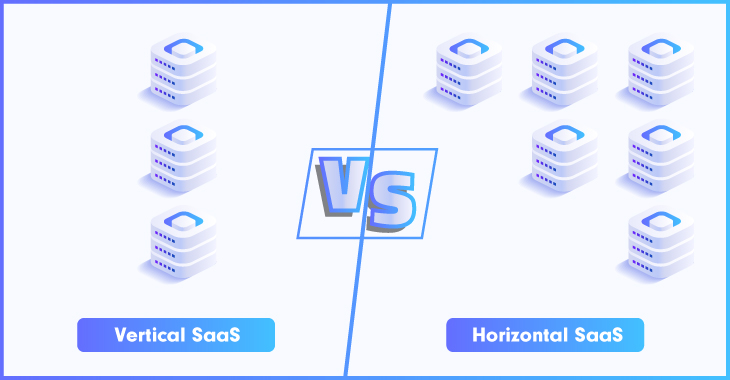
①What is Horizontal SaaS?
Horizontal means “horizontal” and is used here with the interpretation that it is not related to the industry. In other words, horizontal SaaS refers to SaaS that is used for specific tasks regardless of industry. We generally provide functions and services that can be used by companies in any industry.

Examples include CRM tools like Salesforce and Hubspot, cloud accounting systems like freee and Money Forward, and business card management tools like Sansan.

②What is Vertical SaaS?
Vertical means “vertical,” and in SaaS, it refers to an industry-specific format. Specifically, vertical SaaS specializes in a specific industry and provides functions and services that are easy to use for companies in that industry.
Examples include
ANDPAD
, a construction management app specialized for the construction industry, and
CLINICS Medical Records,
an electronic medical record management tool specialized for the medical industry.
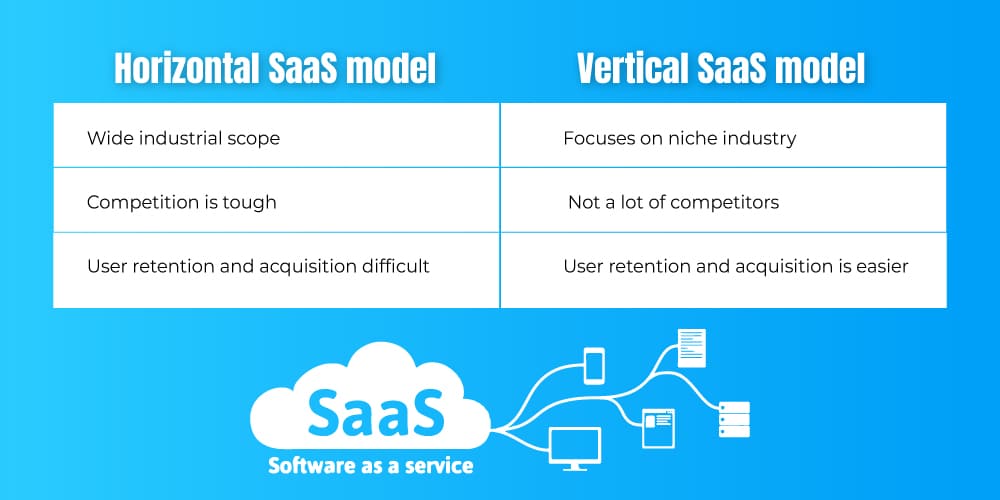
Differences between horizontal SaaS and vertical SaaS from a marketing perspective
Cross-industry horizontal SaaS and industry-specific vertical SaaS differ in the targeting of industries and industries, as well as the versatility of the functions and services provided, so their marketing characteristics will also differ.
When looking at horizontal SaaS and vertical SaaS from a marketing perspective, there are three main differences: market size, number of players and competition, and marketing measures.

①Market size
First, there is a difference in market size. Horizontal SaaS is cross-industry, which means it targets all industries, so the market size is larger than vertical SaaS. Also, if you can expand worldwide like Salesforce, Hubspot, and Slack, the scale will be even bigger.
On the other hand, since vertical SaaS is industry-specific, the market depends on that industry and is naturally smaller than the market size of vertical SaaS. However, if the target industry has industry-specific customs and complex constraints, if you can provide the optimal functions and services for that industry, you may be able to dominate the market and significantly increase profits.

②Number of players and competition

The number of players and competing companies in that market also change in proportion to the size of the market. As mentioned above, vertical SaaS has a large market size, so the number of players and competitors tends to increase.
Companies that are already at the top of the SaaS vendors are expanding their market share by leveraging their deep financial resources and acquiring venture companies and startups through M&A, making it difficult for them to expand their market share. Sho.
Vertical SaaS, which has a limited market size, has a limited number of players and competitors because it specializes in an industry. Additionally, since the number of players in Japan is relatively small, it will be easier to gain market share if you can enter the market early.

However, the fact that there are few players means that there are not enough functions and services that can solve problems while satisfying industry-specific rules and constraints, and it is necessary to develop them, which requires knowledge and know-how about the industry. Therefore, the barrier to entry tends to be higher than vertical SaaS.

③Marketing measures
The marketing measures that should be taken will vary depending on the market size, number of players, and number of competitors.
Horizontal SaaS is industry-independent, so you can implement a wide range of marketing initiatives. We will cast a wide net to acquire leads, select and develop target leads, and close the deal. Although it is not that difficult to acquire a large number of leads because the target is broader, the marketing cost increases accordingly.
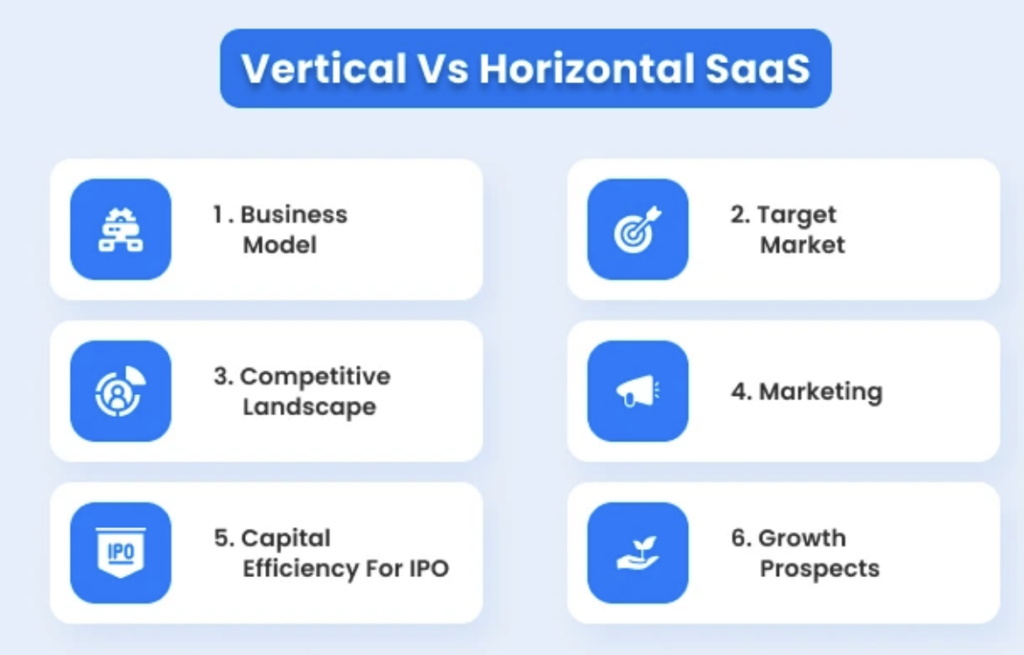
Vertical SaaS implements industry-specific marketing measures. Since we implement measures in a specific industry, channels are limited to a certain extent, allowing us to acquire leads efficiently. Since the target is limited, it is difficult to acquire a large number of leads, and it is necessary to find cost-effective marketing measures.
Points to learn from SaaS companies when creating a download page for BtoB sites

summary
- Horizontal SaaS refers to SaaS used for specific tasks regardless of industry, while vertical SaaS refers to SaaS specialized in a specific industry.
- When looking at horizontal SaaS and vertical SaaS from a marketing perspective, there are three differences: market size, number of players and competition, and marketing measures.
- Horizontal SaaS is cross-industry, which means it targets all industries, so the market size is larger than vertical SaaS.
- Vertical SaaS, which has a limited market size, has a limited number of players and competitors because it specializes in an industry.
- Horizontal SaaS is industry-independent and therefore carries out a wide range of marketing measures, whereas vertical SaaS carries out industry-specific marketing measures.