

SEM is a marketing method to generate revenue by driving users from
search engines
to your website or LP.
However, some people may misunderstand SEM because it has a similar name to
SEO
, or may not understand the difference.
In this article, we will explain the basic concept of SEM and the differences between listing advertising, display advertising, and SEO.
We will also explain the importance of SEM, how to think about it, and the budget for implementation, so please use this as a reference.
What is SEM (Search Engine Marketing)?
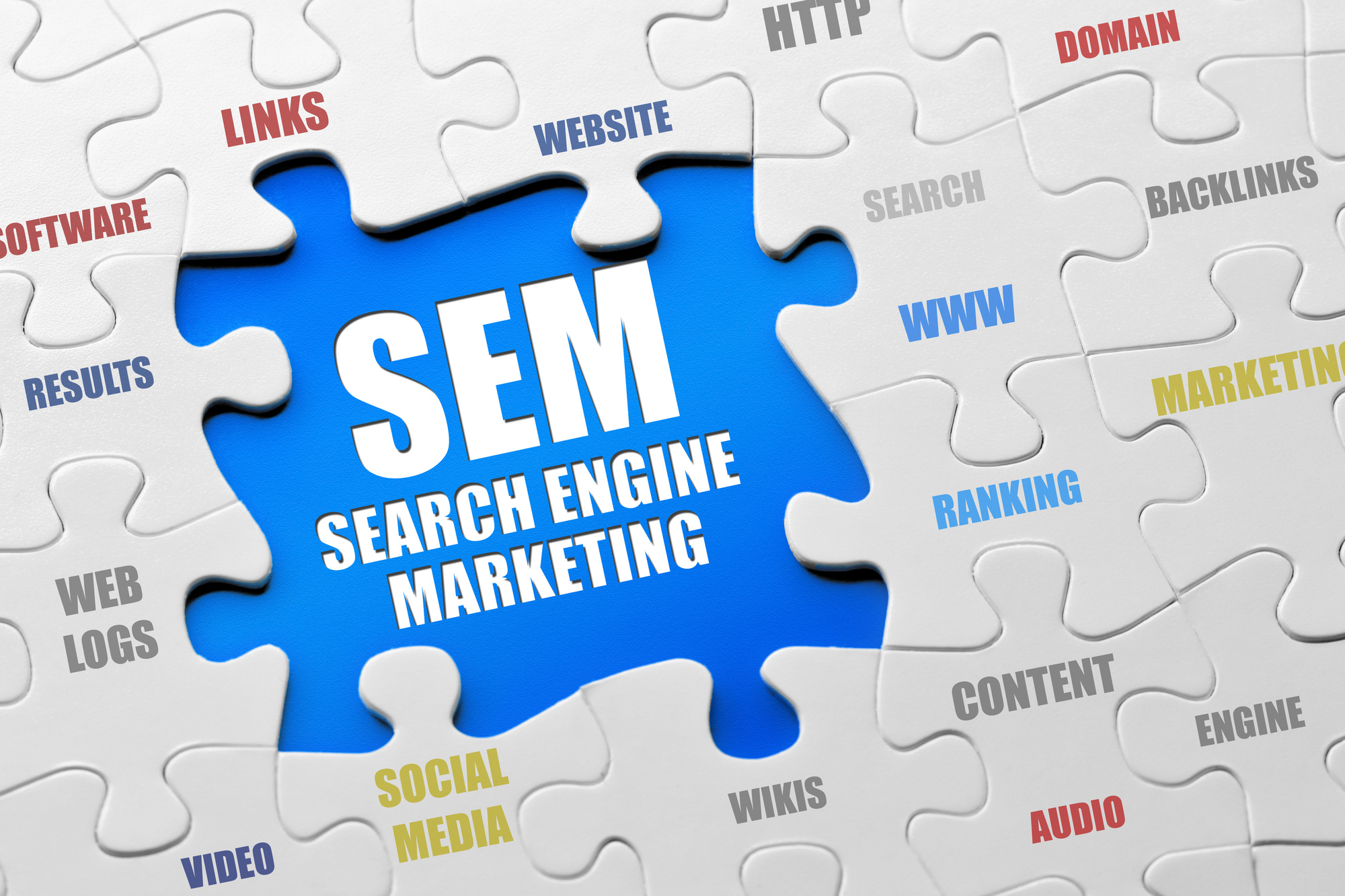
SEM (Search Engine Marketing, or Search Engine Marketing) is an effort to display advertisements linked to search results such as Google and on top pages of search results.
It is abbreviated as SEM, from the English acronym Search Engine Marketing.
The purpose of SEM is to utilize search engines to attract users to your company’s website or LP (landing page), leading to a sale of your product.
For example, users of search engines such as Google may enter search keywords with the purpose of solving their own problems.
When looking at this behavior from a marketing perspective, the user’s behavior is a movement with a specific purpose, so if you approach it according to the behavior, it is easier to aim for
(contract) for products and services. It can be considered as a user.
Specifically, if the user is searching for the keyword “protein difference,” there is a high possibility that the user is someone who has just started muscle training. If you can lead them to an LP that introduces your product, they will be more likely to purchase it.
In this way, SEM is a marketing strategy that utilizes search engines. There are three types of SEM methods: listing advertising, display advertising, and SEO, so we will explain each method separately.
SEM and other differences
We will explain the differences and contents of SEM and the three methods.
I will explain each.

Differences from listing ads
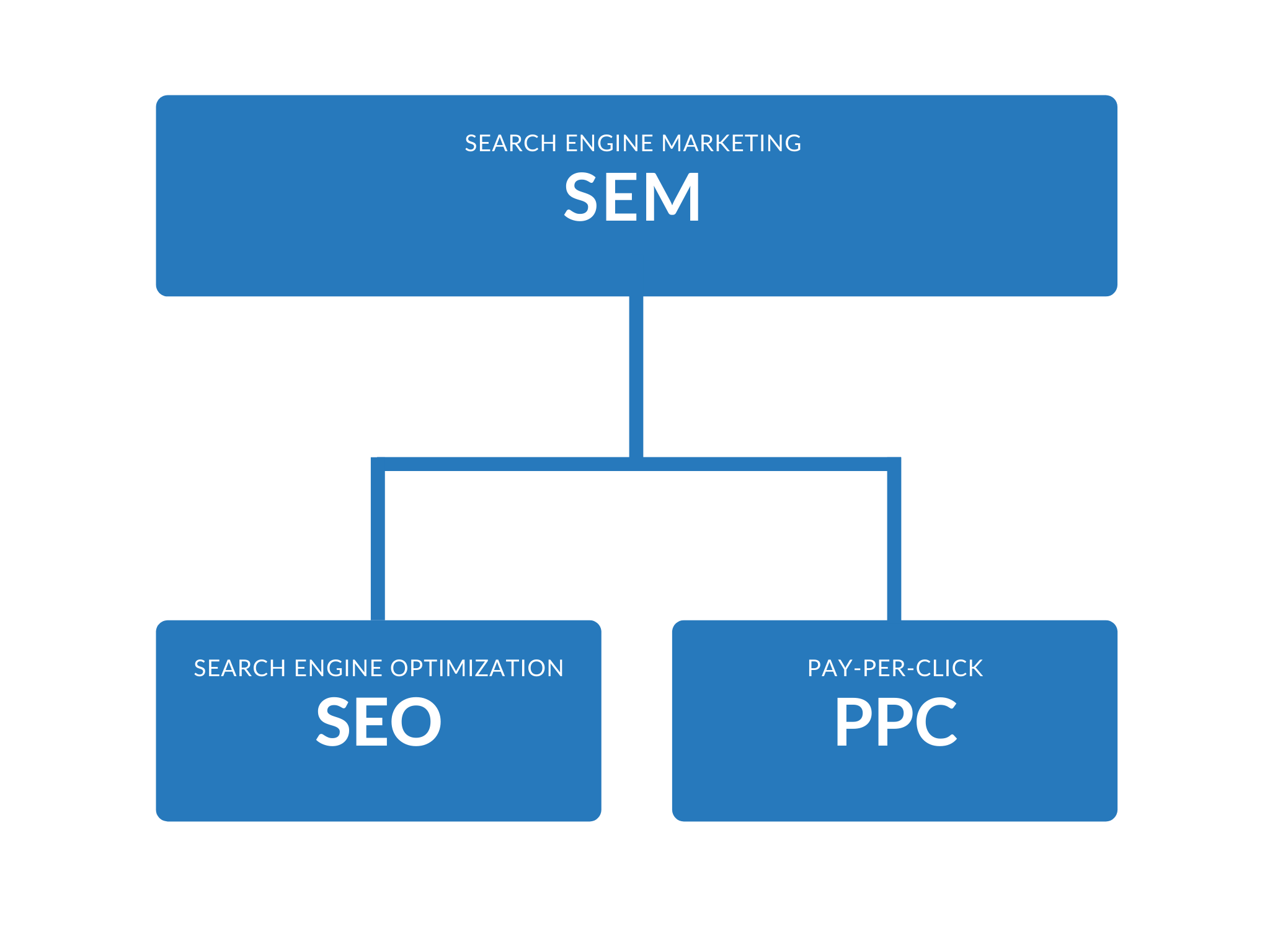
The difference between listing advertisements and SEM lies in their relationship. Listing advertising is one of the methods included in the SEM measure.
Listing ads are text-based ads with the word “ad” displayed at the top or bottom of search results.
Since advertisements can be displayed in conjunction with the keywords searched by users, it is possible to approach potential customers with products and services that match their needs, resulting in a high conversion rate.
SEM, on the other hand, refers to all activities to increase the number of traffic to your company’s website or LP page through the search behavior of users using search engines.
Therefore, SEM includes all of listing advertising, display advertising, and SEO. In other words, remember that listing advertising is one of the elements included in the larger framework of SEM.
Differences from display advertising
The difference between display advertising and SEM is that, as mentioned above, display advertising is one of the methods included in SEM measures.
Display advertising refers to image ads that are mainly displayed in advertising space on websites, personal blogs, mobile applications, etc. that are affiliated with Google.
You can use it to expand awareness in a wide range of areas, and to approach potential customers by placing advertisements in places related to your products or services.
Remember that display advertising is also one of the elements included in the larger scheme of SEM.
Difference with SEO
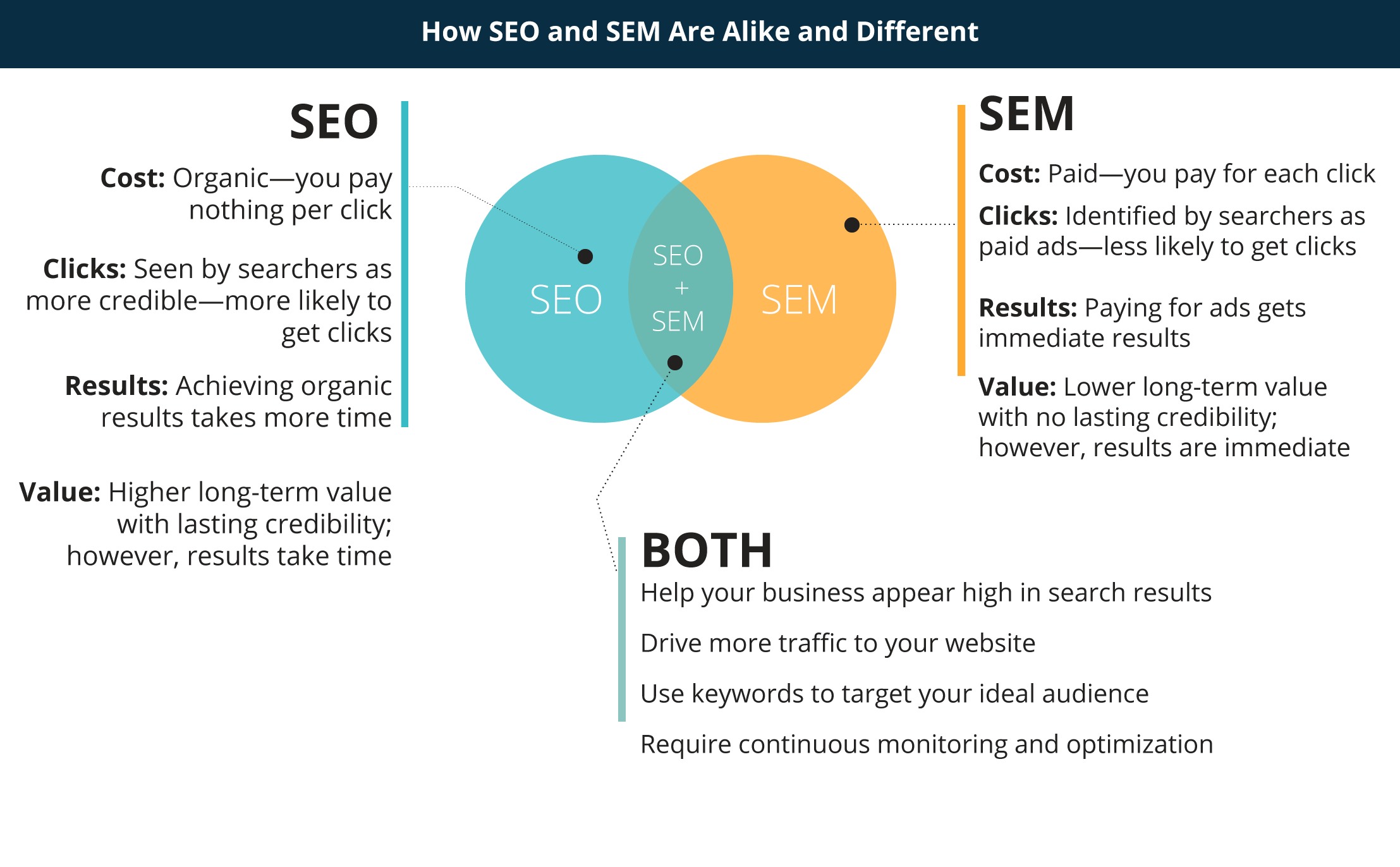
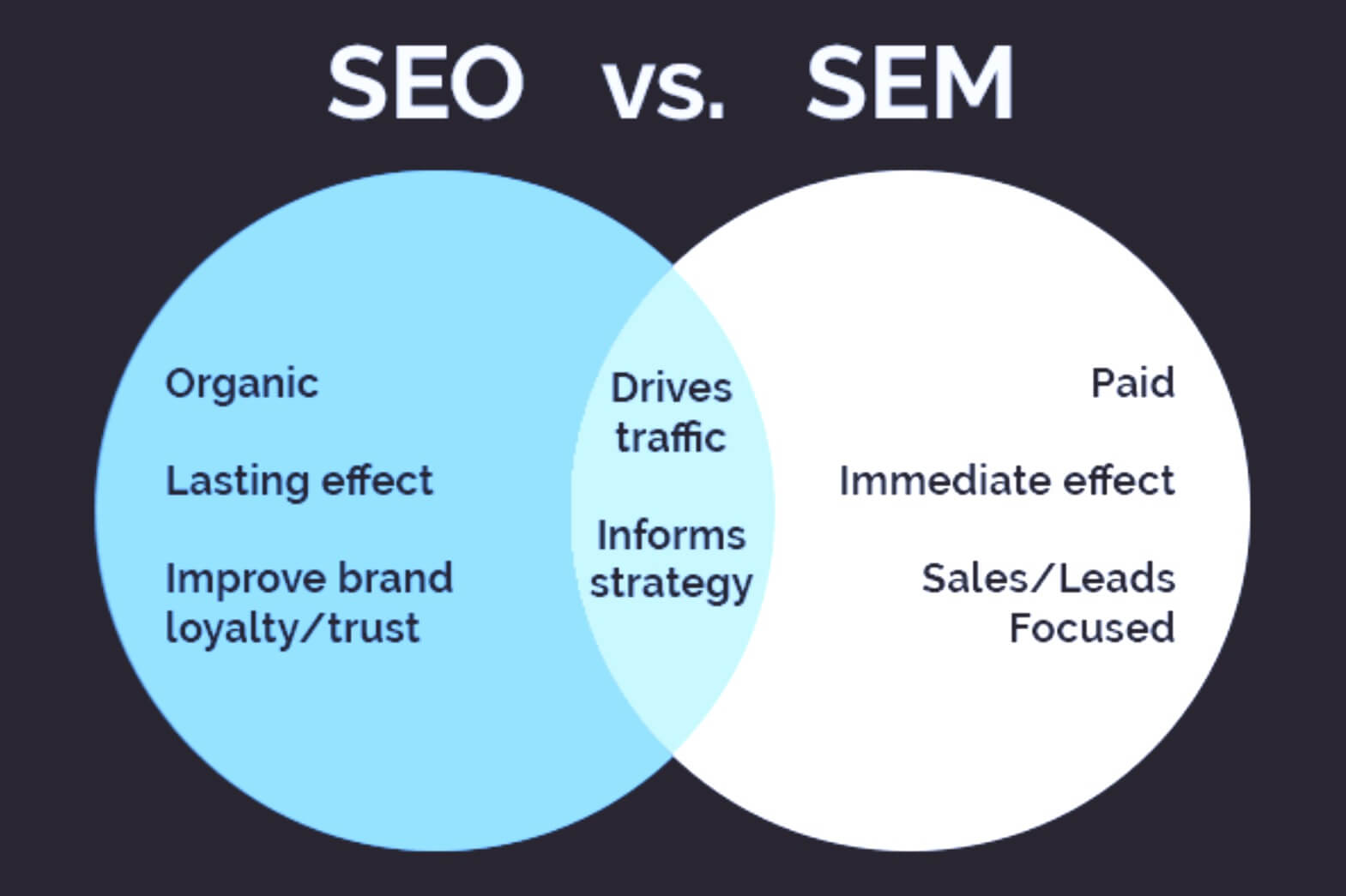
Because SEO and SEM have similar names, they are often confused more than listing ads and display ads, but SEO is also one of the methods included in SEM measures.
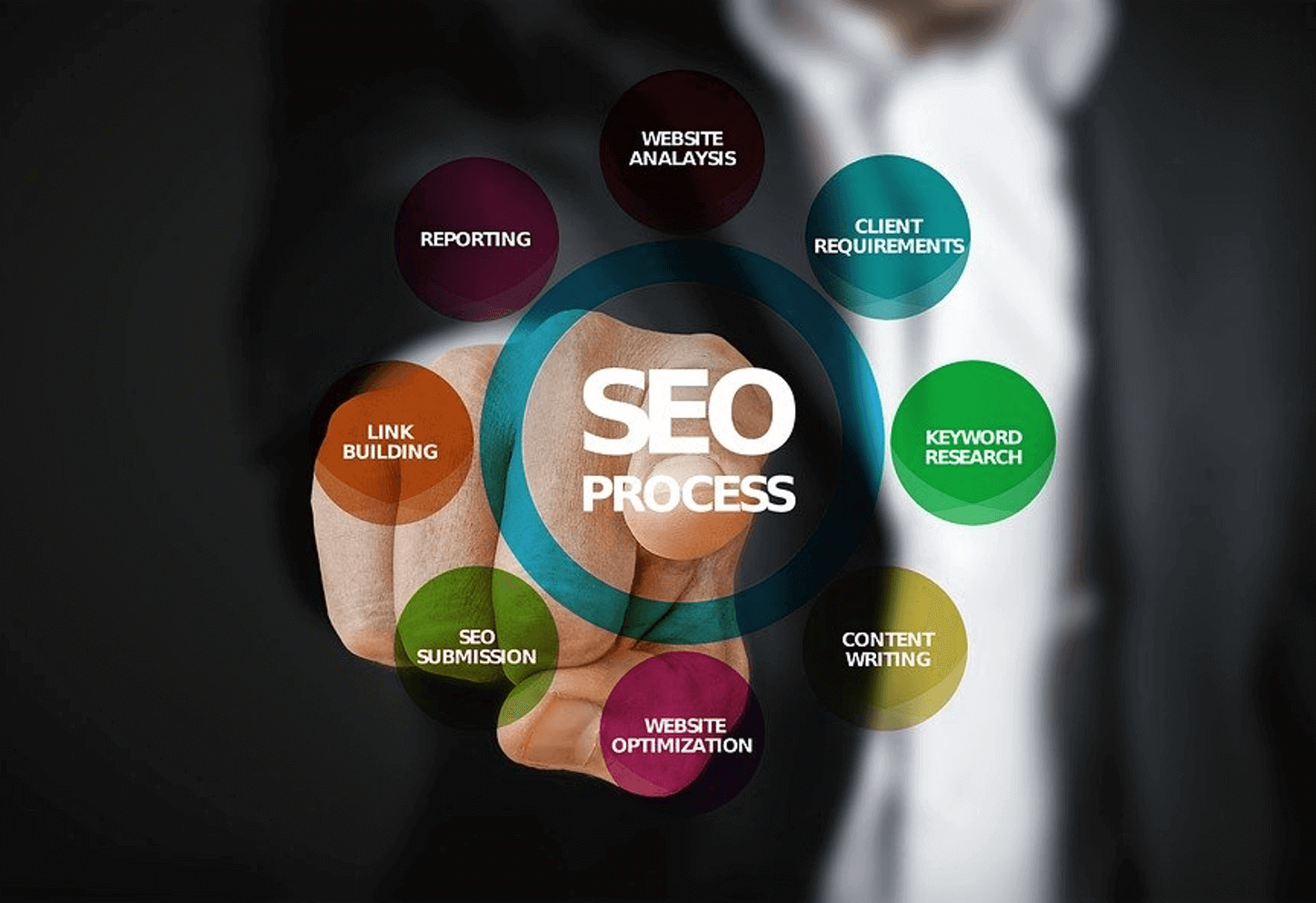
SEO stands for Search Engine Optimization, and is abbreviated from the initial letter SEO.
The SEO approach is a measure that aims for a continuous flow of users by displaying your website on the top pages of search results rather than directly posting advertisements.
While SEO is a measure that specializes in aiming for higher rankings in search results, SEM is positioned as a measure that approaches the overall search behavior of users.
The terms are easy to confuse because they have similar three-letter abbreviations, but it is important to remember that SEO (Search Engine Optimization) is one of the elements included in SEM (Search Engine Marketing).
Why is SEM important?
I will explain why SEM is important from three perspectives.
I will explain them one by one.
The web measures that should be taken differ depending on the company.
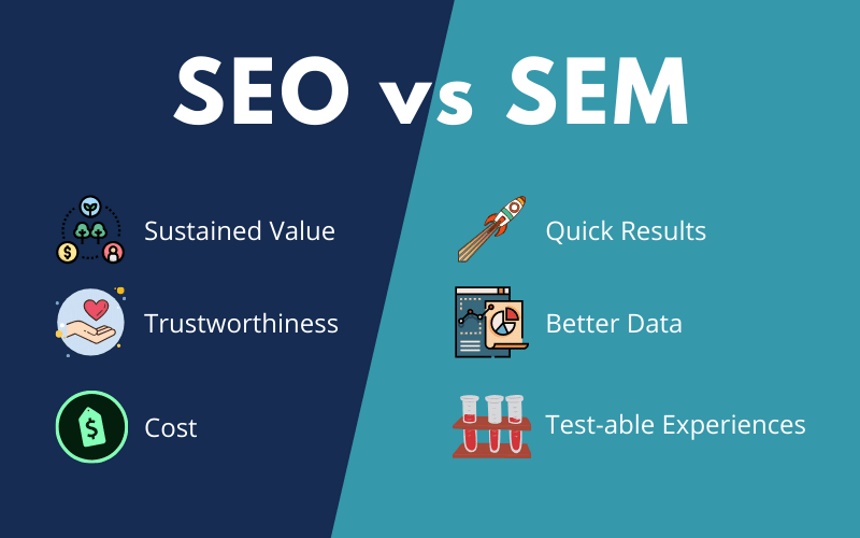
When implementing web measures, it is necessary to choose a method with cost-effectiveness in mind. For example, SEO can be cheaper than listing ads or display ads, but it tends to take longer to see results in customer acquisition.
In other words, if you are aiming to attract customers in the short term and obtain profit results, the measures you need to take will be different, such as choosing something other than SEO.
In order to consider the direction of such measures, you should consider a plan that takes into account the entire search engine marketing.
SEM is also important in order to carry out effective marketing activities with an eye toward the ultimate goal.
To conduct marketing tailored to user behavior
When considering the purchase of a product or service, it is now a natural behavior for users to gather information on the Web before taking action.
In addition, new media and services such as websites, YouTube videos, and mobile applications are appearing one after another even though the web system is the same.
Unless a company’s marketing strategies change in line with user behavior, it will be difficult to increase long-term profits.
In order to continue increasing profits, it is necessary to implement SEM measures that match users’ web activities.

Because we need to expand awareness
In order to get users to choose your product from the many products and services that exist, it is essential to expand awareness.
In order for your products to be found on search engines, you need to let potential customers know about your products and services.
This is because with web initiatives, there are no cases where users simply stop by and pick up the product, as they would with general store sales.
Therefore, in order for users to search for your product, you must help them visualize the actual product name and the information that will be found when they search for it. To that end, SEM measures that aim to expand awareness are important.
How to think when conducting SEM
There are three main ways to think about SEM:
I will explain them in order.
If you are looking for short-term results, run listing ads.
If you are looking for results such as attracting users with a high conversion rate in the short term, consider using listing ads.
Listing ads allow you to pinpoint ads for search keywords. Ads can be displayed where users can see them, such as at the top or bottom of search results, ensuring that your ads reach your intended target.
The time it takes to post an ad is fast, and it appears in search results immediately after posting, so you can expect fast results. In addition, since advertising effectiveness can be checked in real time, it is easy to measure advertising effectiveness, and advertising can be stopped, modified, and restarted quickly.
By quickly implementing the so-called PDCA cycle, which involves looking at advertising effectiveness, reviewing content, and making improvements, you can conduct marketing activities that aim for a high conversion rate even with short-term advertising.
Therefore, if you are looking for short-term results, consider listing ads.
If you want to capture potential customers, run display ads.
If you want to acquire potential users who are not currently aware of your company’s products or services but are likely to become potential customers, consider using display advertising.
Display ads can be placed in a wide range of areas, including ad space on major websites and personal blogs affiliated with Google, as well as ad space on YouTube and mobile applications.
Unlike listing ads, you can place ads for your company’s products and services in a wide range of ad spaces without relying on search keywords.
Even if users don’t need the product at the moment they see the ad, they will remember the product and become interested in it by repeatedly viewing the ad, which will lead to the acquisition of potential customers in the future.
Since you can place advertisements in places that are highly relevant to your products and services, you can aim to acquire potential users even more effectively by posting targeted advertisements.
In this way, it is a good idea to use display advertising to capture potential customers.
SEO if you want to attract stable customers in the medium to long term
If you are aiming to stably attract customers over the medium to long term, consider implementing SEO. SEO is a measure to create your own content and aim for higher rankings in search results.
Users of search engines judge that sites that appear at the top of search results are high-quality websites that provide the information they want to know and the problems they want to solve.
The reason for this is that as a result of the relationship of trust built with users through Google searches, sites that rank high in search results can expect an influx of users.
Since it largely depends on Google’s evaluation criteria, it takes time to stabilize the ranking, but on the other hand, once you receive a high evaluation from Google’s search engine and your SEO gets on track, traffic to your content will naturally increase. Therefore, there is no need for advertising costs.
In this way, while it takes time for SEO to produce results in attracting customers, once it is completed it can attract a stable number of customers, so it is a good idea to consider using it as a SEM for the medium to long term.

How much budget does SEM require?
We will explain the budget guidelines for the three methods used in SEM in the order of listing advertising, display advertising, and SEO.
The first type of listing ads uses a billing method called cost-per-click, which incurs a fee when an ad is clicked.
The cost of a click varies depending on the keyword you specify, but if it’s a popular keyword, it can cost several hundred yen per click. Therefore, it is important to select and use keywords that are appropriate for your company’s products and services.
The required budget will vary depending on keyword settings and number of clicks, but it is a good idea to consider a monthly budget of around 20,000 to 30,000 yen.
The second type of display advertising uses an impression method (charging based on the number of impressions) in addition to the per-click billing method.
Individual costs are often cheaper than listing advertisements. However, since they are posted on many websites and mobile applications, they generate more clicks and impressions, and end up costing about the same amount as listing ads. You should consider your monthly budget to be around 20,000 to 30,000 yen.
Third, the budget for SEO costs varies greatly depending on whether content production such as website creation and article writing is done in-house or outsourced. If you do all the work in-house, the budget for SEO can be 0 yen.
If you outsource, the cost will vary depending on the volume of the main article creation. Depending on the volume of articles, the market price is around 5,000 yen to 10,000 yen per article, so the amount multiplied by the number of articles to be created is a guideline for your budget. If you prepare 50 articles and each article costs 5,000 yen, it would be 250,000 yen.
summary
In this article, we have explained the basic concept of SEM and the differences between listing advertising, display advertising, and SEO.
None of the three SEM methods explained in the article, listing advertising, display advertising, and SEO, is superior, and each has its own effective use.
Therefore, if you want to maximize the effectiveness of SEM, it is important to use the three methods in combination.
Please use this article as an opportunity to further your understanding of SEM and aim to increase your business’s profits by utilizing the appropriate methods.