

Commoditization is one of the issues that has become important in business in recent years. Commoditization refers to the inability of competitors to differentiate their products in a particular market, or a standardized market. So why is commoditization so important?
This article provides an overview of commoditization, its causes, and the problems associated with commoditization. We will also explain methods and
marketing
to solve commoditization, so please use this as a reference.
What is commoditization?
First, I will provide an overview of commoditization. Commoditization is a situation in which competitors are unable to differentiate their products in a particular market, or a situation in which the market is standardized. The word commoditization may seem difficult when you just look at it, but simply put, commoditization refers to “generalization” and “popularization.”
Furthermore, although commoditization is often used to refer to a product, it can also be used when there are two products with different characteristics and the consumer cannot tell the difference between them. I will.
On the other hand, products and markets that have become commoditized are often indispensable to consumers. For example, daily necessities are a typical example of a product that has become a commodity.
Furthermore, commoditization is highly dependent on price elasticity. Price elasticity refers to the rate at which demand changes with the price of a product. From a general consumer’s perspective, when there are two products with different characteristics, they often choose the cheapest product possible. This is a highly price elastic product. It is important to understand that in commoditization, products with high price elasticity tend to sell better.
Why does commoditization occur?
So far, we have provided an overview of commoditization. So why does commoditization occur? Here we will explain three reasons why commoditization occurs.
- The technological level is rising
- The number of low-priced products from overseas is increasing year by year.
- Information has become easier to obtain
Let’s look at each in turn.

The technological level is rising
Increasing technological standards will undoubtedly accelerate commoditization. During Japan’s period of high economic growth, a company’s technological capabilities and high standards became the reason why consumers purchased products. However, in modern times, most companies are able to develop products that meet the demands of consumers, and consumers are no longer able to judge the differences in the technical capabilities of companies.
Naturally, there are companies that have overwhelming technological capabilities. A typical example is Toyota Motor Corporation. In the case of Toyota Motor Corporation, its technological capabilities are overwhelmingly strong, and this technological strength is highly valued, giving consumers a reason to buy Toyota because it gives them peace of mind.
However, the above cases are rare, and industries where technological capabilities have become homogeneous tend to become more commoditized.

The number of low-priced products from overseas is increasing year by year.
In recent years, the number of low-priced products from overseas has been increasing year by year. Prices vary depending on the country, but in addition to being able to make products cheaper overseas than in Japan, they also tend to be able to sell them cheaper. Of course, if these products are sold in Japan, consumers can buy them cheaper than Japanese products, and that becomes a reason for purchasing them.
So, the only way for Japanese companies to sell products made in Japan is to simply match or lower the price of overseas products. As a result, price competition continues to accelerate, leading to further commoditization.

Information has become easier to obtain
In recent years, compared to the period of high economic growth, the Internet, which allows us to obtain information, has evolved. If you use
search engines
and SNS, it is easy to imitate other companies’ business models and products. If a product was found that had even the slightest amount of profit potential, it was quickly imitated.
Naturally, there are companies that take measures to prevent their technology from being imitated by acquiring patents in order to prevent their technology from being imitated. However, just because a patent has been obtained does not mean that similar products will not come out. Additionally, it takes a certain amount of time to obtain a patent, and in the modern Internet society, there is a risk that a business model or product similar to yours will emerge during that period.
This acceleration of the Internet society can be said to be the biggest reason why commoditization is occurring.
Specific examples of products that are becoming commoditized
So far, we have explained the reasons for commoditization. Here we will introduce two specific examples of products that are becoming increasingly commoditized.
- flat screen tv
- convenience store coffee
Let’s look at each in turn.

flat screen tv
Price competition for flat-screen TVs is becoming more intense year by year. Previously, the technological capabilities of Japanese companies were at a high level, but as South Korea’s technological capabilities have increased, Japan’s competitive advantage in terms of technological capabilities has disappeared. Even when it comes to Japanese TVs, from a consumer’s point of view, most people would be unable to answer if they were asked the question, “What manufacturer is this TV from?” with the manufacturer hidden.
In fact, from a consumer’s point of view, the purpose of buying a TV is to watch TV, and it is rare for consumers to be very particular about the detailed functions. Flat-screen TVs are becoming a commodity due to price competition and improvements in overseas technology.
convenience store coffee
All convenience stores such as Family Mart, 7-Eleven, and Ministop offer coffee. We offer coffee for 100 yen per cup, and from a consumer’s perspective, it’s more likely that they’re drinking coffee because it’s from a convenience store near their house, rather than because they want to drink coffee from a convenience store. I buy coffee from a convenience store for a reason. Although convenience stores are trying to differentiate themselves with coffee machines and beans, there is also price competition, and these are typical examples of products that are becoming increasingly commoditized.

Why is commoditization a problem?
So far, we have explained the reasons why commoditization occurs and specific examples, but why is commoditization not a problem? In conclusion, there are three reasons:
- Unable to differentiate products
- There will be price competition
- Difficult to make business proposals
I will explain each reason in turn.

Unable to differentiate products
Although this can be seen as a problem before commoditization occurs, industries that are prone to commoditization are unable to differentiate their products. Because it has become easy for different companies to produce products of the same quality, it is no longer possible to differentiate them based on detailed features or technological capabilities. In other words, as commoditization accelerates, the level of technological capabilities will remain the same, and technological capabilities themselves will decline. These have a major impact on industrial development itself in the medium to long term.
There will be price competition
If a company cannot differentiate itself based on its technological capabilities, the only way to sell its products is to lower prices. Lowering prices also lowers profit margins, which leads to a reduction in the salaries of employees who receive profits back from their profits, which worsens the turnover rate.
A situation in which a company cannot sell without lowering its prices is fine for companies that are at the top of the market, but it is definitely a difficult situation for companies that are following behind. If you are a top company, your profit margins are stable and your products are selling well, so the salaries you return to your employees will inevitably be high. From the perspective of companies that follow, there is a high possibility that they will not be able to hire employees or sell products.
As commoditization progresses, only companies with strong capital will survive.
Difficult to make business proposals
As commoditization progresses, it becomes more difficult to make sales proposals. Naturally, we do not sell exactly the same products, so it is possible to suggest small differences and features during business negotiations. However, it is meaningless if consumers cannot understand them.
For example, when selling mobile phones, store clerks explain the features and functions of mobile phones in detail, but few consumers understand all of them. As a result, there are many cases where the brand name is the reason for purchasing rather than the features, such as “It’s a new phone from Docomo”. In other words, as commoditization progresses, it becomes difficult to differentiate from competitors and it becomes difficult to make sales proposals.
To solve commoditization
Finally, I will explain two things that should be done to solve commoditization.
- Try to add added value
- Differentiate yourself through marketing and sales activities
Let’s look at each in turn.
Try to add added value
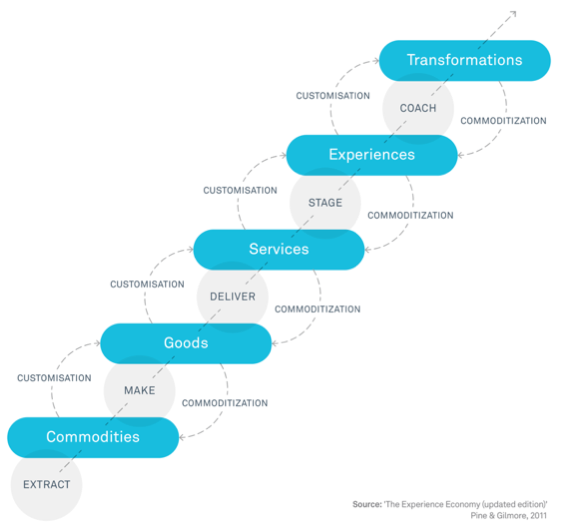
First, it is important to devise ways to add added value. However, we do not recommend adding value-adds such as price or freebies. This is because they are a major reason for accelerating commoditization. For added value, be sure to provide value other than price, such as brand power or product concept.
Differentiate yourself through marketing and sales activities
When it comes to sales activities, many people think of outbound activities such as tele-appointments and
e-mail newsletters
(email marketing). However, these are things that competitors also do as a matter of course, so they cannot differentiate themselves.
In such cases, for example, assign a person from your company to be in charge of dissemination activities on Twitter, etc. If you increase your number of followers and send out attractive messages, you will be able to conduct recruitment and promotional activities in the form of “I’m interested in the company where Mr. In this way, it is important to differentiate yourself through marketing and sales activities.

summary
In this article, we have explained commoditization. If commoditization accelerates, price competition will become more intense, and as a result, only companies at the top will be able to survive. Flat-screen televisions are a typical example of commoditization.
In order to resolve commoditization, it is important to add added value to products and differentiate them through marketing and sales activities. In order to solve these problems, why not start by analyzing the strategies your competitors are using and come up with a strategy that is different from them?