
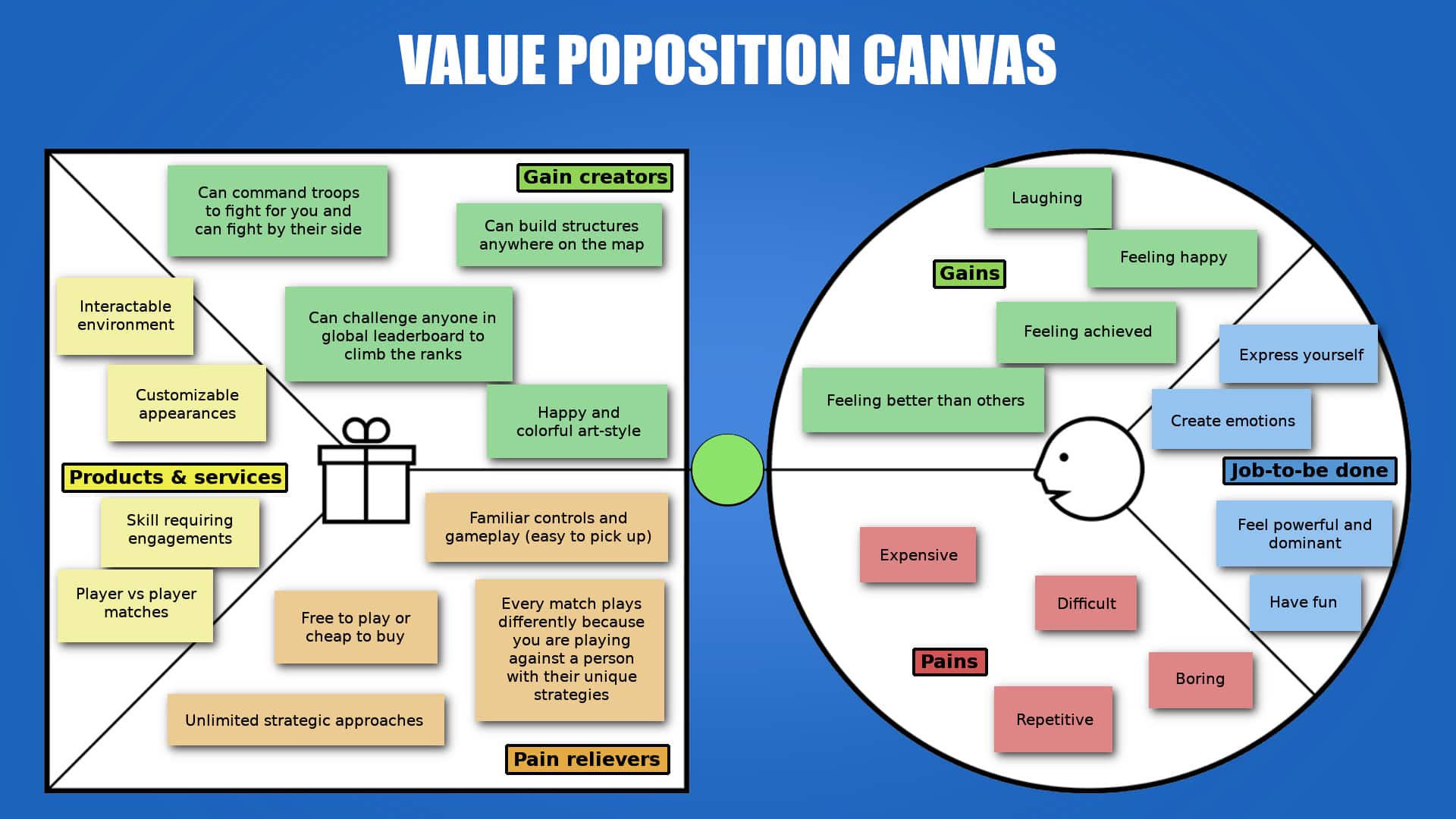
The Value Proposition Canvas is a framework for resolving the misalignment between your products and services and customer needs.
Considering value propositions has become increasingly important in recent years as companies have to differentiate themselves from the competition. In this article, we will thoroughly explain the importance of the value proposition canvas and how to create it.
What is the value proposition canvas?
Value Proposition Canvas is
a framework
for resolving the misalignment between your company’s products and services and customer
needs
.
It was introduced in the book “Value Proposition Design” by Alex Osterwalder in 2015, and has attracted attention.
Just as a designer draws a picture on a canvas, we design the value proposition that we provide to customers on a piece of paper.
By designing these two elements on the same page, the relationship between the two can be visualized and the discrepancy between their needs can be reduced. Additionally, the characteristics of the Value Proposition Canvas are as follows:
The value proposition canvas is especially effective when the market is immature.
The value proposition canvas is particularly effective when the market is still immature and not many competitors have entered the market. This is because your company needs to take the lead in developing the market, and it is important to have a deep understanding of your customers.
If the market is already mature, the value proposition will be used to consider value from the perspectives of the 3Cs (company, competitors, and customers).
There are cases where only your own company’s experience and experiences take the lead.
One of the characteristics of the Value Proposition Canvas that you must be aware of is that “your company’s experience and experiences may take the lead.” Based on their own experiences and experience, companies may be preoccupied with a unilateral belief that “If we do this this way, customers will be happy,” and may not be able to see the value that customers really want.
No matter how customer-oriented your company is, remember that products and services that customers don’t need are meaningless.
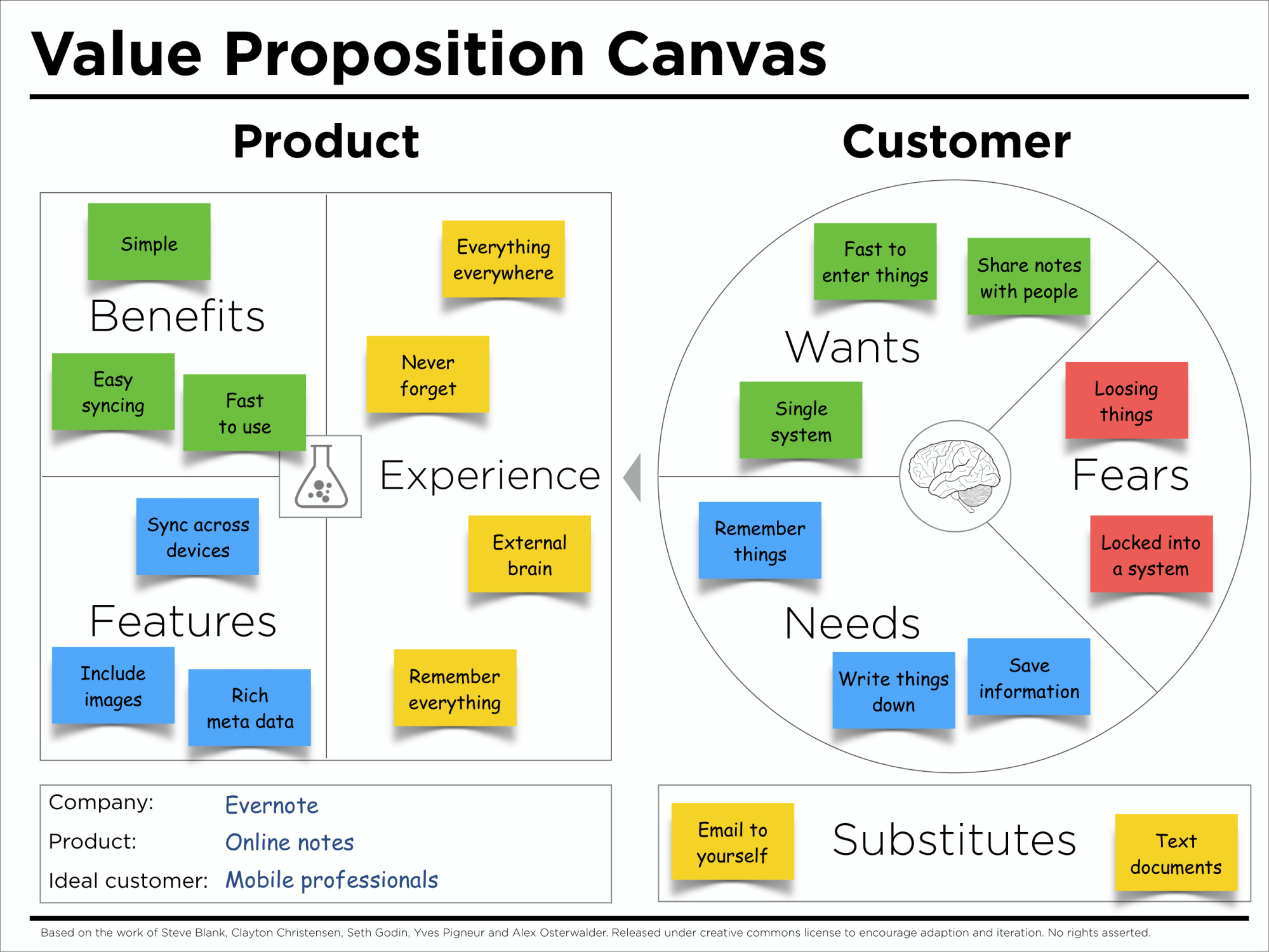
What is the value proposition?
As mentioned above, “value proposition” refers to “value provided to customers.” Customers buy products and services because they perceive them to be of value to them.
When considering the value proposition of your product or service, it’s important to put yourself in your customer’s shoes. Customers often find value that is different from what the company envisions.
For example, the owner of a coffee shop may think that the value of his shop is “being able to drink delicious coffee,” but customers may see it as “a place where you can relax and smoke a cigarette.” yeah.
By using the Value Proposition Canvas, you can check the discrepancy between the value proposition you envision for your company’s products and services and customer needs. By recognizing discrepancies, it becomes possible to transform products and services into ones that are more acceptable to the market.

The importance of considering your value proposition
Examining the value proposition has become increasingly important as companies must differentiate their products and services. In recent years, the number of products and services has increased, creating more competition.
The current situation is that companies cannot survive unless they differentiate their products and services. In a situation where the number of products and services is increasing, it often happens that the services and functions added for differentiation are out of sync with customer needs.
Customers increasingly find it difficult to use, and companies also incur unnecessary costs. When differentiating your product, it is important not just to be different from your competitors, but to ensure that your product meets customer needs better than your competitors.
The value proposition canvas is attracting attention because it means that we are now in an era where it is essential for companies to think carefully about the value they provide to customers.
Advantages of creating a value proposition canvas
The benefits of creating a value proposition canvas include:
You can clarify the gap between the value your company provides and the customer’s expected needs.
By creating a value proposition canvas, you can clarify the gap between the value your company provides and the customer’s anticipated needs.
However, there are times when customer needs have not yet become apparent, and in such cases it is difficult to grasp them, and you may not realize that there is a discrepancy between your company’s needs and those of your customers.
In such cases, it is important to consider sharing information across the organization and objectively explore needs across multiple departments.
You can explore new customer needs
By using the Value Proposition Canvas, you may discover new customer needs. By increasing the frequency of use in
marketing
or incorporating it from the product development and planning stage, you can explore new customer needs.
Incorporating the Value Proposition Canvas in as many phases as possible will lead to the discovery of new needs.
Find improvements and strengths of your own products and services
As you create your value proposition canvas, you will be able to identify areas for improvement in your products and services.
The discrepancy with customer needs is what is called an improvement point for the company, and results in value that the customer is not looking for. In addition, while improving the gap between needs, you may be able to discover your own products, services, and strengths. It often happens that we were able to create a technology that our competitors could not, or that our company had the ability to do something like this.
By repeating this type of exploration and discovery, your company’s development and production capabilities will be strengthened, and the performance of your products and services will improve.
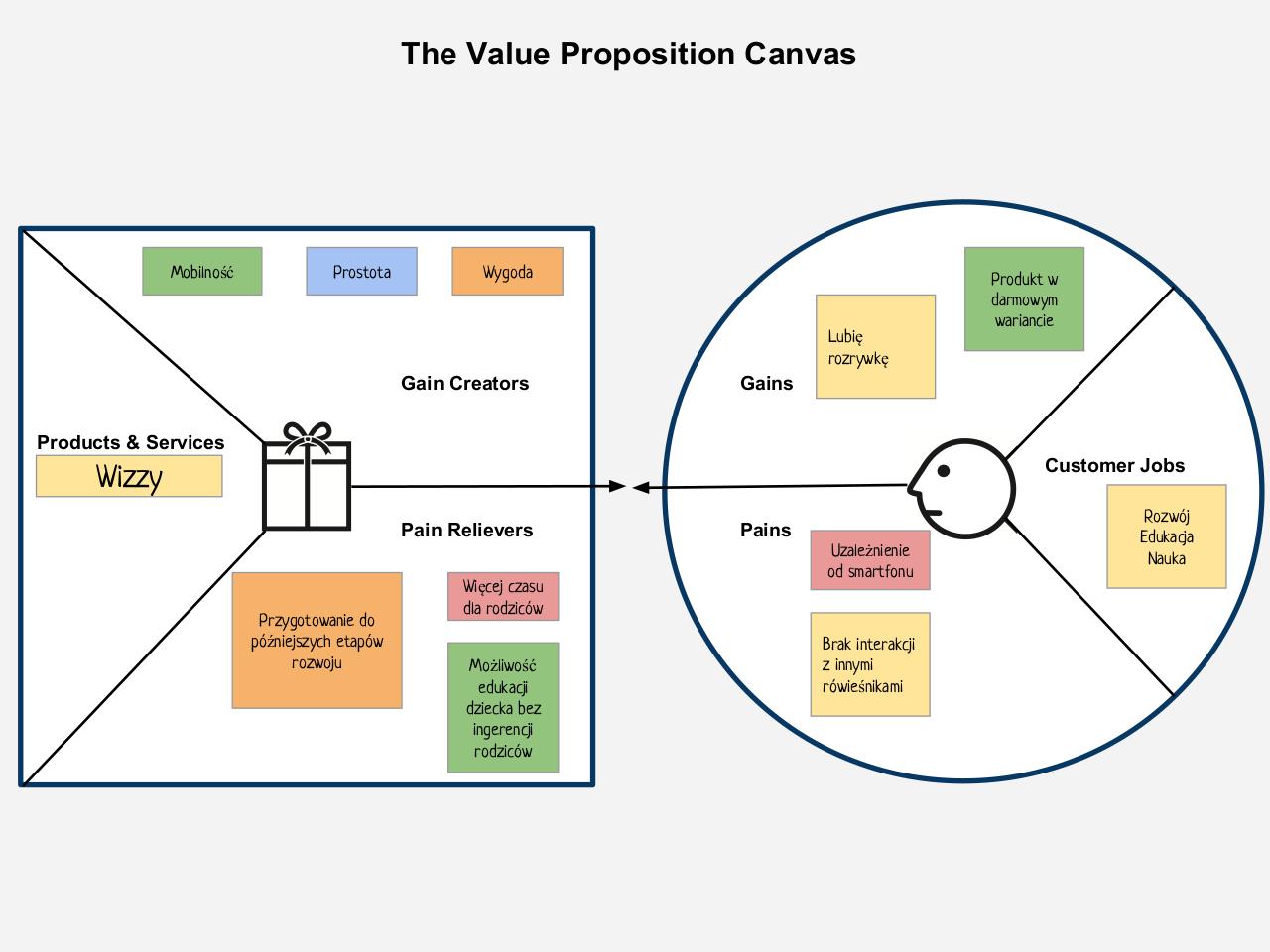
How to create a value proposition canvas
Now let’s take a look at how to create a value proposition canvas.
The creation procedure is
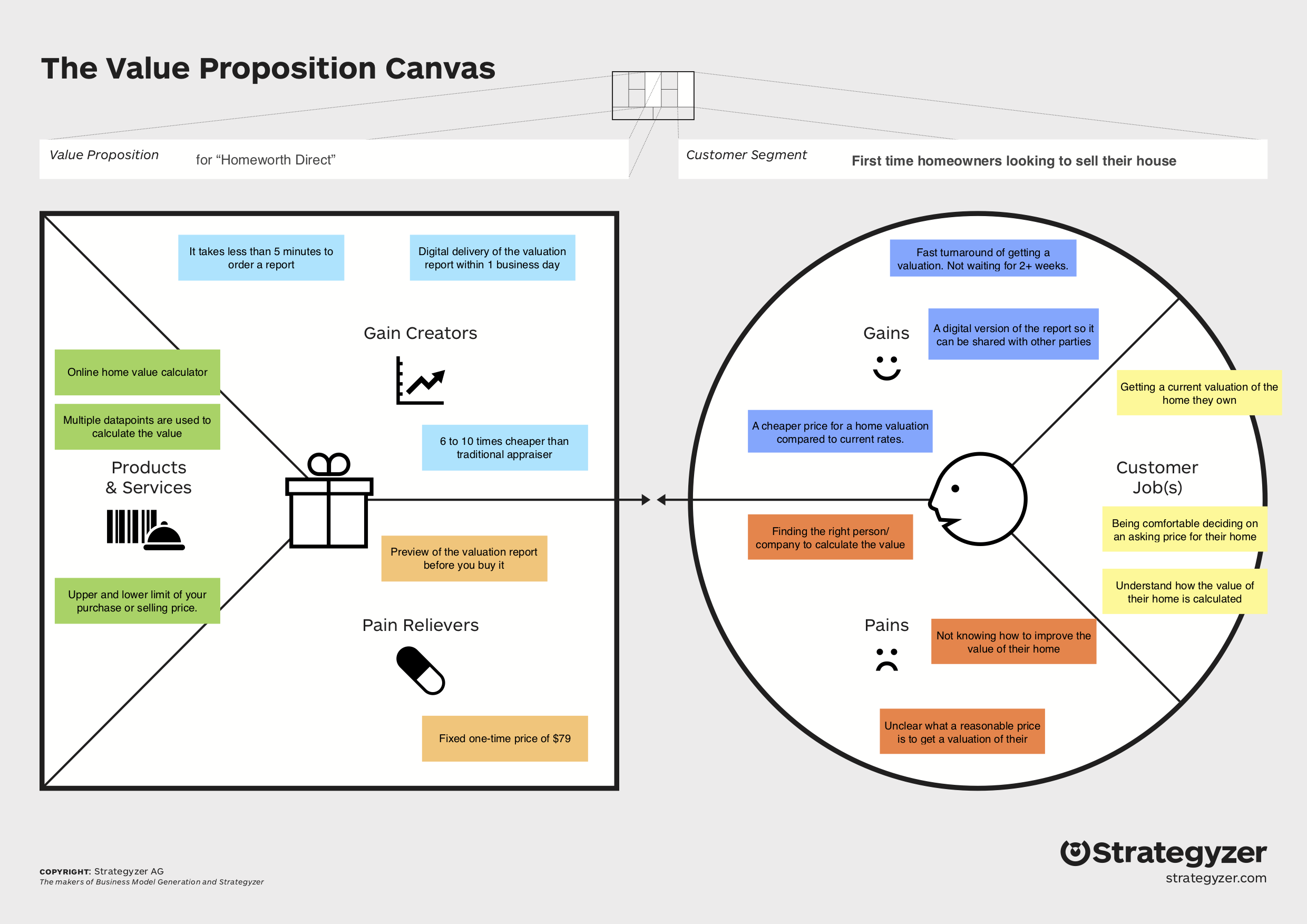
1. Write a concise description of what you are offering and to whom
2. write customer needs
3. Write down the value you can provide to your customers
There are 3 stages.
1. Write a concise description of what you are offering and to whom

First,
①Value Proposition…Value provided to customers
②Customer Segment…Fill in the customer segment
field.
There is no need to write long here. It is important to express it concisely in one sentence. In the case of
BtoB
, think carefully about the customer segment (2) in particular.
Rather than looking at the organization as a whole, it is important to clearly target specific people within the organization, such as management or sales managers.
2. write customer needs

Next, fill in the fields under Customer Segment.
③Customer Job(s)…Issues that customers want to solve
<br/> We abandon subjectivity as much as possible and think objectively about the issues that customers want to solve.
<Example> In the case of a consulting company to strengthen sales management, this would include a target list and sales tools to achieve the business plan.
④Gains…customer’s gains
<br/> Next, by solving the problem, we will make up for what the customer gains.
<Example> The number of customers will increase, the skills of salespeople will improve, etc.
⑤Pains…Customer’s troubles
<br/> Fill in the customer’s troubles when solving the problem.
<Example> There is an increase in the number of consultations regarding the maturity of projects, bias in business partners, etc.
3. Write down the value you can provide to your customers
Finally, fill in the fields below the value you can provide your customers.
⑥Product & Services …Products and Services
<br/>Write your company’s products and services.
⑦Gain Creators…Things that bring customer gainWrite
the content of products and services that correspond to customer gain in ④ and bring gain.
<Example> Workshops to strengthen sales capabilities, building business models for new development, etc.
⑧Pain Relievers…Write the content of products and services that respond to and eliminate the customer’s concerns listed
in ⑤.
<Example> Sales agency, customer development calls, etc.

Points to remember when creating a value proposition canvas
When creating a value proposition canvas, keep the following points in mind.
Make it easy to understand
One of the key points when creating a value proposition canvas is to make it easy for anyone to understand.
As explained in the above item “Clarify discrepancies between customers’ anticipated needs”, if customer needs have not yet manifested and are difficult to understand, it may be necessary to share information with other departments. .
In such cases, it is necessary to make it as easy to understand as possible so that everyone involved can have a common understanding.
Think from the customer’s perspective
When creating your value proposition canvas, you should always think from the customer’s perspective. If you don’t consider the needs from the customer’s perspective, you’ll end up with a value proposition canvas that’s too complacent.
If you consider the needs of the customer and also consider the things that make the customer happy and the things that they don’t like, you will be able to come up with ideas that are more customer-oriented.
Understand your competitors
When you get absorbed in creating your value proposition canvas, it’s easy to focus on customer needs and forget about your competitors.
The important point of a value proposition is to provide “value unique to your company that your competitors do not have.” In other words, while putting customer needs first, you also need to consider the value that only your company can provide that your competitors can’t offer.
If you consider these factors from your competitors as well, you will be able to create a more accurate value proposition canvas.

Value proposition canvas template
On the website of a company called ”
Strategyzer AG
“, you can download a value proposition canvas template for free from
this page
.
The company, based in Preverenge, Switzerland, provides advice, coaching and training programs in corporate innovation.
Although the template is in English, it has easy-to-understand icons and is very easy to use if you know how to use it.

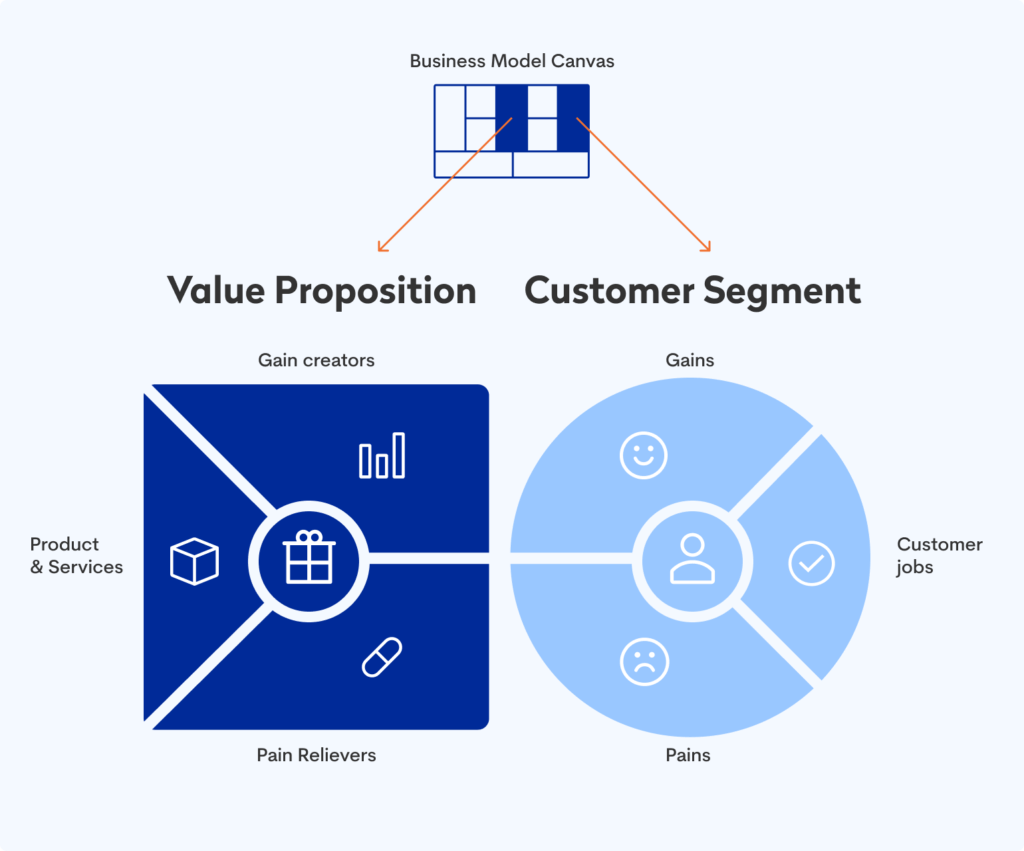
Difference between value proposition canvas and business model canvas
The Value Proposition Canvas allows you to correct the discrepancy between the value your company provides and customer needs. In other words, it is a framework that focuses on the customer and aligns the company’s value with the customer.
On the other hand, there is also a framework called Business Model Canvas. The business model canvas has the following nine elements that are interrelated, and by visualizing the relationship between each element, you can understand the profit structure of your business.
The Business Model Canvas is mainly used to thoroughly examine the value that your company can provide, and in contrast to the Value Proposition Canvas, it is a framework that allows you to think about your company.
These two frameworks are very compatible, and using them together can often lead to rethinking the business structure itself.
The nine elements of the Business Model Canvas include the Value Proposition Canvas’ Value Proposition (value provided to customers) and Customer Segments, so they can be incorporated into the Business Model Canvas as is.
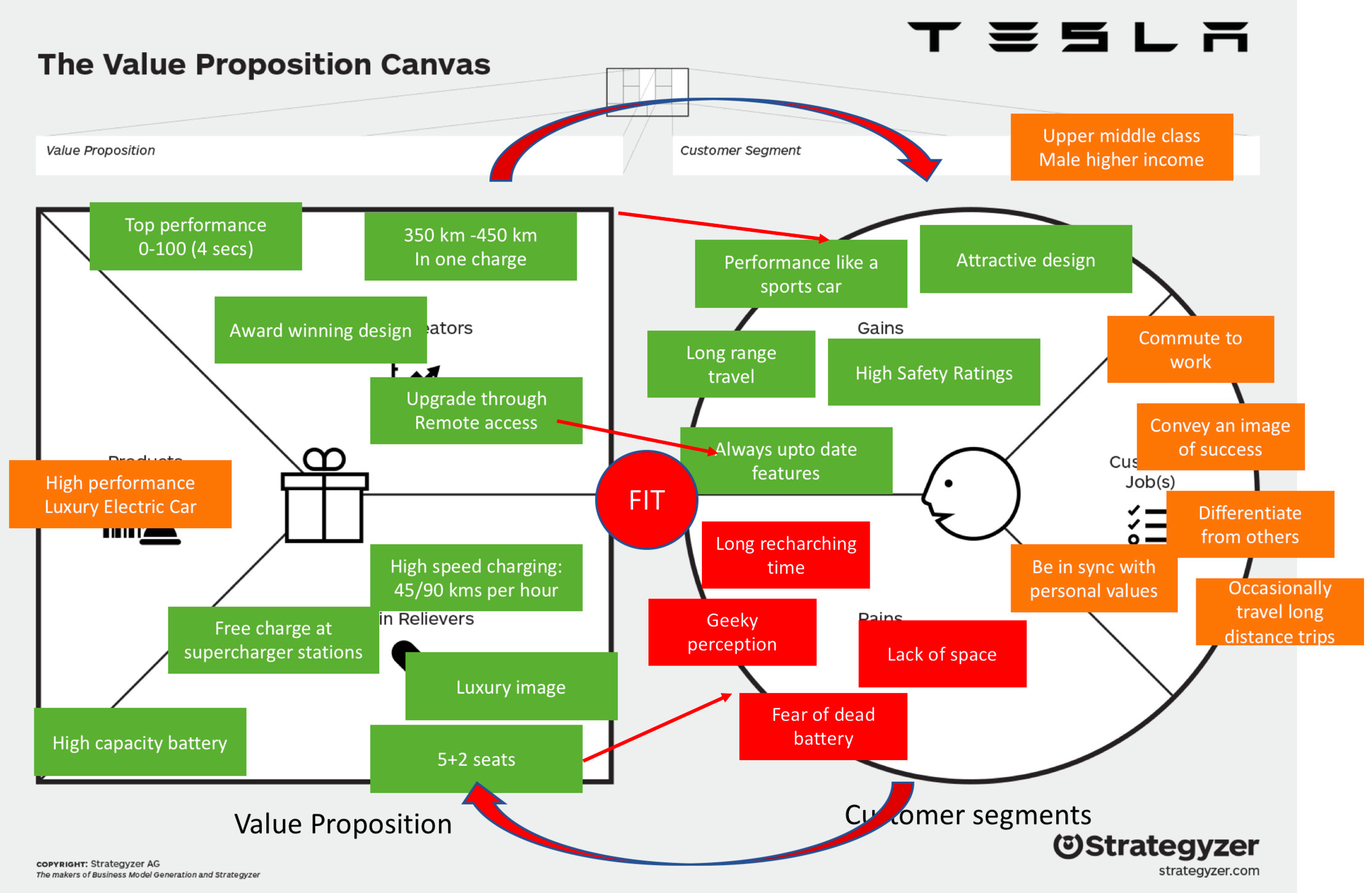
summary
◆ The Value Proposition Canvas is a framework for resolving the discrepancy between your company’s products and services and customer needs.
◆ Examining value propositions has become increasingly important in recent years.
◆ To create a value proposition canvas, first fill in the customer segments, then fill in the value provided.
◆ When creating a value proposition canvas, the key is to understand your competitors and create one that is easy to understand from the customer’s perspective.